Exclusive: H&M Group CEO on why sustainability is good for business — can shoppers be persuaded?
H&M's CEO Daniel Ervér says decarbonisation is driving profit, not just planet points — with a 41% emissions cut and SEK 2.8bn invested to prove it.

While most major fashion groups are quietly walking back their climate commitments, H&M Group CEO Daniel Ervér is going the other direction. In an environment where more and more companies are abandoning their emissions targets and sustainability plans, H&M Group remains firmly committed to its climate goals. In a wide-ranging conversation with Business of Fashion, Ervér spoke about why the retail giant is continuing to push on climate action, persuade consumers to see it as more than a fast-fashion giant, and prove that reducing emissions can drive business performance. The case he makes is not ideological. It is operational: cleaner supply chains cost less to run, and better materials make better product.
The Business Case for Decarbonisation
Ervér's core argument is one that should make shareholders pay attention, not just sustainability teams. "We are strengthening our offering and showing that growth, profitability and reduced emissions can go hand in hand," Ervér said. "In 2025, we saw an increase in profits, a positive sales trend, and a decrease in our CO₂ emissions." That is not a marketing line. CEO Daniel Ervér emphasized that the company's scale offers both an opportunity and a responsibility to lead transformation in the fashion sector, noting that aligning business growth with sustainable practices remains central to the company's direction.
The numbers back the position. Greenhouse gas emissions fell by 41% in Scopes 1 and 2, and by 34.6% in Scope 3 compared to a 2019 baseline, putting H&M on track to meet its science-based targets. The group invested SEK 2.8 billion in decarbonisation and material innovation during the year. That level of capital commitment is not a sustainability department side project. It sits at the heart of the procurement roadmap.
Centralising Sustainability Governance
One of the structural decisions underpinning the strategy is where sustainability lives inside the organisation. Rather than operating as a parallel function, H&M has integrated it into core business decisions spanning buying, logistics, pricing and product development. Leyla Ertur, Chief Sustainability Officer, said: "We remain deeply committed to advancing our sustainability agenda and driving positive change across our industry. In 2025, we reduced CO₂ emissions, increased the use of recycled materials, and lowered freshwater consumption."
Ertur's direct involvement in the BoF interview alongside Ervér signals that the CSO role at H&M is not a compliance function bolted onto a commercial structure. It is a seat at the strategy table. The group's ambition, as Ertur framed it, is to "decouple growth from resource use and emissions while supporting people and communities."
Supply Chain: Where the Real Work Happens
The biggest sustainability lever for a retailer the size of H&M is not what gets printed on a swing tag. It is what happens deep in the supply chain, across hundreds of factories in supplier countries concentrated predominantly in Asia, particularly Bangladesh, Cambodia, India and Vietnam.
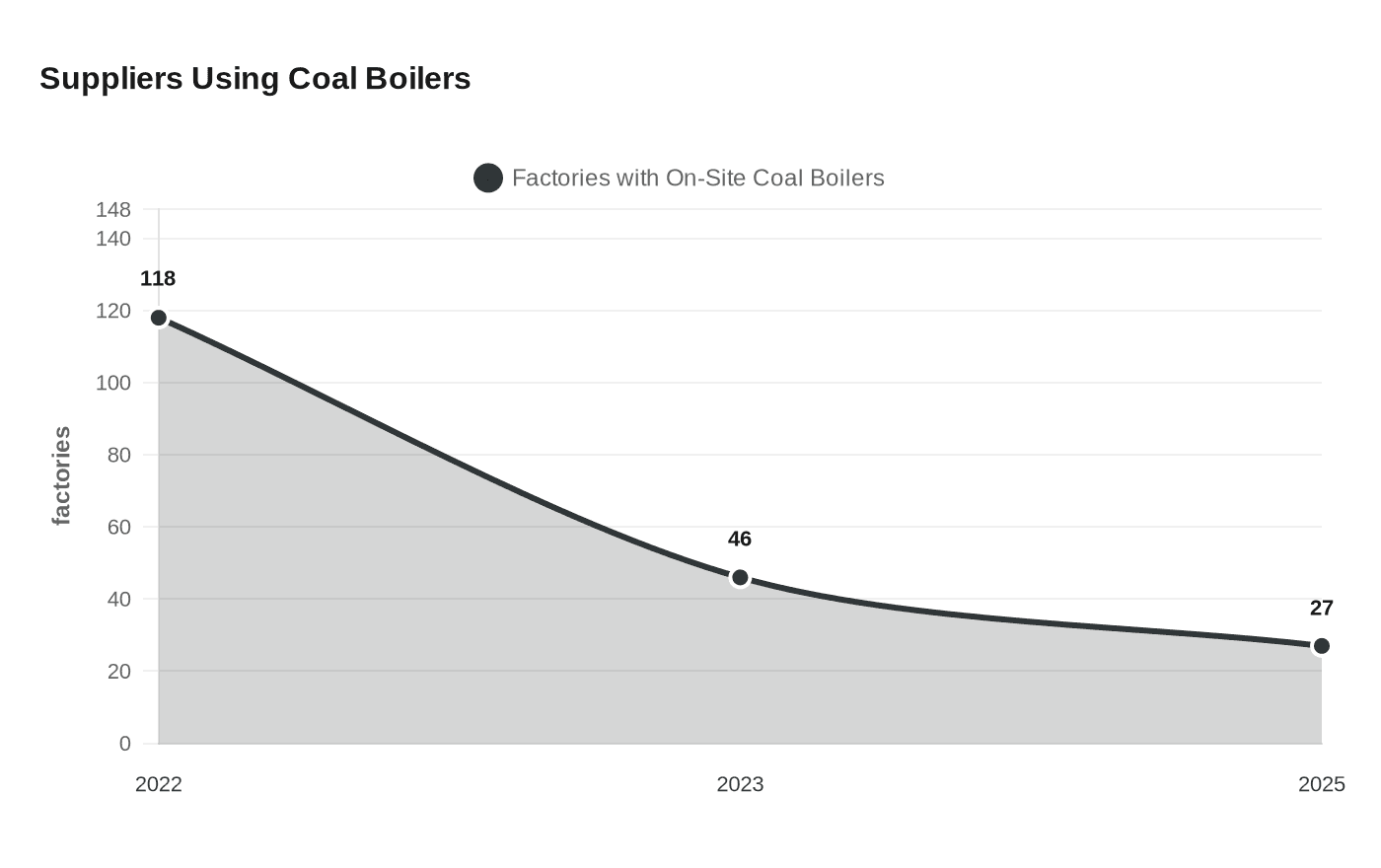
The coal phase-out is one of the clearest indicators of how seriously that commitment is being applied. Since 2022, the number of apparel suppliers using on-site coal boilers has decreased by 108, and the group aims to completely eliminate this technology by 2026. The number of factories using on-site coal boilers declined to 27 in 2025, down from 46 in 2023 and 118 in 2022. That trajectory is steep, and the 2026 full phase-out target is now within reach.
Water use tells a similar story. Apparel suppliers using wet processes saw absolute freshwater consumption decrease by 22.8% compared to 2022 levels, exceeding the company's 10% reduction target for 2025. Reductions of that scale inside a global supply chain require sustained supplier collaboration and procurement pressure, not wishful reporting.
Materials: Hitting Targets Early
On materials, H&M has cleared the bar it set for itself. Some 91% of the materials used last year were either recycled or sustainably sourced, with the share of recycled materials standing at 32%, surpassing its previously stated 30% target. The longer-term ambition is to reach 50% recycled materials by 2030, with the sourcing team working with partners to prioritise low-impact fibres and processes.
The group also achieved 100% organic or recycled cotton usage, marking a critical milestone in reducing its dependence on virgin agricultural inputs. For shoppers, cotton is the most tactile proof point: the feel of a garment, the weight of a jersey, the way a canvas tote holds its shape. If H&M can make sustainable cotton the baseline, not the premium, it changes the conversation from sacrifice to standard.
Circularity and Resale: A Growing Revenue Line
Resale activities accelerated during the year, supported by platforms such as Sellpy and the group's own brands, with H&M now offering resale services in 26 markets. Resale represented 0.8% of the group's turnover in 2025, a share that has increased 31%. That figure remains small in absolute terms, but the growth rate points to a segment the group is actively scaling. Sellpy, H&M's dedicated second-hand platform, provides the infrastructure; the question now is whether the marketing machine can close the gap between circular ambition and consumer behaviour.
The Shopper Persuasion Problem
This is where Ervér's challenge sharpens. The operational efficiency story is compelling inside H&M Group headquarters. Getting it to land at the till is a different discipline entirely. The group operates across 81 markets worldwide, with 4,100 stores and 132,000 employees, and it is trying to shift how shoppers perceive a brand many still shorthand as fast fashion.
H&M has been recognised for its sustainability progress, receiving an A rating for climate and water from CDP, making it a leader in environmental reporting. That credential carries weight in institutional circles. Whether it changes behaviour in a fitting room in Manchester or Manila is a harder problem, one that Ervér acknowledged requires translating sustainability from a corporate agenda into something customers can see, feel and justify paying for.
The group's answer appears to rest on product quality and price integrity rather than sustainability marketing alone. The aim is to demonstrate that a more sustainably made garment does not ask the shopper to compromise on style or spend more. As Daniel Ervér put it, "our goal is always the same: to create accessible fashion." The sustainability strategy, at its best, should be invisible inside that promise, baked into the fabric rather than printed on a label. The next test is whether a shopper picking up a recycled-cotton jersey in a Stockholm flagship or a Seoul mall even needs to know the backstory, as long as the garment earns its place in the wardrobe.
This article was produced by Prism’s automated news system from verified source data, official records, and press releases, then run through automated quality and moderation checks before publishing. The system is built and supervised by the people who set the standards it runs under. Read our full AI policy.
Did this article answer your question?


