Fashion's Water Crisis Forces Brands, Suppliers, and Policymakers to Act
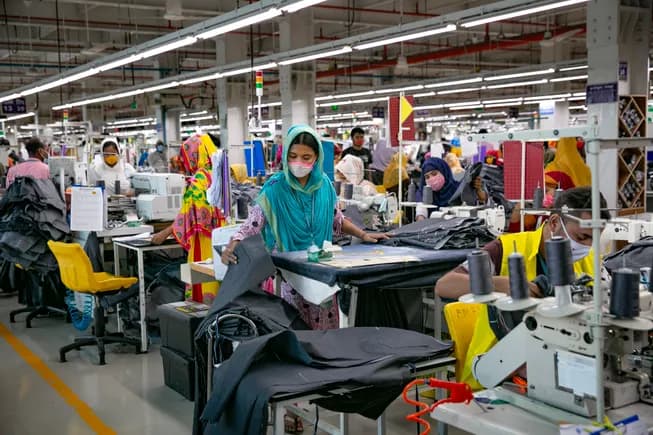
H&M Group and Vancouver start-up Viridis ran an industrial-scale pilot across three Dhaka textile mills, cleaning dye wastewater for reuse in closed-loop cycles.

Textile dyeing has long been fashion's dirtiest secret, not in the metaphorical sense but in the literal, chemical-contamination sense. The process that gives denim its indigo depth and jerseys their saturated hues generates enormous volumes of toxic wastewater, and for decades the industry has largely treated that problem as someone else's to solve. A new industrial-scale pilot in Dhaka, Bangladesh's capital, suggests the calculus may finally be shifting.
Vancouver-based water treatment start-up Viridis partnered with H&M Group to deploy its technology across three textile mills in Dhaka, targeting the wastewater produced during dyeing, a process that runs across several stages of production and leaves water laden with chemical dye residue and organic pollutants. The system treated that contaminated water and removed nearly all visible dye and organic pollutants, rendering it suitable for reuse in subsequent dye cycles. In practical terms, factories could reuse much of the same water rather than discharging it, a structural shift that could significantly cut both freshwater demand and pollution across textile manufacturing. The closed-loop model also demonstrated potential to recover certain auxiliary chemicals used in production, pointing toward a pathway that reduces both consumption and effluent discharge simultaneously.
The significance of this is harder to appreciate without understanding how thoroughly wastewater has been sidelined in fashion's sustainability conversation. While decarbonisation has dominated boardroom agendas and investor scorecards, the issue of wastewater from dyeing, washing, and cooling boilers has remained what the industry itself has called a stubborn environmental blind spot. That blind spot sits in one of the world's most water-stressed geographies: Bangladesh is among the climate-vulnerable manufacturing hubs where freshwater scarcity is an accelerating operational risk, not a future scenario.

Tangible technical progress is welcome, but the Viridis-H&M pilot is candid about the distance between proof of concept and systemic change. Scaling wastewater innovation across fragmented global supply chains will require significant capital investment, supplier incentives, and tighter enforcement of discharge standards in key manufacturing hubs, none of which are currently guaranteed. The three mills in Dhaka represent a data point, not a transformation.
What has changed is the political and financial pressure surrounding water stewardship. Regulators, investors, and civil society are increasing their scrutiny, particularly in climate-vulnerable regions, and wastewater treatment is fast becoming a litmus test for whether fashion can move beyond incremental efficiency gains toward systemic operational change. For an industry that has spent years measuring progress in carbon metrics while contaminated water flowed into rivers downstream from its supply chains, that litmus test is long overdue.
This article was produced by Prism’s automated news system from verified source data, official records, and press releases, then run through automated quality and moderation checks before publishing. The system is built and supervised by the people who set the standards it runs under. Read our full AI policy.
Did this article answer your question?