Germany's Textilfabrik 7.0 Launches a Real-World Lab for Circular Textile Production
Germany's Textilfabrik 7.0 launched in Mönchengladbach with €25M in funding, targeting CO₂-neutral circular textile production from a region once defined by coal.
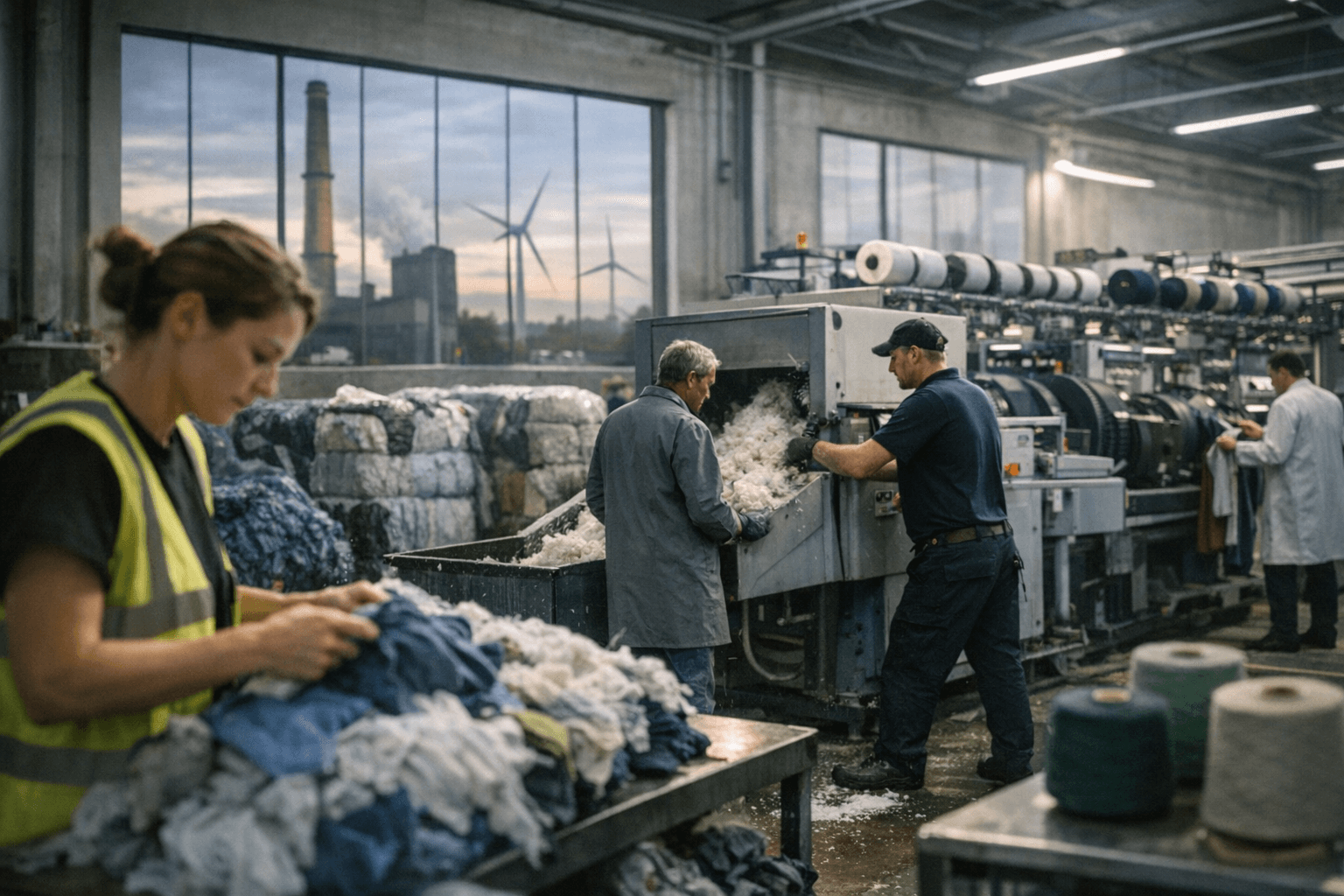
A major transformation project for the German textile and apparel industry has launched in the Monforts Quarter in Mönchengladbach, carrying the name Textilfabrik 7.0 and the shorthand T7. The launch took place on March 19 inside the TextilTechnikum of the Monforts Quarter, between historic textile machinery, lending the kickoff a charged symbolism: a former industrial heartland signaling its intent to rewire itself for the next century of production.
At the Textile Roundtable, an event format organized by the Zukunftsagentur Rheinisches Revier, representatives from industry, research, politics, and the regional economy came together to jointly lay the foundation for CO₂-neutral, circular, and economically viable textile production in Germany. The urgency behind that mandate is hard to overstate. The textile and fashion industry worldwide faces major challenges: around ten percent of global CO₂ emissions are attributed to it. At the same time, companies in Germany are under considerable competitive pressure.
Textilfabrik 7.0 addresses precisely this intersection by bringing together research institutions, industry, and regional stakeholders to accelerate the transfer of innovative technologies and production processes into industrial application. The project is a joint initiative of the Research Institute for Textile and Clothing (FTB) at Niederrhein University of Applied Sciences, the Institute for Textile Technology (ITA) at RWTH Aachen University, the Association of the North-West German Textile and Clothing Industry, the Association of the Rhenish Textile and Clothing Industry, the Textile Academy NRW, and WFMG, Mönchengladbach's economic development corporation.
At the heart of T7 are four core modules: On-Demand Manufacturing, MicroFactory Engineering, Digital Textiles, and Biosphere, which formed the basis for four workshops at the launch, in which participants discussed the requirements the industry has for future production solutions. Through its real-world lab approach, T7 aims to test and optimize new technologies along the entire textile value chain, including robotics, digital process chains, and biotechnological methods that can help establish a functioning circular economy in practice.
The project carries official funding of 25 million euros from the state of North Rhine-Westphalia, and T7 is one of 19 anchor projects in the Rhenish mining region, considered by the state to be central to the successful, rapid, and visible implementation of structural transformation. The project also makes an important contribution to structural change in the Rhenish mining region, where new perspectives for industrial value creation and skilled employment are emerging under the guiding principle "From Coal to AI."
The ambitions stretch beyond the current phase. In a second development phase, a future industrial park is planned to be created beyond Textilfabrik 7.0, where the textile and apparel industry will develop and produce under zero-emission conditions and with CO₂-neutral processes. The industrial park will provide space for innovative production facilities, company branches in the textile sector, and sustainable textile start-ups, creating a modern industrial hub that combines research, development, and industrial production.
Silke Krebs, State Secretary at North Rhine-Westphalia's Ministry of Economic Affairs, said the initiative would play a key role in transforming the Rhenish mining region into a modern industrial hub, combining sustainable textile production with research and development. Mayor Felix Heinrichs highlighted Mönchengladbach's deep textile heritage and described the project as a milestone for the city's structural and economic transformation. The city's textile past, it turns out, may be precisely the infrastructure its future requires.
This article was produced by Prism’s automated news system from verified source data, official records, and press releases, then run through automated quality and moderation checks before publishing. The system is built and supervised by the people who set the standards it runs under. Read our full AI policy.
Did this article answer your question?