Goodwill and Reju Outline Textile Recycling Expansion Plans for Rochester
Reju will build a $390 million, 145,000 sq. ft. regeneration hub at Eastman Business Park to turn polyester-rich textiles into rBHET and Reju PET, targeting operation by end of 2029.

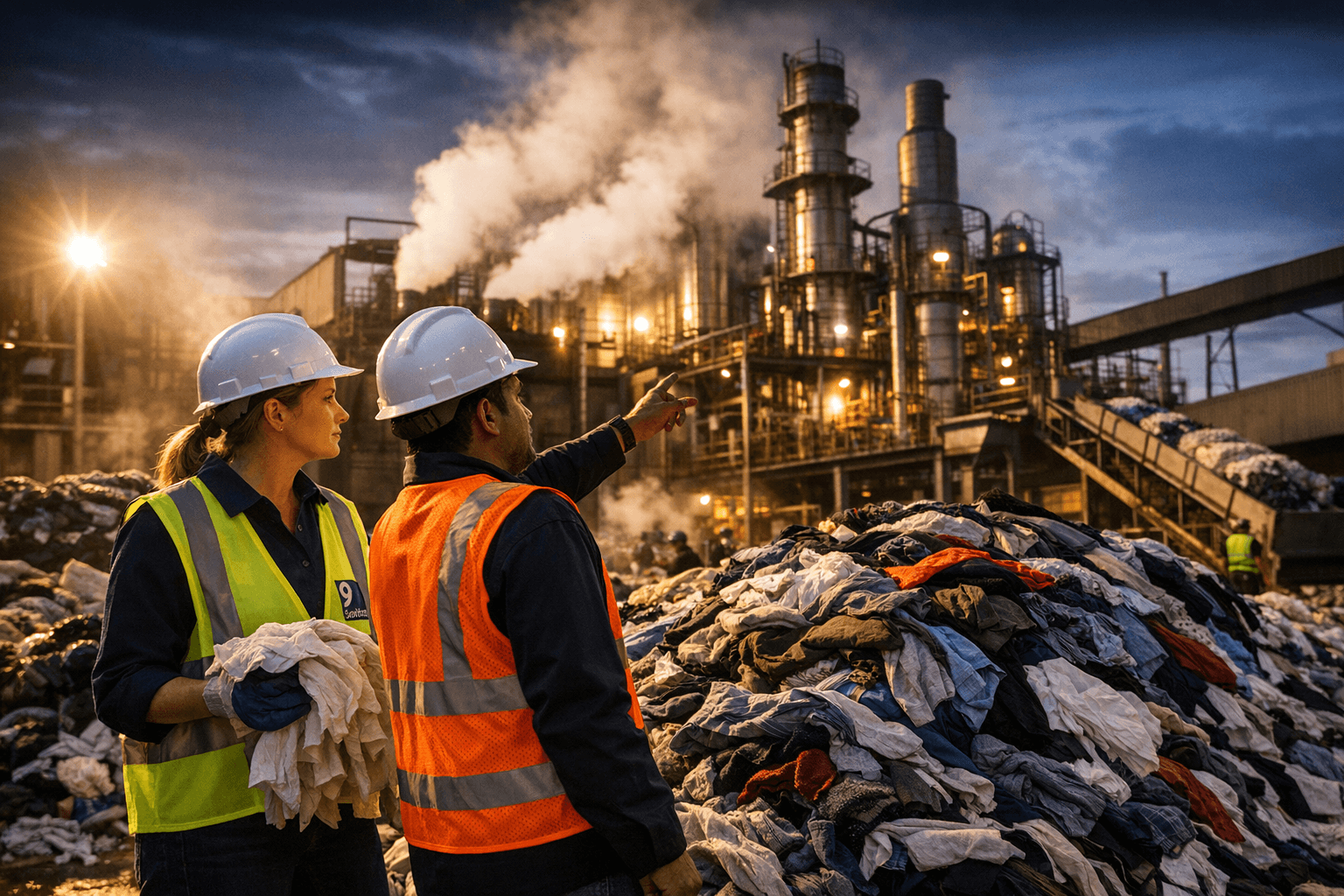
Reju framed its Rochester plan as an industrial answer to fashion’s textile overflow: an industrial-scale Regeneration Hub designed to treat textile waste as a strategic resource, not a disposal problem. The company announced Rochester as the site for its first U.S. facility and highlighted Eastman Business Park’s industrial footprint as the logical place to transform polyester-rich post-consumer clothing into recycled outputs.
The announcement unfolded at a Feb. 17 press conference held at the Goodwill Clearance Center in Henrietta, where leaders from Goodwill of the Finger Lakes joined Reju executives and city and county officials. Goodwill of the Finger Lakes’ president and CEO Jennifer Lake captured the partnership’s promise: “By transforming polyester-rich materials into high-quality regenerated polyester fiber, Reju is helping close the loop in a way that has not previously been possible at scale.”
Reju has selected an 18.9-acre parcel at Eastman Business Park described by state officials as a nearly 19-acre vacant lot for a planned 145,000 sq. ft. facility. The project is reported as a $390 million investment, backed in part by a $4 million capital grant from Empire State Development and additional regional partners, though the venture remains subject to a final investment decision by the board of Technip Energies, Reju’s parent company. Company and municipal materials set a target for the hub to be operational by the end of 2029.
The hub’s technological brief is specific: Reju will produce rBHET from post-consumer polyester-rich textiles and repolymerize that feedstock into Reju PET. LinkedIn posts from Reju describe the facility as capable of regenerating the equivalent of up to 300 million garments annually and assert the recycled polyester will have a “50% lower carbon footprint than virgin materials.” Reju CEO Patrik Frisk put the partnership in civic terms at the Henrietta event: “It’s an example of how we need to look at the future, how governmment, non-for-profits, for-profits [and] technology all comes together to build something for the future.” Frisk also noted Rochester’s industrial legacy, saying, “Rochester has a long history of industry leadership and that legacy will continue with Reju.”
Economic impact was front and center for county leaders. The project is projected to create roughly 70 direct jobs across engineering, technician, machinist and production roles, with additional ancillary employment expected regionally. Monroe County Executive Adam Bello praised the collaboration’s local benefits: “Reju’s expansion and new partnership with Goodwill of the Finger Lakes shows that Monroe County and the City of Rochester are leading the way in attracting innovative, sustainable businesses to our community. This project will generate quality jobs, strengthen our economy, and establish Rochester as a premier circular textile hub. I thank Mayor Evans and Goodwill of the Finger Lakes for their partnership, and Reju for their commitment to our community.”
Operational logistics bind Goodwill’s front-end sorting to Reju’s industrial processing. Goodwill of the Finger Lakes sorts donations at the Henrietta clearance center; officials said 11 Goodwill hubs across the northeastern U.S. will supply unsold textiles to Reju’s planned hub. Goodwill Industries International President & CEO Steven Preston placed the move in organizational context, underscoring a multi-decade mission and noting that a partnership formed with Reju and WM in 2024 helped set the stage for today’s program announcement.
If Technip Energies’ board signs off, Rochester will gain a 145,000 sq. ft. regeneration plant on an 18.9-acre site that aims to convert unsold, polyester-rich clothing into industrial-grade recycled fiber at scale by the end of 2029. For a region built on mills and chemistry, the project promises to recut textiles’ lifecycle into a new silhouette of manufacturing and reuse.
This article was produced by Prism’s automated news system from verified source data, official records, and press releases, then run through automated quality and moderation checks before publishing. The system is built and supervised by the people who set the standards it runs under. Read our full AI policy.
Did this article answer your question?