H&M Foundation Launches Free Toolkit to Help Halve Fashion's Emissions
H&M Foundation's free System Map toolkit turns fashion's decarbonisation blueprint into three annotatable workshop modules, targeting halved emissions every decade until 2050.
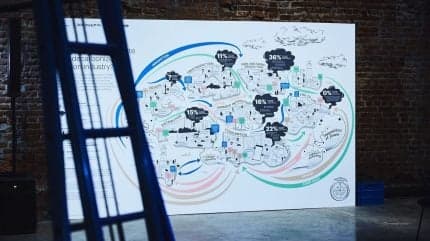
H&M Foundation has released a new open-source workshop toolkit to guide the textile industry's response to climate change, solving a problem the foundation names plainly: the industry's obstacle to halving emissions isn't ambition, it's alignment.
Developed in partnership with Accenture, the toolkit comprises three workshop modules: identifying an organisation's role and influence within the system, locating critical leverage points for intervention, and envisioning a decarbonised future for the sector. Working with Accenture, H&M Foundation developed both a digital and in-person toolkit that includes a keynote introduction to the System Map, as well as three educational workshops.
H&M Foundation introduced the System Map in 2024, framing the textile industry as an ecosystem influenced by flows of capital, incentives, regulation, innovation, and consumer demand. The map presents the full value chain from fibre production through to end-of-life, alongside indicative carbon emissions at each stage and systemic forces such as profit priorities and power imbalances. Grounded in Actor Network Theory, it is free to download and presents the fashion system not as a linear value chain running from design to disposal, but as a series of interconnected "islands" — design, fibre production, yarn and fabric production, garment production, distribution, consumption and end-of-life — each with its own actors, processes and carbon footprint.
The physical scale of the toolkit is deliberate. The guide's final section positions the map as something to be written on, not just read. It asks users to consider where in the system they have the most power to influence change, who they need to collaborate with, and what they would prioritise first. The toolkit is explicitly designed for group use in workshops, with the large-format map — 4 by 2.5 metres in its printed form — intended to be laid out on a table and annotated. That shift from report-on-a-shelf to writable working surface is the toolkit's most pointed design choice.
By mapping connections between actors and revealing how decisions can impact emissions across the entire chain, the foundation says the toolkit is designed to avoid simply shifting costs or burdens from one part of the supply chain to another. Instead, it offers a way to examine structural barriers and power dynamics that can hinder effective climate action.
Anna Gedda, CEO of H&M Foundation, put it directly: "Change won't come from islands of perfection — in a system as interconnected as fashion, every part influences the other. The System Map helped make that visible and now this toolkit makes it usable. If we want to halve emissions every decade, we have to stop optimising in silos and start pulling the right levers together."

Annie Lindmark, programme director at H&M Foundation, framed the underlying logic: "If we don't see the system, we can't change it, and that's exactly what this work helps us do."
The toolkit sits within a broader body of work. In October 2025, H&M Foundation and Accenture published "From Signals to Systems Change," a report stressing that decarbonising fashion "requires reimagining the entire system" and featuring a Reimagined System Map designed to visualise how early-stage innovation could drive a just and net-zero textile future. That report identified eight macro trends reshaping the sector: the toolkit arrived alongside this broader programme of work, with the eight trends spanning geopolitical uncertainty, increasing textile regulation including the EU's Corporate Sustainability Due Diligence directive, the politicisation of sustainability, AI and digitalisation, climate risks to production, material scarcity and biodiversity loss, decarbonisation financing pressures, and market fragmentation.
The financial case for urgency is not abstract. The Apparel Impact Institute has warned that some fashion firms are likely to see a 34% decline in profit by 2030 if they take no action on climate, with that decline potentially hitting 67% by 2040. Three primary factors contribute: higher raw material costs, higher energy costs, and compliance with environmental regulations including carbon taxes.
Both the original System Map and the new facilitation materials remain open-access resources. The foundation maintains that coordinated action based on a shared understanding of these systems will be essential if the industry is to reach its stated goal of halving greenhouse gas emissions each decade until 2050. The toolkit and System Map are available for free download on the H&M Foundation's website.
This article was produced by Prism’s automated news system from verified source data, official records, and press releases, then run through automated quality and moderation checks before publishing. The system is built and supervised by the people who set the standards it runs under. Read our full AI policy.
Did this article answer your question?


