Indian Peacock Pays Fair Wages to India’s Handloom Artisans
Indian Peacock’s real innovation is a supply chain built on fair wages and repeat orders. The question is not romance, but whether handloom can pay steadily.

Indian Peacock’s most persuasive idea is not a dress, but a business model. The label says it works directly with Jamdani weavers in West Bengal, Ikat weavers in Telangana, handblock print artisans in Rajasthan, and Mangalagiri weavers in Andhra Pradesh, then treats them as partners rather than vendors. In a market that still often treats handloom as a festive exception, that shift matters because it turns craft into recurring work, not an occasional flourish.
What artisan-partnership really looks like
The language of “artisan as partner” can sound soft until you look at the mechanics. Indian Peacock says it supports makers with fair wages and consistent orders, which is the difference between a craft economy and a hobby economy. A weaver can plan warp, yarn, labor, and household cash flow only if orders are steady enough to justify the loom staying active.
That stability is especially important because handloom is slow by design. A motif woven directly on the loom cannot be rushed without loss of quality, and a block print or resist-dyed pattern depends on skilled hands making careful, repeated decisions at every stage. When a label builds products around that pace instead of fighting it, the result is more durable than a seasonal capsule dressed up as sustainability.
Indian Peacock describes itself as a homegrown fashion brand offering artisan-made clothing from India, with minimal, thoughtful designs and a modern take on apparel. That matters stylistically too. The pieces are not meant to read as museum objects; they are meant to live in a wardrobe, to be worn with denim, sharp tailoring, or a clean cotton sari, then washed, repeated, and kept in circulation.
Why the economics of handloom cannot be ignored
India’s handloom sector is not a niche corner of fashion. Government material describes it as a major cultural and economic sector and, crucially, as the second-largest employment provider for the rural population after agriculture. The Fourth All India Handloom Census 2019-20 recorded 31.45 lakh households and 35.22 lakh handloom weavers and allied workers, which makes every new order pattern a livelihood question, not a branding exercise.
That scale also explains why policy support matters. The Office of the Development Commissioner for Handlooms was set up on 20 November 1975 and now functions under the Ministry of Textiles. It oversees support structures such as the National Handloom Development Programme and the Raw Material Supply Scheme, both designed to promote handlooms and support weavers’ welfare.
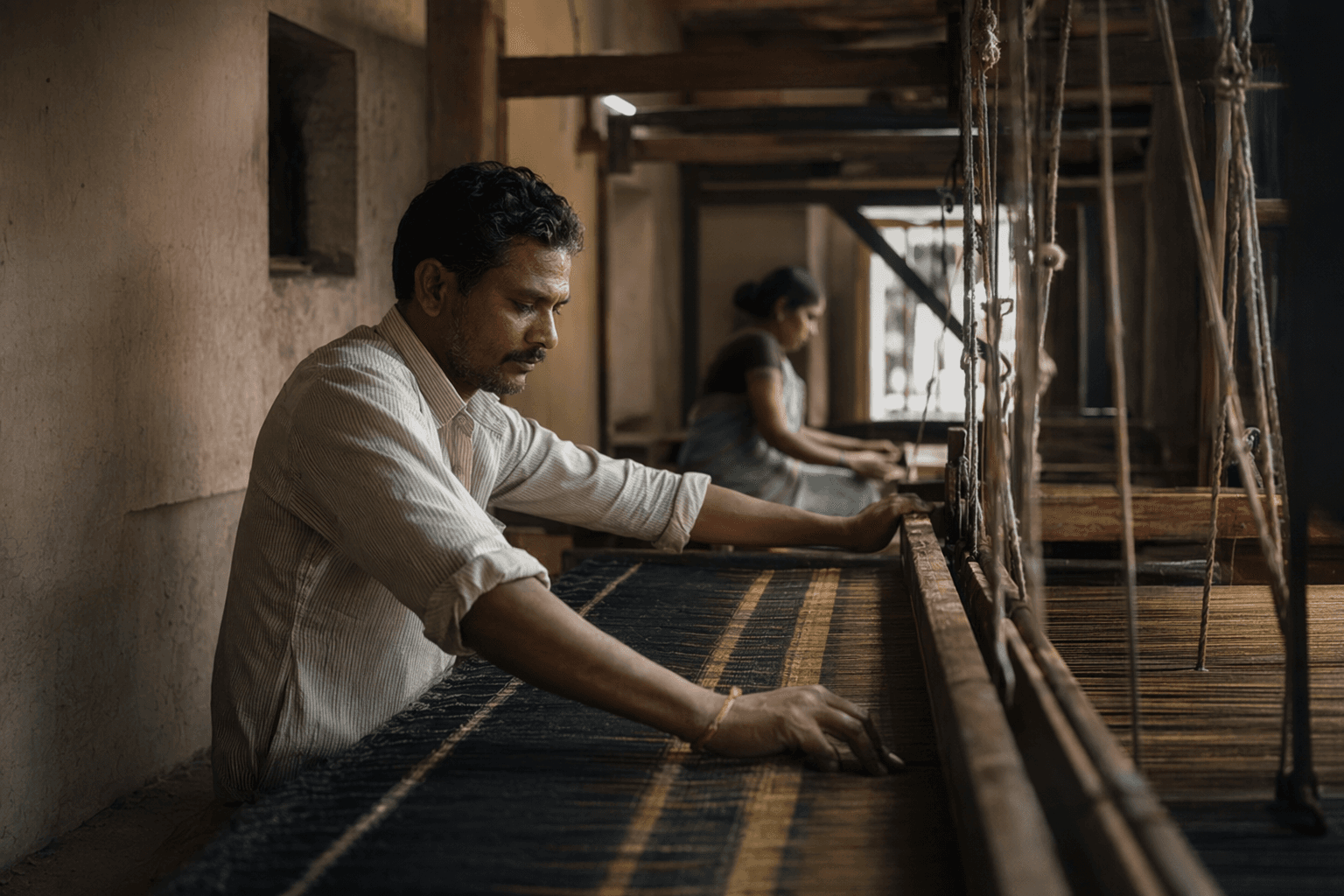
The point for fashion readers is simple: sustainability in handloom is not only about preserving technique. It is about whether the supply chain produces enough regular income to keep families in the trade, enough predictability to retain skill, and enough production stability to prevent the next generation from leaving for work that pays faster.
The fabrics carry their own histories
Jamdani brings the highest romance and the hardest labor to this story. UNESCO describes it as a vividly patterned, sheer cotton fabric woven on a handloom, historically associated with the Dhaka region, with motifs created directly on the loom. That means the pattern is not merely applied; it is built into the fabric thread by thread, a process that explains why Jamdani has long been prized and why it demands serious patience.
Ikat works differently but no less dramatically. The blur of the pattern is part of its identity, a result of dyeing the yarn before it is woven, so the image settles into the cloth with a slightly luminous, edge-softened quality. In a modern wardrobe, that makes Ikat especially useful for pieces that need visual interest without loud ornament.
Mangalagiri adds another register entirely. APCO, the Andhra Pradesh State Handloom Weavers’ Cooperative Society, traces it among the region’s heritage weaves and says it has operated since 1958 to protect weaving communities and promote Andhra Pradesh and Telangana handloom traditions. In practical terms, that kind of institutional memory signals that this is not a new craft trend being discovered by fashion, but a textile language with deep regional roots and organized support behind it.
Handblock print, meanwhile, keeps the collection grounded in touch and repetition. A good block print has a human rhythm in it, the slight pressure changes, the layering of pigment, the evidence that the cloth has passed through hands before it ever reaches the rack. Put alongside Jamdani, Ikat, and Mangalagiri, it gives Indian Peacock a material vocabulary that feels broad without becoming chaotic.
Why everyday wear is the real test
The smartest part of Indian Peacock’s pitch is its insistence on everyday use. Slow fashion only becomes economically meaningful when it moves beyond occasionwear and into the clothes people actually rotate: easy shirts, crisp separates, airy layers, pieces that can survive office hours, school runs, travel, and repeated laundering. That is how a handloom purchase stops being a sentimental one-off and becomes part of a buying habit.
This is where design discipline matters. Minimal silhouettes let the fabric do the talking, which is exactly right for handloom. When the cut is clean and the finish thoughtful, the weaver’s work reads clearly, and the garment can compete with mass-produced clothing on versatility rather than novelty.
That is also the point at which artisan partnership becomes measurable. Fair wages matter, but so do repeat orders, predictable production calendars, and product design that gives a craft a dependable life in the market. If a brand can keep a loom busy in January and again in June, not just during a festive drop, then it is doing more than storytelling.
The larger fashion lesson
Indian Peacock’s model suggests that handloom’s future may depend less on preserving it as an heirloom and more on making it financially ordinary. Not ordinary in quality, but ordinary in use, present in wardrobes the way good poplin shirts, strong denim, and dependable tailoring are present: constantly, without ceremony.
That is the real test of artisan partnership. If fair wages, regular orders, and everyday product design can hold together, handloom becomes something stronger than a heritage label. It becomes a working system, one that keeps skill in circulation, income moving through weaving communities, and the cloth itself alive in the present tense.
This article was produced by Prism’s automated news system from verified source data, official records, and press releases, then run through automated quality and moderation checks before publishing. The system is built and supervised by the people who set the standards it runs under. Read our full AI policy.
Did this article answer your question?


