Lisbon Fashion Week 2026: trends, craftsmanship and a sustainability throughline
Portugal's craft-led runway is now a sourcing brief: GOTS-certified mills, the APICCAPS footwear cluster, and 30-day lead times make Lisbon's sustainability story commercially actionable.
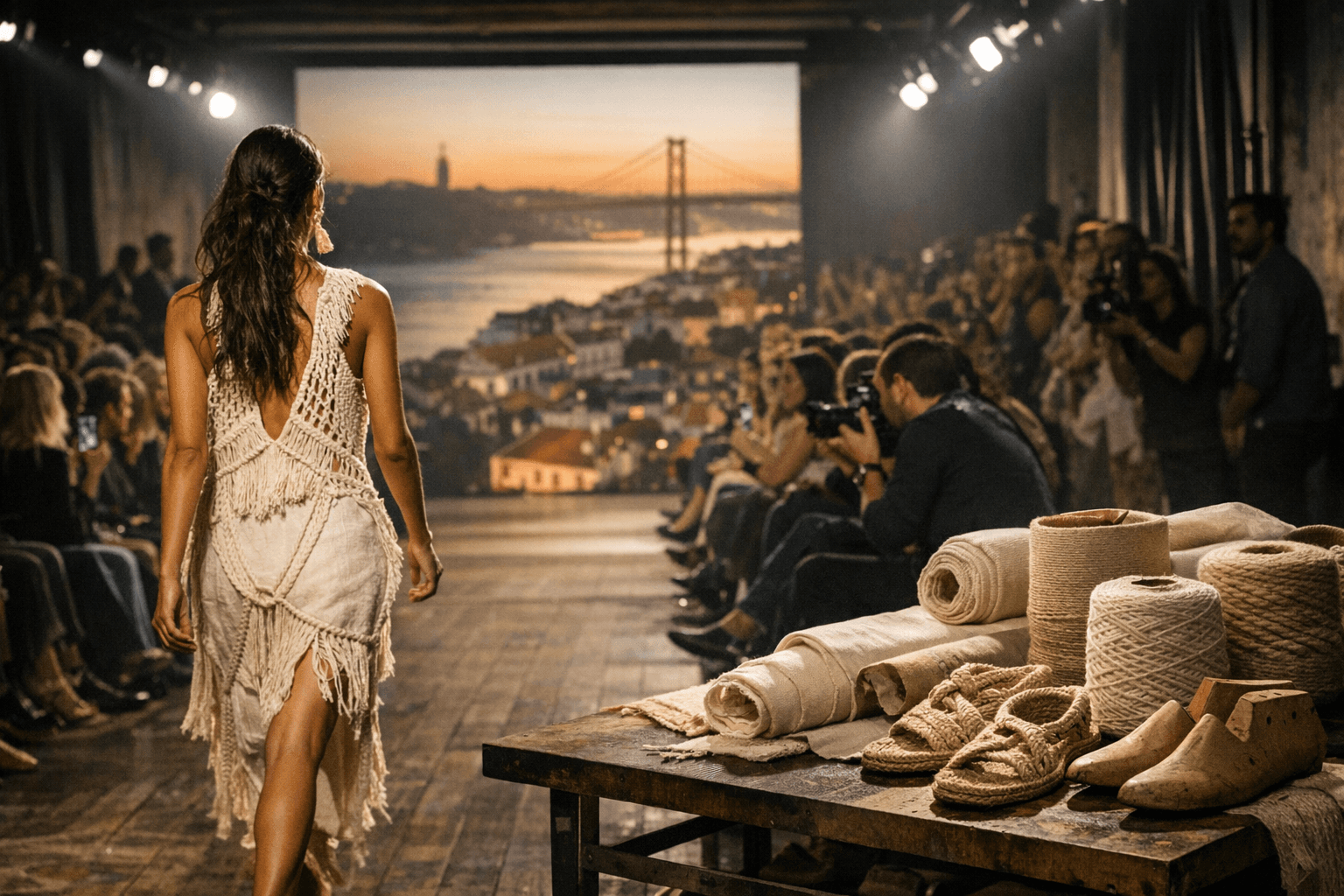
Artisanal knitwear: the material trend with the clearest supply chain
Lisbon Fashion Week's March edition consistently challenges the boundaries of contemporary fashion, but the most commercially useful signal from the 2026 runway was not a silhouette; it was a production philosophy. Artisanal knitwear, worked in natural fibers and positioned explicitly as a durable, repairable alternative to fast fashion, appeared across multiple collections at MODALISBOA PEBBLING, the 66th edition of Lisboa Fashion Week, which ran March 12-15 and was co-organised with the Municipality of Lisbon. Forbes' March 20 coverage identified this as a throughline: small-batch knitwear made close to home, designed to last and be mended rather than replaced.
For brands, the practical implication is immediate. Portugal's textile manufacturing heartland, concentrated in the Minho and Ave Valley regions north of Porto, hosts over 120 GOTS-certified factories capable of producing certified-organic knitwear with lead times in the range of 30 days, a fraction of the 90-to-120-day windows typical of Asian production. Portuguese mills hold certifications including GOTS, GRS, OCS, FAIRTRADE, the Better Cotton Initiative, and OEKO-TEX Standard 100, meaning a brand can build a credible traceability narrative at the fiber stage, not just at the finished-garment level. Etfor, one of the country's established certified producers, formalised its sustainability department in 2019 and now carries that full certification stack. Minimum order quantities at the knit-fabric level can run as low as 100 metres, which makes small-batch capsule production genuinely viable, not just aspirational.
Natural fibers and what traceability actually looks like
The runway emphasis on natural fibers, primarily wool and linen, reflects something structurally real about Portugal's supply chain. Unlike cotton-heavy sourcing markets in South Asia, Portugal's certified mills can offer near-complete chain-of-custody documentation for organic or low-impact fiber, with digital transaction certificates issued against each GOTS or OEKO-TEX order. For brands navigating the EU's incoming mandatory sustainability disclosures, that paper trail is not a marketing extra; it is a compliance asset.
Portugal leads Europe in sustainable textile innovation, with significant renewable energy powering its mills and substantial water-recycling infrastructure, which means the environmental footprint of fabric production itself is lower before a garment is even cut. Sustainable fabric pricing from Portuguese mills runs roughly €4.80 to €9.50 per metre depending on fiber content and certification tier, a premium over conventional sourcing but one that collapses when you factor in shorter shipping distances, lower carbon offset costs, and the reduced reputational risk of an auditable supply chain. Linen, in particular, is worth attention: European-grown flax linen carries FSC and organic certifications and can be sourced within a single regional supply chain, from fiber to finished fabric.
The footwear cluster: APICCAPS and the BioShoes4all model
APICCAPS, the Portuguese Footwear Association, has aligned with the BioShoes4all sustainability initiative and curated a "Portuguese Soul" group presentation at Lisbon Fashion Week, bringing together designers including Ambitious, Carlos Santos, Leather Goods by Belcinto, Helena Mar, Miguel Vieira, Penha, Sanjo, and Valuni to showcase the country's legacy of craftsmanship. This is not a soft cultural gesture; it is a cluster-model approach to circular supply-chain development, with shared infrastructure, sustainability standards, and collective market positioning.
Luís Onofre, luxury footwear designer and president of APICCAPS, presented his "Legacy" collection at the March event, celebrating 25 years of production made in Portugal at his family's factory. The collection is a direct argument for craft continuity: high-quality construction, made domestically, at a price point that reflects genuine material and labor costs. For buyers, the APICCAPS cluster represents an accessible entry point into Portuguese footwear sourcing with built-in sustainability credentials, an association that has been structuring its members around circular economy principles and traceable materials.
Design-for-durability as a commercial strategy, not a values statement
With an enduring focus on sustainable transition and a deep-rooted social conscience, Lisbon Fashion Week stands as a space of intellectual provocation and hands-on transformation. What makes the 2026 edition distinct is how that ethos translated into specific design decisions with downstream commercial logic. The Sangue Novo emerging designers competition, which formed part of the programme, structured its second phase around four pillars: international training, responsible production, brand creation, and innovation in crafts. ModaLisboa describes Sangue Novo as a space for continued development, reinforcing responsible production from brand creation to innovation in crafts. These are not retrofit values; they are the founding architecture of the next generation of Portuguese designers.
The WORKSTATION DESIGN supported by Jean Louis David platform gave production and technical infrastructure to emerging labels including ARNDES, Bárbara Atanásio, Çal Pfungst, Francisca Nabinho, and DRIONADREAM, each presenting collections that foregrounded material integrity and handcraft. Bárbara Atanásio's work, shown at previous ModaLisboa editions alongside these newer voices, has consistently engaged memory and material honesty as design drivers. Kolovrat took the concept further with a site-specific presentation at the Engawa Space of CAM, the Gulbenkian Modern Art Center, built around the idea of a seed: growth, origin, and cyclical renewal expressed through garment and installation.
What deadstock and recycled-fiber production tells buyers
At ModaLisboa's SS26 edition, at least one designer utilized over 80% deadstock and recycled fibers, championing sustainable practices while crafting pieces that resonate with complexity and care. That figure matters because it signals a shift from token sustainability gestures to production systems genuinely built around waste reduction. For brands looking to integrate deadstock sourcing into their own models, Portugal's proximity to European fabric mills means access to end-of-roll and surplus stock from some of the continent's best-certified producers, with shorter logistics chains and lower minimum commitments than equivalent programs in Italy or France.
The MODAPORTUGAL talk at MUDE, the Design Museum, brought together designers and the textile industry as part of the broader public programme, and FAST TALKS at CAM addressed Fashion, Identity, and Technology as interconnected forces. This cross-sector dialogue is precisely what near-sourcing requires: designers, mills, and retailers speaking the same language about material provenance, certification standards, and production timescales.
The sourcing brief in practical terms
For brands evaluating Portugal as a near-source option after the March runway, the priority checklist looks like this:
- Knitwear: approach GOTS-certified mills in the Minho/Ave corridor directly; ask for digital transaction certificates at the yarn stage, not just the fabric stage.
- Footwear: engage through APICCAPS for cluster introductions; the BioShoes4all framework provides a pre-vetted sustainability baseline across member ateliers.
- Deadstock and recycled fiber: Portuguese mills carry GRS-certified recycled content options alongside organic lines; MOQ flexibility at 100-metre minimums makes capsule drops realistic.
- Lead times: 30-day production windows versus 90-plus days from Asia represent a meaningful difference in inventory risk, particularly for brands running smaller, more frequent collections.
- Certification stack: GOTS, OEKO-TEX Standard 100, and GRS are the three credentials to require as a minimum; they cover fiber origin, chemical safety, and recycled-content verification respectively.
Portugal's fashion week has long carried a reputation for craft intelligence over spectacle. What the March 2026 edition confirmed is that the supply chain behind that craft is now structured enough, certified enough, and transparent enough to serve not just Portuguese designers, but any brand willing to reframe near-sourcing as a strategic asset rather than a geographic compromise.
Now let me format this properly as requested:
Artisanal knitwear: the material trend with the clearest supply chain
The most commercially useful signal from Lisboa Fashion Week 2026 was not a silhouette; it was a production philosophy. Artisanal knitwear, worked in natural fibers and positioned explicitly as a durable, repairable alternative to fast fashion, ran as a throughline across multiple collections at MODALISBOA PEBBLING, the 66th edition of Lisboa Fashion Week, which ran March 12-15 co-organised with the Municipality of Lisbon. Forbes' March 20 coverage identified this as the sustainability thread binding the season: small-batch knitwear made close to home, designed to outlast trends and be mended rather than discarded.
For brands, the practical implication is immediate. <cite index="3-1">Portugal leads Europe in sustainable textile innovation, and its manufacturing heartland, concentrated in the Minho and Ave Valley regions north of Porto, hosts over 120 GOTS-certified factories capable of producing certified-organic knitwear. Etfor, one of the country's established certified producers, carries GOTS, GRS, OCS, FAIRTRADE, the Better Cotton Initiative, and OEKO-TEX Standard 100 certifications, having restructured its business strategy and formed a sustainability department in 2019. Lead times from these mills run in the range of 30 days, compared to the 90-to-120-day windows typical of Asian production, and minimum order quantities at the knit-fabric level can run as low as 100 metres, which makes small-batch capsule production genuinely viable rather than aspirational.
Natural fibers and what traceability actually looks like
The runway emphasis on wool and linen reflects something structurally real about Portugal's supply chain. Unlike cotton-heavy sourcing markets in South Asia, Portugal's certified mills can provide near-complete chain-of-custody documentation at the fiber stage, with digital transaction certificates issued instantly against GOTS, GRS, and OEKO-TEX orders. For brands navigating the EU's incoming mandatory sustainability disclosures, that paper trail is not a marketing extra; it is a compliance asset.
Portuguese mills offer organic cotton from regional regenerative co-operatives, and one supplier traces 100% of fibers via blockchain, while digital reactive dyeing delivers 95% color retention and zero wastewater. Sustainable fabric pricing from Portuguese mills runs roughly €4.80 to €9.50 per metre depending on fiber content and certification tier. That is a premium over conventional sourcing, but one that narrows significantly when you factor in shorter shipping distances, lower carbon-offset costs, and the reduced reputational risk of an auditable supply chain. Linen, in particular, is worth prioritising: European-grown flax with FSC and organic certifications can be traced within a single regional supply chain, from raw fiber to finished fabric.
The footwear cluster: APICCAPS and the BioShoes4all model
APICCAPS, the Portuguese Footwear Association, aligned with its BioShoes4all sustainability initiative and curated a "Portuguese Soul" group presentation at Lisbon Fashion Week, bringing together designers including Ambitious, Carlos Santos, Leather Goods by Belcinto, Helena Mar, Miguel Vieira, Penha, Sanjo, and Valuni to put the country's legacy of craftsmanship and supply-chain agility on shared display. This is not a soft cultural gesture; it is a cluster-model approach to circular supply-chain development, with shared infrastructure, sustainability standards, and collective market positioning.
Luís Onofre, luxury footwear designer and president of APICCAPS, presented his "Legacy" collection at the March edition, celebrating 25 years of production made in Portugal at his family's factory. The collection is a direct argument for craft continuity: high-quality construction, built domestically, at a price point that reflects genuine material and labor costs. For buyers, the APICCAPS cluster represents an accessible entry point into Portuguese footwear sourcing with built-in sustainability credentials, an association that has been structuring its members around circular economy principles and traceable materials.
Design-for-durability as a commercial strategy, not a values statement
The Sangue Novo emerging designers competition, central to the ModaLisboa programme, structured its second phase around four explicit pillars: international training, responsible production, brand creation, and innovation in crafts. ModaLisboa describes Sangue Novo as "a space for continued development and projection within the fashion system," opening new possibilities for young designers from international training to responsible production, from brand creation to innovation in crafts. These are not retrofit values appended to an existing program; they are the founding architecture of the next generation of Portuguese designers.
The WORKSTATION DESIGN supported by Jean Louis David platform gave production and technical infrastructure to emerging labels including ARNDES, Bárbara Atanásio, Çal Pfungst, Francisca Nabinho, and DRIONADREAM, each presenting collections that foregrounded material integrity and handcraft. Kolovrat took the concept of origin further with a site-specific presentation built around the idea of a seed, staged at the Engawa Space of CAM, the Gulbenkian Modern Art Center. After the presentation, the pieces remained on display for several days, framing garments not as product but as material argument.
What deadstock and recycled-fiber production tells buyers
At ModaLisboa's SS26 edition, at least one designer utilized over 80% deadstock and recycled fibers, championing sustainable practices while crafting pieces that resonate with complexity and care. That figure matters because it signals a shift from token sustainability gestures toward production systems genuinely built around waste reduction. For brands looking to integrate deadstock sourcing into their own models, Portugal's proximity to European fabric mills means access to end-of-roll and surplus stock from some of the continent's best-certified producers, with shorter logistics chains and lower minimum commitments than equivalent programs in Italy or France.
The MODAPORTUGAL talk at MUDE, the Design Museum, brought together designers and the textile industry as part of the broader public programme, while FAST TALKS at CAM addressed Fashion, Identity, and Technology as interconnected forces. This cross-sector dialogue is precisely what near-sourcing requires: designers, mills, and retailers speaking the same language about material provenance, certification standards, and realistic production timescales.
The sourcing brief in practical terms
For brands evaluating Portugal as a near-source option after the March runway, the priority checklist is as follows:
- Knitwear: Approach GOTS-certified mills in the Minho/Ave corridor directly; request digital transaction certificates at the yarn stage, not just at finished-fabric level.
- Footwear: Engage through APICCAPS for cluster introductions; the BioShoes4all framework provides a pre-vetted sustainability baseline across member ateliers.
- Deadstock and recycled fiber: Portuguese mills carry GRS-certified recycled-content options alongside organic lines; MOQ flexibility at 100-metre minimums makes capsule drops realistic.
- Lead times: 30-day production windows versus 90-plus days from Asia represent a meaningful difference in inventory risk, particularly for brands running smaller, more frequent collections.
- Certification stack: GOTS, OEKO-TEX Standard 100, and GRS are the three credentials to require as a minimum; they cover fiber origin, chemical safety, and recycled-content verification respectively.
Portugal's fashion week has long carried a reputation for craft intelligence over spectacle. What the March 2026 edition confirmed is that the supply chain behind that craft is now structured, certified, and transparent enough to serve not just Portuguese designers, but any brand willing to reframe near-sourcing as a strategic advantage rather than a geographic compromise. The runway is the preview; the mills, ateliers, and footwear clusters running north of Lisbon are the product.
This article was produced by Prism’s automated news system from verified source data, official records, and press releases, then run through automated quality and moderation checks before publishing. The system is built and supervised by the people who set the standards it runs under. Read our full AI policy.
Did this article answer your question?


