Malayalam Film Butterfly Girl 85 Spotlights Upcycling as Creative and Economic Lifeline
A Malayalam film makes upcycling its protagonist's lifeline, stitching sustainable fashion into the heart of its storytelling.
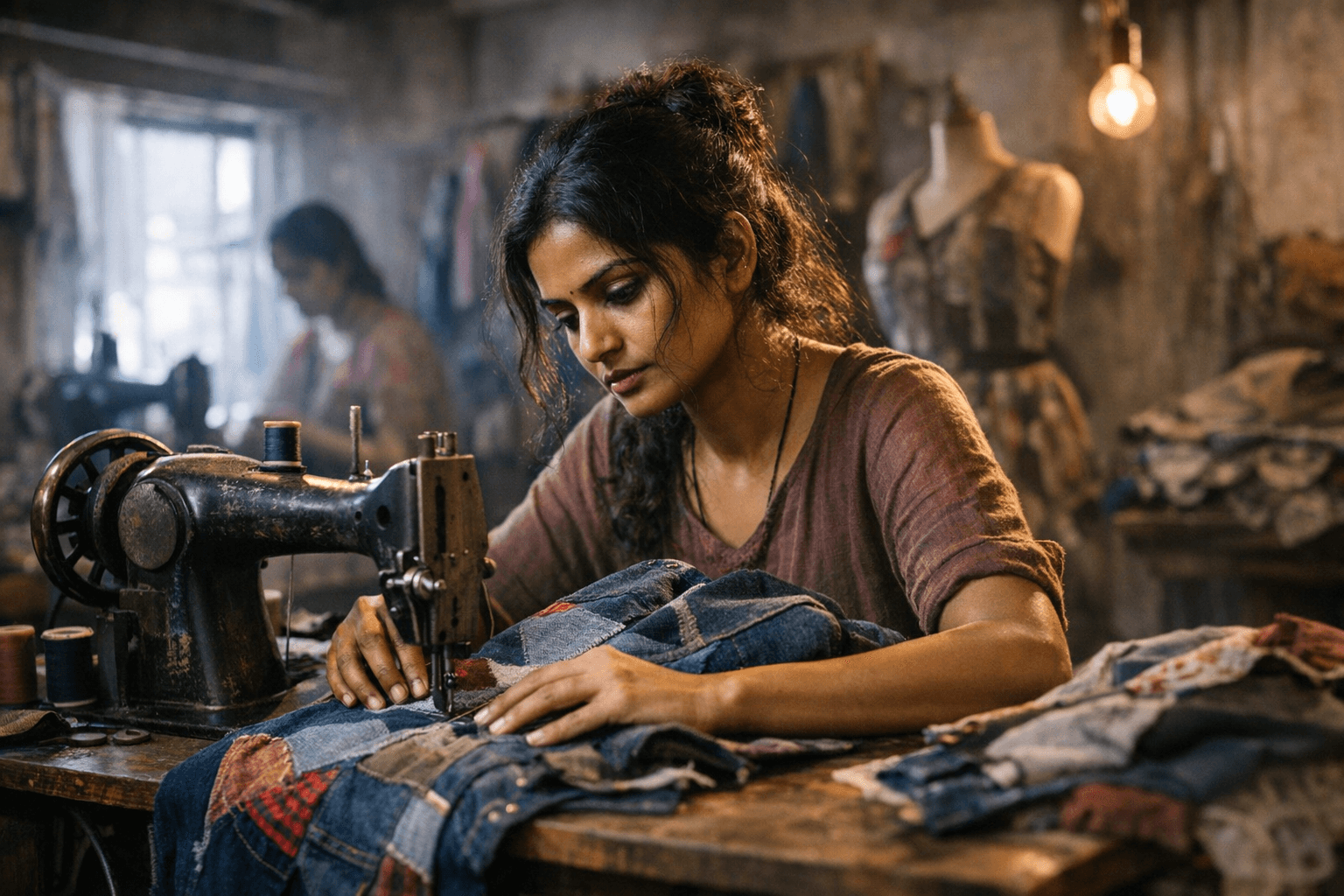
There is something quietly radical about a film that treats a needle and thread as instruments of survival. "Butterfly Girl 85," the Malayalam feature drawing attention this week, does exactly that: it positions upcycling not as an aesthetic choice or a trend-cycle talking point, but as the axis around which a woman's creative identity and economic reality revolve. In a moment when sustainable fashion often gets packaged as a luxury proposition, the film's premise cuts against that grain entirely.
A Story Sewn From Necessity
The film's central character turns to sewing and upcycling discarded materials as both a means of income and a form of self-expression. That pairing matters. Too often, narratives around sustainable fashion separate the practical from the poetic: either it's a scrappy survival skill or it's an artisanal cottage industry with a glossy Instagram presence. "Butterfly Girl 85" refuses that split. The protagonist's relationship with discarded cloth is framed as simultaneously urgent and meaningful, the kind of creative practice that emerges when necessity and imagination occupy the same workspace.
This is a premise with deep cultural resonance in Kerala, where textile traditions, tailoring communities, and the rhythms of garment repair have long been woven into everyday domestic life. Upcycling, in this context, isn't imported terminology from a fashion week panel. It's a continuation of something far older: the understanding that fabric holds value beyond its first use, that a torn sari or an outgrown school uniform is raw material, not waste.
What Upcycling Actually Looks Like as Practice
For readers who engage with sustainable fashion as a consumer category, the film offers a useful reframe. Upcycling, at its most elemental, is the practice of transforming discarded or end-of-life materials into something of equal or greater value without breaking them down into raw components. It sits above recycling in the material hierarchy precisely because it preserves the embodied energy already invested in spinning, weaving, and finishing a fabric.
In practice, this ranges considerably:
- Restructuring vintage or worn garments into new silhouettes, taking a dated blazer and stripping it to its lining and interfacing to build something entirely different
- Patchwork construction, where offcuts and remnants are assembled into new textile panels, each piece carrying its own wear history
- Embellishment and surface reworking, where staining or damage is addressed through embroidery, appliqué, or dye, turning a flaw into a focal point
- Deconstruction and reassembly, where multiple discarded pieces are combined so thoroughly that the origin garments become unrecognizable
What "Butterfly Girl 85" appears to understand is that these aren't craft hobbies. For the communities in which they're practiced at scale, they represent a genuine economic model and one with considerably lower barriers to entry than starting a brand from scratch with new materials.
The Economics Beneath the Aesthetics
Fashion's sustainability conversation has a tendency to focus on the premium end: organic cotton certifications, deadstock fabric lines, small-batch production with transparent supply chains. These matter, but they presuppose capital. The upcycling economy that the film's protagonist inhabits operates on a different set of inputs. The raw material is, by definition, already abundant and low-cost because it's been discarded. The primary investment is skill, time, and the imaginative capacity to see potential in what others have written off.
This is not a minor distinction. In regions where garment workers and independent tailors operate outside formal fashion industry structures, upcycling offers a path that doesn't require minimum order quantities, fabric supplier relationships, or import logistics. A woman with a sewing machine and access to secondhand markets or textile waste streams can build a practice and a livelihood from the seams outward.
The film's framing of upcycling as an "economic lifeline" is, in this sense, entirely accurate to how the practice functions for millions of people globally, particularly women in the Global South, who have long transformed textile waste into income without the benefit of being called sustainable designers.
Why Cinema Is the Right Vehicle for This Conversation
Fashion journalism and industry reporting can cover upcycling statistics and waste tonnage figures, but cinema does something different. It sits with the emotional texture of the work: the hours at a machine, the decisions made at the cutting table, the specific satisfaction of a garment that has been remade into something that fits a body and a moment it was never originally intended for.
Malayalam cinema, in particular, has shown a consistent willingness to center women's labor and interiority in ways that larger industry productions often sidestep. A film like "Butterfly Girl 85," which places a woman's hands, her skill, and her resourcefulness at the center of the story, participates in a longer tradition of regional Indian cinema that treats domestic and creative work as worthy of serious narrative attention.
The title itself carries something worth sitting with. "Butterfly" suggests transformation, the metamorphic logic of taking one thing and becoming another. "85" anchors it, a specificity that resists the vague romanticism that sustainable fashion stories can sometimes drift into. Together, they suggest a story that is interested in the precise mechanics of change, not just its symbolism.
What This Means for How We Talk About Sustainable Fashion
The film arrives at a moment when the sustainable fashion industry is genuinely reckoning with whose sustainability story gets told. The dominant narrative has centered Western brands pivoting toward circularity, influencers documenting thrift store hauls, and designers presenting upcycled collections at fashion weeks. These are real and sometimes meaningful developments. But they represent one thin layer of a much larger global practice.
"Butterfly Girl 85" redirects attention toward a protagonist for whom upcycling is not an ethical upgrade to a pre-existing comfortable consumption pattern. It is the pattern. The fashion choices available to her are shaped by what she can find, what she can transform, and what her hands can make. That is a fundamentally different relationship with clothing than the one most sustainable fashion content addresses, and it is, arguably, the more instructive one.
Cinema has always had the capacity to make visible what policy papers and trend reports cannot: the lived experience of a practice, its weight, its texture, its stakes. If "Butterfly Girl 85" reaches the audiences it deserves, it may do more to shift how people understand the creative and economic logic of upcycling than a hundred sustainability reports. The most powerful argument for circularity in fashion has never been a carbon calculation. It's always been a woman who knows exactly what to do with a piece of cloth that everyone else has thrown away.
This article was produced by Prism’s automated news system from verified source data, official records, and press releases, then run through automated quality and moderation checks before publishing. The system is built and supervised by the people who set the standards it runs under. Read our full AI policy.
Did this article answer your question?