OECD warns scaling textile-to-textile recycling poses labour, environmental and governance risks
OECD warns scaling textile-to-textile recycling risks labour and governance harms as more than 90% of recycled fibres come from PET bottles while polyester T2T is only about 2%.
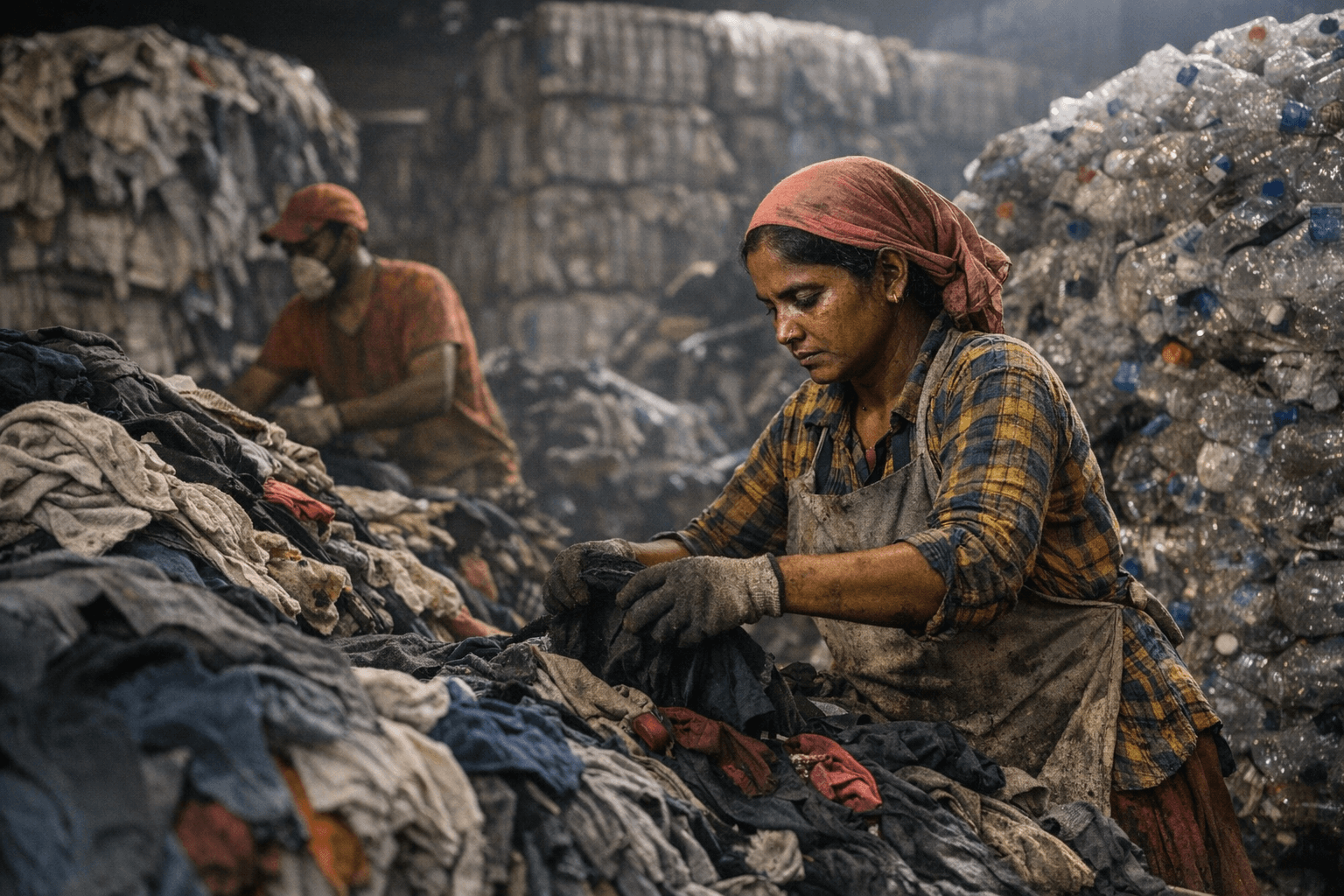
The OECD’s 2026 guidance, DUE DILIGENCE ON RECYCLING PROCESSES IN THE GARMENT AND FOOTWEAR SECTOR, warned that scaling textile-to-textile recycling brings labour, environmental and governance risks and that key recycling steps - “sorting, and cleaning, and often produce lower-quality fibres unsuitable for high-performance or long-lasting products.” That blunt framing sits uneasily next to industry pledges to cut virgin-fibre use.
The numbers underline why fashion’s circular rhetoric feels premature for now. Shenglufashion reports the market share of recycled fibers was approximately 7.6% of total textile-fibre production in 2024, but “of all recycled fibers, more than 90% was recycled polyester made from open-loop plastic bottles and less than 10% from actual post-consumer textiles.” The OECD also cites Textile Exchange’s 2025 estimate that “Polyester textile-to-textile recycling is estimated to account for around 2% of all recycled polyester content (Textile Exchange, 2025).” Global Fashion Agenda and PerformanceDays put the core problem in starker relief: “Despite this momentum, less than 1% of textile waste is recycled into new fibres, and there is no evidence of a sharp change in growth rate,” and “Less than 1% of textiles are recycled into new textiles, with most recycled polyester still sourced from PET bottles not garments.”
The technical contours are as varied as fabric hand-feel. PerformanceDays notes mechanical recycling suits cotton and wool, while synthetics such as polyester and nylon need thermo-mechanical, chemical or enzymatic methods and polyamide recycling is “still in early stages of development.” Blends, coatings and elastane remain persistent barriers. Fashion for Good’s 2022 study, cited by the OECD, shows a further hurdle: revenue for sorters comes primarily from the top-quality 30% of textiles, even though the same study found 74% of non-rewearable and low-value rewearable textiles could technically serve as feedstock.
Labour and governance risks are not abstract. Shenglufashion flags that “In Dhaka alone, around 100,000 women and children work as informal waste pickers,” and it warns that “For fashion brands and retailers that source clothing made with recycled textile materials, this means that due diligence must go beyond traditional Tier 1 or Tier 2 suppliers to include waste and recycling networks.” The OECD cites academic work on resource recovery and migrant labour, signalling that scaling recycling without robust oversight could redistribute harms to invisible and informal actors in places like Bangladesh’s ready-made garment economy.
Policy shifts are forcing the industry’s hand. The EU’s Ecodesign for Sustainable Products Regulation, the revision of the Waste Framework Directive and the expansion of Extended Producer Responsibility schemes will mandate separate collection of textiles, “require sorting prior to export to prevent misclassification of waste as reusable goods,” and “shift the financial responsibility for end-of-life management to producers.” Shenglufashion warns these changes are likely to raise compliance costs and demand greater traceability throughout supply chains, including post-consumer waste.
Brands and alliances are responding: IKEA adopted eight circular design principles in 2024; ASOS, BESTSELLER, H&M and Zalando formed a Circular Design Consortium in 2023; H&M and Vargas Holding launched Syre in 2025 to scale textile-to-textile recycled polyester; and G-Star Raw issued a 2025 sustainability strategy. Global Fashion Agenda cites McKinsey modelling that current technologies could potentially deliver 75% textile-to-textile recycling by 2035 with an additional 5% feedstock from other industries, but it also warns “the system faces a chicken and egg marketplace challenge; the system cannot scale capacity without demand, but the demand can’t be generated without capacity.”
PerformanceDays presses a pragmatic agenda: “What’s needed now is coordinated investment in scalable infrastructure, fiber-specific technologies, and transparent data systems to make textile-to-textile recycling a viable reality,” alongside trusted standards such as Cradle to Cradle Certified® and the Recycled Claim Standard to verify recycled content and traceability. The OECD’s conclusion is clear: scaling recycling is possible, but unless investment, certification and due diligence extend to the sorting floors and informal collectors who currently supply feedstock, the industry risks trading one set of fast-fashion derivatives for another - cheaper recycled fibres that fail to hold shape, cost, and social responsibility.
This article was produced by Prism’s automated news system from verified source data, official records, and press releases, then run through automated quality and moderation checks before publishing. The system is built and supervised by the people who set the standards it runs under. Read our full AI policy.
Did this article answer your question?


