Paris atelier turns antique lace into one-off sustainable pieces
Antique lace gives Les Fleurs Studio its poetry, but also its limits. María Bernad’s Paris atelier shows circular fashion at its most exquisite and most rare.

Paris is where María Bernad has turned antique lace into a delicate argument about fashion’s future. At Les Fleurs Studio, centuries-old textiles are not treated as relics but as raw material, cut into one-off pieces that feel intimate, scarce and deeply considered. The tension is the point: this is sustainable fashion as preservation, but also as privilege, because the supply of old fabric is shrinking even as the appetite for romantic upcycling grows.
A rare kind of circularity
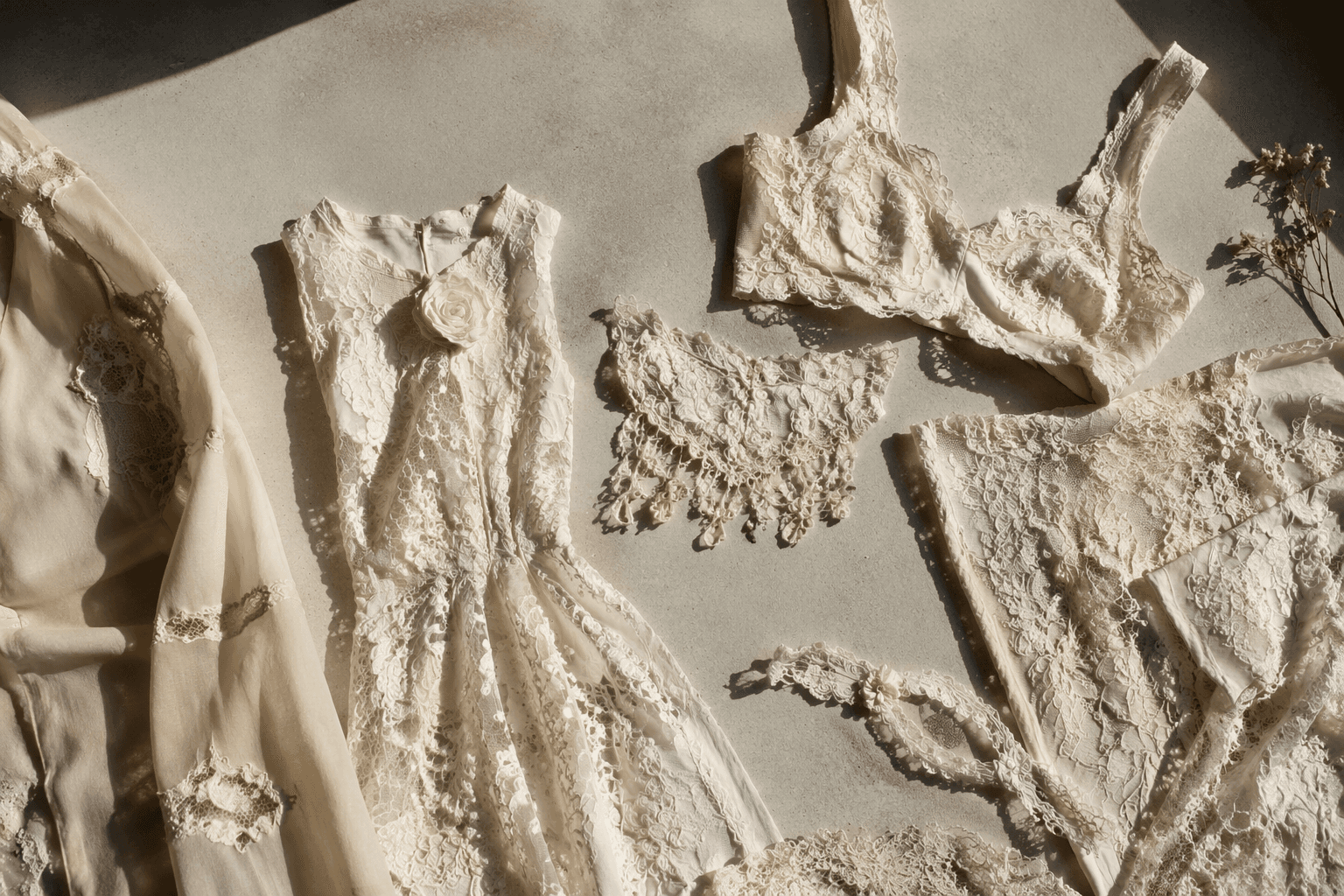
Bernad founded Les Fleurs Studio in 2019 as an upcycled project, and the label still reads like a love letter to salvage done with discipline. The brand describes its Paris atelier as operating from a zero-waste philosophy, building one-of-a-kind pieces from vintage European textiles from the 19th and 20th centuries. FashionUnited says Bernad’s workshop goes even further back, using fabrics from the 18th, 19th and 20th centuries, which makes each garment feel less like seasonal product and more like an archaeological recovery.
That is what makes the collection distinctive: it is not upcycling in the casual, patchwork sense. It is couture-minded editing, where the material itself dictates the design language. Lace, corsetry, floral embellishment and tailoring details are not simply decorative flourishes here. They are the structure of the story.
Why lace still carries so much charge
Lace has always arrived with social meaning stitched into it. The Metropolitan Museum of Art notes that high-quality lace in Europe from 1600 to 1800 was extremely expensive and subject to sumptuary legislation, the kind of rules that tell you how closely fashion once tracked wealth, rank and access. That history still clings to the fabric today, which is part of why antique lace can feel so emotionally loaded on a modern runway or in a carefully styled editorial spread.
There is also a labor history in the thread. A 2023 Oxford Academic article on French lacemaking describes how nineteenth-century production continued through a putting-out system and involved tens of thousands of women working from home. That matters because old lace is not just precious for its delicacy. It is precious because it carries evidence of a whole economy of hands, households and inherited skill. When Les Fleurs Studio reworks these materials, it is not only recycling cloth. It is handling the residue of a long European textile culture.
Scarcity is the real headline
Bernad has said the method is niche because old fabrics are increasingly hard to source, and that scarcity is the crucial pressure point in any serious conversation about circular luxury. Upcycling sounds scalable until you ask where the material comes from, who can access it and how much of it still exists in usable condition. Antique lace is beautiful, but beauty is not a supply chain.
That is why this kind of work sits in a narrow lane between sustainability and connoisseurship. It relies on scavenged, surviving textiles rather than industrial quantities of recycled input. There is value in that, but also a limit. The model cannot easily become mass production without losing the very irregularity that gives it meaning. In other words, it is a compelling template for how to treat deadstock and historic remnants with care, but it is unlikely to become a universal answer for fashion’s waste problem.
How Les Fleurs makes provenance part of the appeal
The strongest proof of the atelier’s method is in the product pages themselves. Les Fleurs Studio lists pieces made from 1920s corsets, embroidery fabric dresses, 19th-century floral headpieces, antique lace veils and Victorian jackets. That range tells you the brand is not working with a single archive or a single decade. It is moving across eras, collecting fragments that can be recut into garments with an almost theatrical sense of provenance.
This specificity matters because provenance is one of the few ways a customer can understand the difference between generic vintage styling and true material reclamation. A veil made from antique lace feels different from a “lace-inspired” piece in new fabric. A jacket built from Victorian material carries a different charge from a garment that merely borrows a silhouette. The era is part of the aesthetic. It is also part of the value.
FHCM describes Les Fleurs as a Paris-based pre-à-couture house making one-of-a-kind pieces from recycled materials, which places Bernad’s work closer to artistic craft than to conventional ready-to-wear. That framing is apt. These pieces are less about wardrobe volume than about singularity, and singularity has always been the currency of fashion’s most persuasive objects.
Why the lace resurgence matters now
Les Fleurs Studio is moving in step with a broader fashion return to lace. FashionUnited notes that lace is once again prominent in fashion, and that the trend was identified by Pinterest Business using millions of user signals. That kind of data does not create taste on its own, but it does confirm what the market already feels: consumers are reaching for texture, softness and visible handiwork after years of minimalism and technical sheen.
In that context, Bernad’s atelier feels timely without being trendy. The lace resurgence gives the work visibility, but the real distinction is the restraint behind it. These are not garments made to flood a feed. They are made to hold attention up close, where the irregularity of antique material, the fragility of the weave and the precision of the cut can actually be seen.
What this model can, and cannot, prove
The lesson of Les Fleurs Studio is not that every brand should start sewing antique lace into new garments. That would miss the point entirely. The more useful takeaway is that fashion can treat old material as something beyond inventory, something with lineage, emotional weight and a legitimate place in contemporary design.
Still, this is a romantic exception, not a complete system. It works because Bernad is operating at a scale where rarity can be an asset and every piece can justify its existence. For modern sustainable fashion, the broader lesson may be less about copying the exact model and more about respecting the logic behind it: source carefully, waste less, and let material history shape the final form. In a market full of disposable novelty, that kind of scarcity feels almost radical.
This article was produced by Prism’s automated news system from verified source data, official records, and press releases, then run through automated quality and moderation checks before publishing. The system is built and supervised by the people who set the standards it runs under. Read our full AI policy.
Know something we missed? Have a correction or additional information?
Submit a Tip