Rivers and Coastal Sediments Trap Most Textile Microfibers Before Reaching Open Ocean
80% of polyester microfibers from your laundry never reach the open ocean, trapped instead in rivers and estuaries, a new study in the Salish Sea finds.
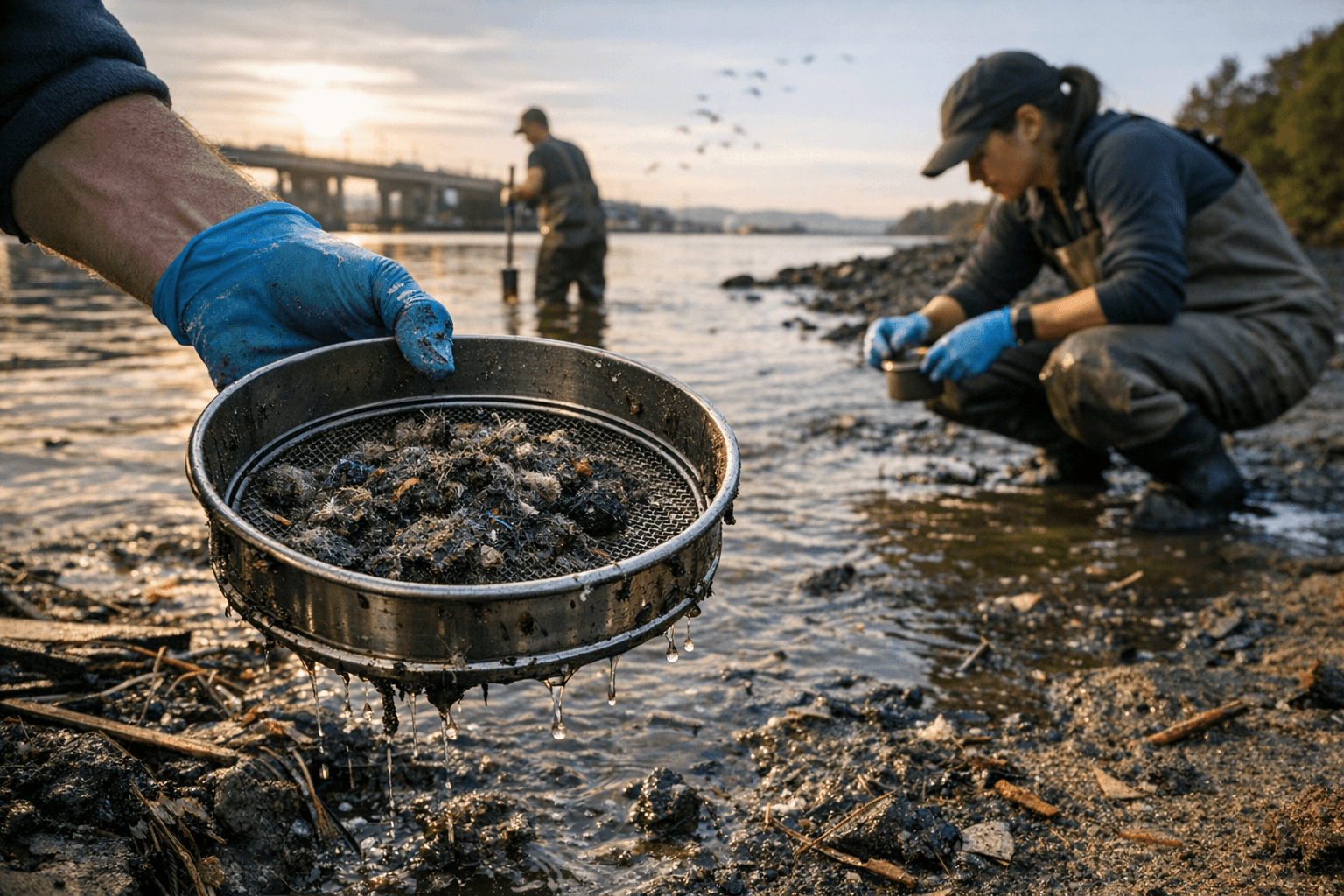
Up to 80% of polyester microfibers released from wastewater treatment plants in the Salish Sea, a network of coastal waters spanning British Columbia and Washington state, are caught close to shore in rivers, estuaries, and shallow bays before they can drift into the open ocean. That number, produced by a computer transport model published in the Journal of Geophysical Research: Oceans under lead author J. Valentí-Muelas, reframes where fashion's microplastic problem actually lives.
Every time a load of laundry runs, tiny polyester fibers escape from clothes and slip down the drain. These microfibers, so small they can be invisible to the naked eye, are among the most common forms of microplastic in the ocean. The prevailing anxiety in sustainable fashion has centered on that final destination: deep sea sediment, marine life, the food chain. But this study draws attention to a more immediate geography.
The researchers used a computer model to track how polyester microfibers move and settle in the Salish Sea's coastal system, simulating transport under different settling conditions. Slower-settling fibers traveled farther, while faster-settling fibers accumulated near their source. Narrow basins and deep channels functioned like traps, retaining large quantities of fibers in sediment and along beaches.
Only about 0.13% of released fibers ultimately reach the open ocean, with local hydrodynamics influencing their distribution. The geography matters: fibers released in fast-moving coastal areas like the mouth of Juan de Fuca Strait traveled farther than those from slow-moving estuaries like Puget Sound, emphasizing how local hydrodynamics shape microfiber pathways.
The findings complicate but do not soften fashion's fiber problem. Even with high retention near their sources, microfibers don't disappear. Sediments can act as long-term reservoirs, releasing fibers back into the water during storms or strong tidal events. Coastal sediments and beaches act as long-term reservoirs, highlighting the need for targeted pollution management.
Napper and Thompson estimated that 6 kg of clothing releases over 700,000 microfibers during a single laundry cycle, a figure that puts the scale of the problem in tactile terms. That polyester fleece pullover, that performance running kit, that fast-fashion jersey knit: every wash cycle sheds invisibly into the water system.
These findings are important because they help identify where microfibers are most likely to accumulate and can guide targeted monitoring and cleanup efforts. For the fashion industry, that translates to a sharper argument for source-level intervention: tighter fabric constructions, laundry filtration technology, and upstream design decisions that reduce shedding before a single fiber ever reaches a drain. The coast, it turns out, is catching what the runway sends down the drain.
This article was produced by Prism’s automated news system from verified source data, official records, and press releases, then run through automated quality and moderation checks before publishing. The system is built and supervised by the people who set the standards it runs under. Read our full AI policy.
Did this article answer your question?


