Shanghai Fashion Week Elevates Heritage Crafts Into Modern Design
Shanghai Fashion Week is turning craft codes into modern runway language, but the real test is whether that beauty builds lasting support for makers and lower-impact production.
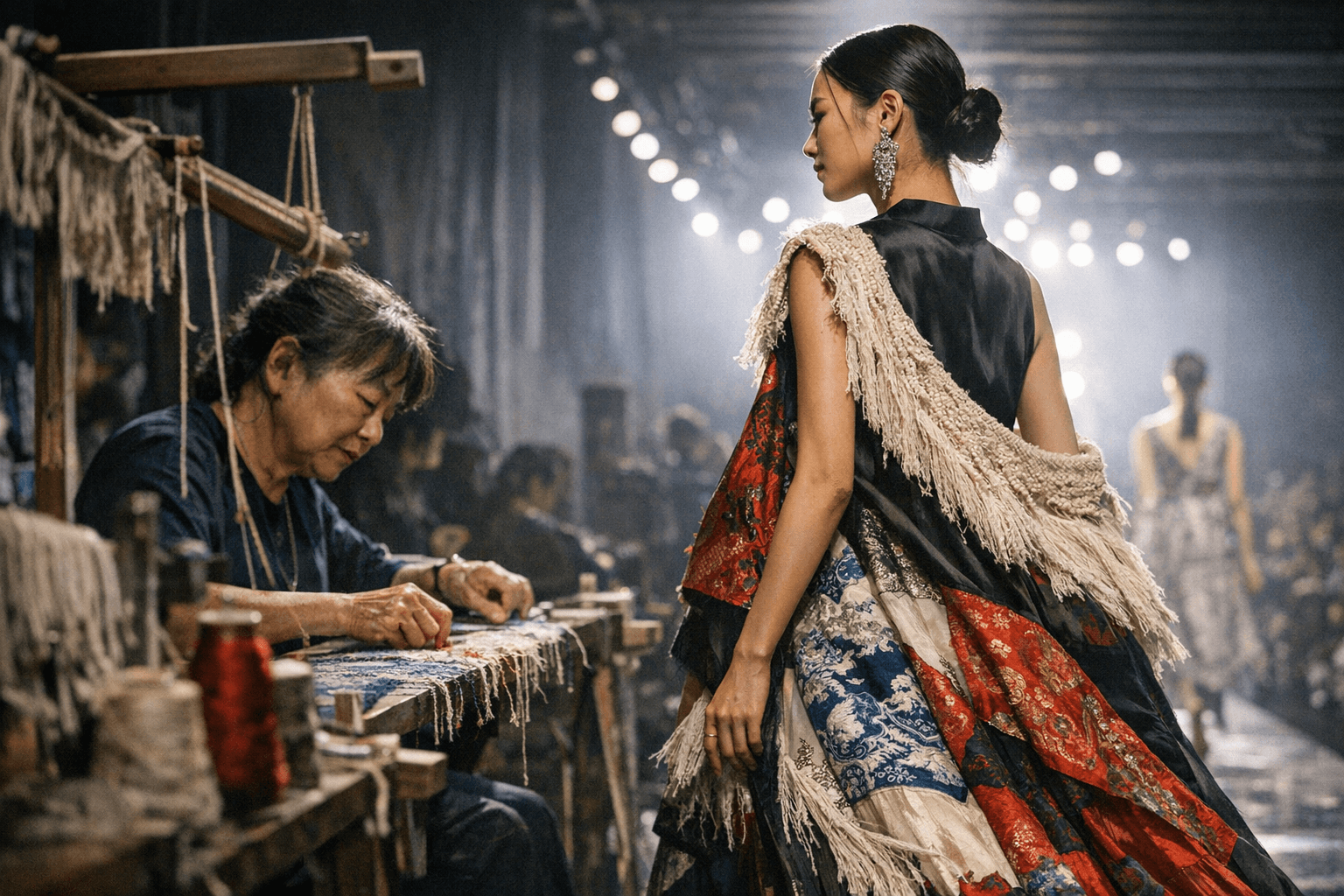
Heritage, worn as a living language
Shanghai Fashion Week’s most interesting clothes do not treat heritage like a museum label. They turn black clay, white porcelain, denim, frog buttons and silk into a working vocabulary, with designers translating local material memory into silhouettes that feel current, sharp and export-ready. The result is not costume. It is a distinctly Shanghai way of making the past look usable again, in jackets that sit close to the body, skirts that move with authority and details that read as craft before they read as decoration.
That distinction matters. Heritage on a runway can become a mood board exercise, all surface and no afterlife. Here, the stronger collections suggest something more deliberate: local references recast as design intelligence, where texture, closure and finish carry as much meaning as print or embellishment. Frog buttons, for instance, are not merely quaint, they can become a quiet architectural gesture; silk, when handled with discipline, brings softness without slackness; and porcelain or clay references can sharpen a garment’s visual line rather than flatten it into theme dressing.
A fashion week built to do more than stage shows
Shanghai Fashion Week was founded in 2003, and its official mission has always balanced local roots with an international outlook. It is held twice a year and runs on a familiar fashion-week engine of runway presentations, trade exhibitions and industry networking, but the commercial side is not an afterthought. The platform is designed to help brands expand market influence and strengthen links across the supply chain, which gives its heritage storytelling a much bigger stake than aesthetic novelty alone.
That structure makes Shanghai particularly interesting in a sustainability conversation. When a fashion week is built to connect design, sales and manufacturing, craft references are not just visual cues for editors and buyers. They can become signals of where a brand sources, whom it employs and how much of its value stays close to home. In the best case, the runway becomes the public-facing edge of a more durable regional ecosystem.
The 2026 season spread the message across the city
The Autumn/Winter 2026 season opened on March 25, 2026 and unfolded across Huangpu District, Jing'an District and Pudong New Area, with venues including Xintiandi, Yongyuan Road and Yandang Road. That citywide spread matters because it turns fashion week into a geographic argument as much as a stylistic one. Shanghai is not using heritage as a single enclosed theme; it is staging it across districts, streets and commercial zones, as if to say that local identity should be visible in the city’s everyday fashion economy, not only inside a runway tent.
The official schedule also included a sustainability space, which is exactly where this conversation belongs. Sustainability is too often treated as a side aisle at fashion events, a polite annex to the real action. Here, it sits inside the program, alongside the business machinery and the cultural spectacle. That placement suggests the industry understands at least one hard truth: if heritage is going to matter beyond images, it has to be linked to how collections are made, not only how they are presented.
Why Shanghai’s industrial depth changes the stakes
Shanghai is not simply a stylish backdrop. Around 70 creative industrial parks in the city host design and creative institutions from more than 30 countries and regions, a scale that helps explain why heritage-led collections can travel so well here. The city government’s description of Shanghai as an international fashion cluster is more than civic branding. It points to a system where cultural identity, retail traffic and exportable brand value are all being pulled into the same orbit.
That system is what gives local craft a second life. Black clay and white porcelain are not just references to tradition; they become shorthand for a city that wants to convert material history into market power. Denim, meanwhile, anchors the conversation in contemporary wardrobes, making the old feel structurally relevant rather than merely decorative. The most convincing designers understand that a regional story only becomes globally legible when it is cut into pieces people can actually wear.
From aesthetic storytelling to support for makers
This is where the optimism should be held to account. Heritage styling is compelling, but it only becomes meaningful sustainable fashion if it supports artisans, regional supply chains and lower-impact production methods. A beautifully referenced sleeve means little if the craft it invokes is not paid for, transmitted or protected. The question Shanghai Fashion Week keeps raising, intentionally or not, is whether the city’s appetite for local identity can be turned into a longer-term industrial commitment.
There are reasons to think the answer could be yes. In late 2025, Shanghai Fashion Week and Kering launched Kering CRAFT to support a new generation of Chinese designers through a Creative Residency for Artisanship, Fashion and Technology. That kind of initiative matters because it links design development to skills, experimentation and institutional backing rather than short-lived trend cycles. It also signals that the conversation around Chinese fashion is moving beyond visibility toward infrastructure.
What to watch in the craft-forward Shanghai model
The strongest takeaway from Shanghai Fashion Week is that heritage is no longer being treated as a backward glance. It is being used as runway styling, commercial strategy and cultural positioning all at once. That can be thrilling when the work is precise, when silk is handled with restraint, when buttons are chosen as design statements and when porcelain-inspired surfaces feel disciplined rather than decorative.
The harder question is what survives after the lights go down. If the city’s craft references help keep artisans in business, strengthen regional production networks and reward lower-impact methods, then Shanghai Fashion Week is building a model other fashion capitals will want to study. If not, the beauty still matters, but it remains only half the story. The real measure of success is whether heritage here becomes a living practice, not just a polished image on the runway.
This article was produced by Prism’s automated news system from verified source data, official records, and press releases, then run through automated quality and moderation checks before publishing. The system is built and supervised by the people who set the standards it runs under. Read our full AI policy.
Did this article answer your question?


