Spotlight on Global Sustainable Labels Driving Material Innovation and Circularity
A short roll call of brands and innovators, Stella McCartney, Modern Meadow, MycoWorks and Climeworks, who are turning lab-grown collagen, mushroom leather and carbon removal into the next generation of high-fashion materials.
1. Stella McCartney
Stella McCartney has moved beyond advocacy into institutional influence, recently appointed ambassador to King Charles’ Sustainable Markets Initiative and arriving at London Fashion Week with a sustainably sourced cashmere scarf as a visible emblem of that partnership. Her collections still read like careful architecture, clean tailoring and fluid coats, but the point of style now doubles as supply-chain proof: visible, wearable commitments to traceable raw materials. In practice that means replacing leather, reformulating cashmere procurement and using high-profile moments to make circularity fashionable rather than purely technical.
2. Modern Meadow
Modern Meadow is one of the biofabrication pioneers translating cellular biology into fashion-grade textiles, focusing on lab-grown collagen as an alternative to animal hides. The appeal to designers is practical, the material can be engineered for specific hand, thickness and finish, while the climate argument is that it sidesteps traditional livestock emissions and land use. For editors and buyers, the texture matters: Modern Meadow’s materials aim for the same suppleness and tensile strength leather demands, which makes them immediate contenders for structured jackets, accessories and footwear where performance is non-negotiable.
3. MycoWorks
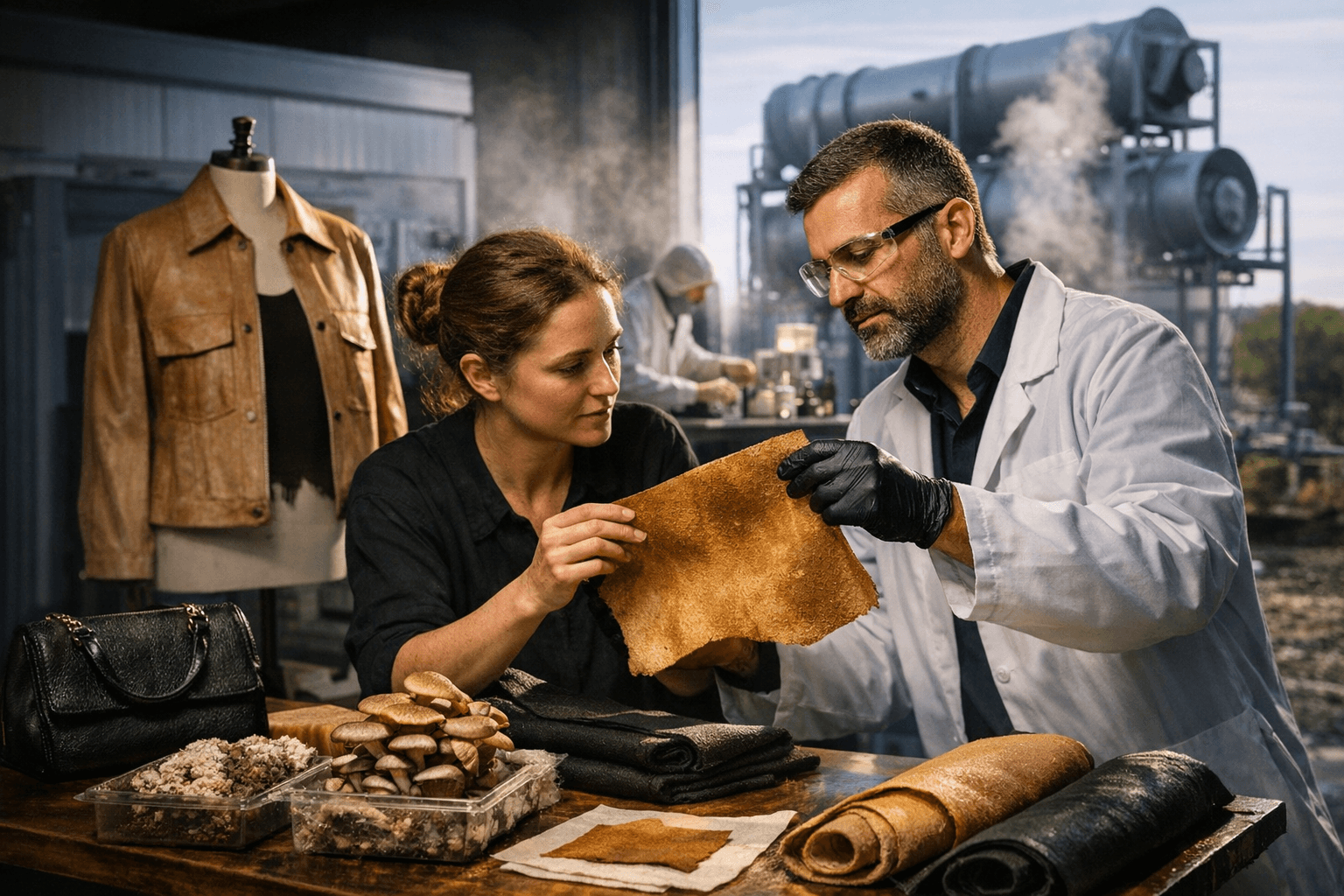
MycoWorks has taken mycelium, the root structure of fungi, and refined it into a leather-like material with a remarkably convincing hand and grain. The company’s Fine Mycelium platform is designed to be tunable, so manufacturers can ask for different weights and finishes for bags, outerwear or structured garments. Crucially for circularity, mycelium materials are biologically based and can be integrated into closed-loop systems more easily than mixed-fiber synthetics; that makes them attractive to labels who want both the look of luxury leather and a believable end-of-life story.
4. Climeworks
Climeworks operates outside the atelier but squarely within the ledger: direct air capture companies like Climeworks are becoming part of fashion’s toolkit for managing residual emissions. When high-end houses pair material innovation with carbon removal purchases, they create a two-pronged claim, reduced upstream impact plus quantified removals downstream, which matters to corporate sustainability teams and regulators alike. For designers, this allows riskier material experiments to proceed while brands work to balance their net emissions in ways that are measurable and marketable.
5. Sustainably sourced cashmere initiatives
Cashmere remains a tactile and political battleground: the sustainably sourced cashmere scarf that appeared in recent shows is emblematic of a broader push toward traceability, herd management and regenerative grazing practices. Labels are increasingly demanding farm-level traceability and certifications that track fiber from goat to garment, and that pressure is pushing merchants and mills to publish origin data and better prices for producers. For shoppers, the difference is felt in the scarf’s weight and warmth, properly sourced cashmere has a distinct loft and softness, and in the knowledge that fragile ecosystems and rural herders are part of the economic equation, not incidental.
6. Collaborative supply-chain platforms and certification partners
Material innovation only scales when designers, mills and investors work on common standards, platforms and certification partners are the connective tissue. Whether it’s verification of mycelium processes, lab-grown collagen scalability or verifying regenerative cashmere claims, these third-party systems create the commercial confidence for luxury labels to commit larger orders and premium price points. That dynamic is why fashion weeks and trade shows now host technical briefings as regularly as runway shows; buyers need to know tensile strength, dye stability and repairability before grid-buying a season’s worth of jackets.
7. What designers are actually doing on the runway
Fashion’s most persuasive statements occur when concept and craft meet: designers are not just spotting alternatives, they are tailoring them. Expect mycelium panels used in boxy blazers, lab-grown collagen trims on structured bags and cashmere pieces with repair patches or modular hems to extend useful life. These are not mere eco-signals, when a material holds a seam, presses crisply and wears well, it earns its place in a collection. The runway is thus becoming a testing ground for technical performance as much as for visual surprise.
8. Barriers to scale and the economics of change
Innovation is aesthetic and expensive: biofabricated and mycelium leathers currently carry a cost premium relative to commodity synthetics and conventional hide. Manufacturing scale, regulatory hurdles around bio-based production, and the need for new finishing labs all slow adoption. That said, when high-visibility designers like Stella McCartney tie their brand equity to these materials and larger partners like Climeworks shoulder part of the climate accounting, the collective market signal accelerates investment and manufacturing scale-ups, exactly the economic nudge needed to move a niche lab product toward industrial output.
9. What this means for shoppers and wardrobes
For the style-minded buyer, the immediate impact is tactile: expect new leathers that feel less processed, scarves and knitwear that come with provenance data, and outerwear designed to be repaired rather than discarded. Price will remain a gating factor, but resale and repair services bundled by brands are beginning to change the total-cost-of-ownership calculus. Practically, that means a cashmere coat bought today with traceable origins and a repair program is a smarter long-term purchase than a cheaper, unlabeled alternative.
10. The near-term outlook: convergence, not replacement
The most important shift is convergence: no single material will replace leather, cashmere or nylon overnight. Instead, expect hybrid strategies, biofabricated panels with recycled linings, mycelium accents on classic silhouettes, offsetting residual emissions with verified removals, to define the next five fashion seasons. The market test will be whether these materials deliver the sensory and longevity standards luxury customers expect while offering transparent, auditable claims about supply chains and climate impact. If the recent appointments and product reveals are any guide, fashion’s top tier is betting on that convergence to make sustainability both desirable and saleable.
Conclusion The future of luxury is less about purist substitution and more about engineering a responsible product story: designers who pair tactile innovation with traceability, backed by verification and carbon solutions, are the ones shaping a new standard for how clothes are made, worn and eventually returned to the cycle.
This article was produced by Prism’s automated news system from verified source data, official records, and press releases, then run through automated quality and moderation checks before publishing. The system is built and supervised by the people who set the standards it runs under. Read our full AI policy.
Did this article answer your question?


