Trims Become Fashion’s Biggest Barrier to Circular Recycling
Trims are the tiny parts killing circular recycling. Zippers, labels, and elastics now decide whether a garment gets recovered, recycled, or rejected.

The trim trap
A garment can look ready for a second life and still fail at the last inch. Zippers, elastics, labels, thread, tapes, bindings, beads and sequins are turning out to be the tiny wrecking balls of circular fashion, because they can block sorting, deconstruction and preprocessing before textile-to-textile recycling even starts. WWD says trims can make up more than 40 percent of a garment’s bill of materials, which is the kind of number that should make every brand stop treating them like finishing details.
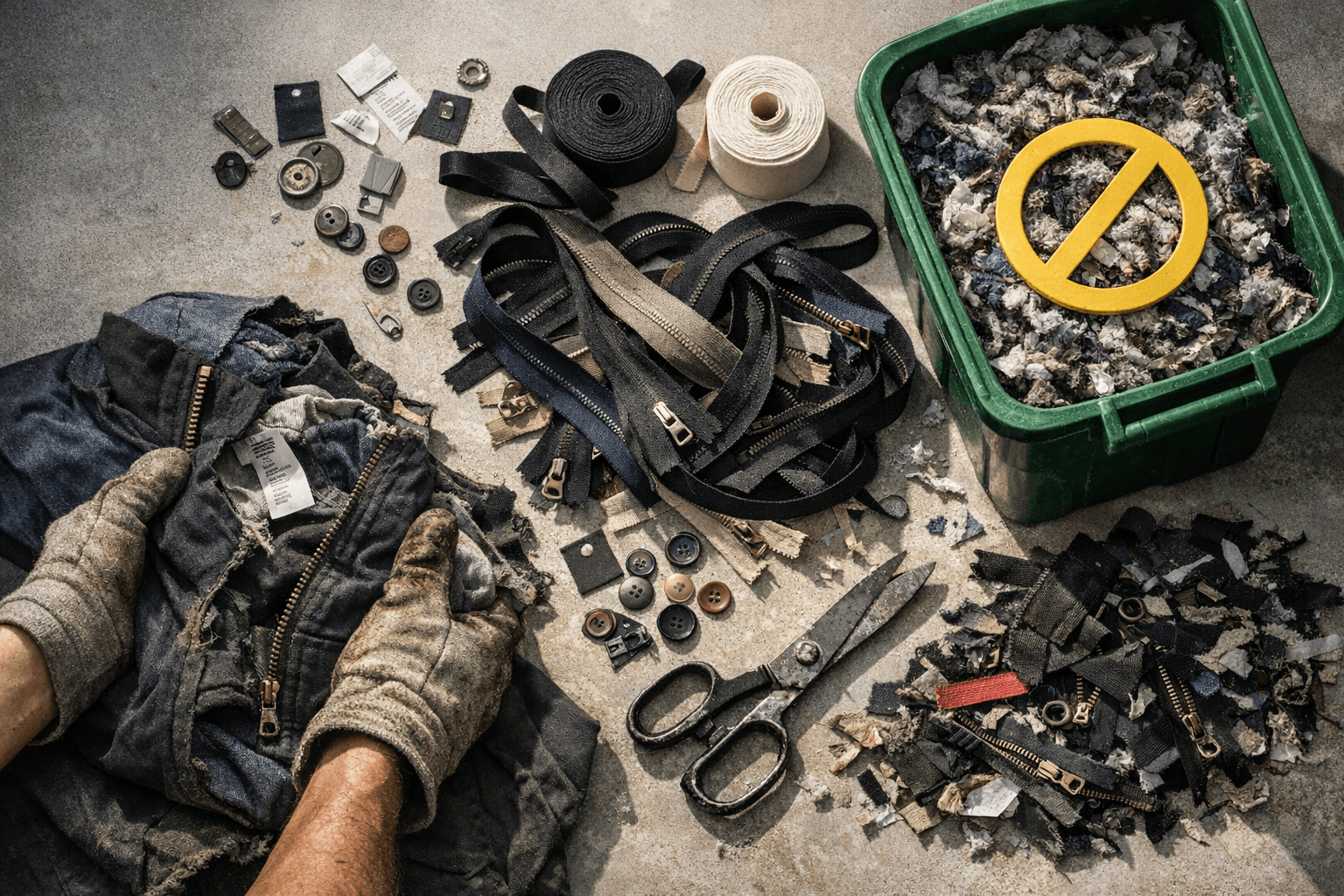
That is the real accountability test now. Brands love talking about fabric innovations, deadstock, and recycled yarns, but the trim stack is where those claims either hold up or collapse. If the zipper is inseparable, the label is unreadable, or the elastic contaminates the fiber stream, the garment is not circular in practice. It is just nicely branded waste.
Why trims break recycling
The circularity problem is brutally physical. Buttons, zippers, fasteners, grommets, thread, tapes, bindings, beads and sequins all create friction in textile-to-textile recycling systems, because they have to be removed, sorted out, or routed around before a feedstock can be processed cleanly. Accelerating Circularity’s Sarah Coulter has pointed out that trims and related materials are among the most common contaminants that have to come out for recycling to work at scale.
Her recovery-rate examples tell the story better than any slogan. A T-shirt with minimal trims can recover at up to 90 percent. Jeans may only recover at 30 to 40 percent. A multi-layer jacket loaded with embellishment can be rejected outright. That is not a minor design issue. That is the difference between a product that feeds a recycling system and one that becomes expensive, contaminated residue.
The industry has spent years optimizing the visible surface of sustainability, mostly fabric content and recycled blends, while the least glamorous components got ignored. That is why trims are suddenly moving from backstage to center stage. They are not decorative. They are infrastructure.
Follow one garment from cuff to collar
Take a jacket, the hardest case in the rack. The outer shell may be recycled polyester, the lining may carry a circularity story, and the brand may point to a traceable supply chain. Then the details hit: a coated zipper, synthetic thread, elastic binding, printed care label, snap fasteners, maybe a woven badge and some decorative hardware. Each piece can be made from a different material family, sourced through a different supplier, and attached with a different method.
That is where current traceability systems often fail. They can tell you what the brand bought, but not always what the recycler will have to remove. They can show broad material claims, yet still leave the physical product riddled with incompatible components. If a system cannot connect the upstream bill of materials to what is actually sitting on the garment, it is only half a map.
The smarter move is design-for-disassembly. That means fewer mixed-material trims, fewer permanent bonds, clearer material labeling, and attachment methods that let recovery teams separate components without destroying the base textile. It also means choosing trims that can either stay in the stream or come out cleanly, not those that poison the process.
Traceability is becoming a compliance issue, not a brand nice-to-have
The data side of trims is getting sharper because regulation is pushing it there. Trimco Group says its ProductDNA platform launched in 2022, and its April 21, 2026 partnership with Retraced ties labeling, packaging, RFID and variable data capabilities to Retraced’s supply-chain intelligence platform. The pitch is simple: connect upstream mapping to the physical product with QR codes that can surface structured information for consumers, retailers and regulators.
That matters because transparency only works when it is usable. Camilla Mjelde, Trimco’s sustainability and compliance director, put it plainly: transparency only creates value when it is accessible, structured and connected to the physical product. That is the standard now. A traceability system that lives in a spreadsheet and never reaches the garment tag is just paperwork with better branding.
Retraced is framing the partnership against rising regulatory complexity and a fragmented ecosystem of overlapping tools. That is not abstract corporate language. The European Union’s Ecodesign for Sustainable Products Regulation entered into force on July 18, 2024, and the Digital Product Passport is moving from concept to compliance architecture. Retraced says rollout will begin by business revenue scale starting in 2024, with full implementation by 2030. For fashion brands, that means the product itself is becoming a data carrier, and trims are part of the compliance story whether teams like it or not.
What a serious trim strategy looks like
The best response is not just more tracking. It is better design, better sourcing, and fewer excuses.
- Specify trims that are recyclable, recyclable-compatible, or easy to remove at end of life.
- Reduce mixed-material construction, especially on zippers, elastics, labels, tapes and decorative hardware.
- Build product data so each trim is visible in the bill of materials, not hidden inside a generic component code.
- Use QR-linked labeling, RFID, and variable data to keep product-level information tied to the physical item.
- Favor attachment methods that support disassembly instead of permanent, contamination-heavy bonding.
This is where standards matter. The field does not need another vague sustainability pledge. It needs consistent trim specifications, removal protocols, and shared definitions for what counts as recyclable, recoverable, or compatible with textile-to-textile systems. Without standardization, every brand becomes its own island and every recycler pays the labor tax.
Harnest is trying to make the trim stack commercial, not theoretical
Harnest’s Responsible Trims Collection is the most practical answer in the mix because it is built like something that is supposed to ship, not just sit in a mood board. The collection includes threads, elastics, drawstrings and drawcords made with recycled materials, regenerated inputs and advanced biodegradable solutions. Harnest says it produced the line within its vertically integrated manufacturing system in Bangladesh, which matters because control over production is where trim innovation stops being a concept and starts becoming repeatable.
The company says its textile-to-textile recycled polyester is designed to replace virgin polyester with less than half the associated CO2 emissions. That kind of swap is only meaningful if it is viable at the price point and performance level brands actually use, and Harnest says the collection is intended to sit at cost parity with conventional options. That is the commercial unlock: sustainability that does not require a luxury surcharge.
The biodegradable side is equally important. Harnest’s biodegradable polymer option is positioned as a drop-in alternative that combines biodegradability, PET recyclability, performance parity and industrial scalability. That combination is rare, because most materials only solve one problem while creating another. Add in partner materials from OceanSafe, Indorama Ventures and Jiaren, and you can see the direction of travel: trims are being rebuilt as a sourcing category, not just a waste problem.
OceanSafe’s naNea material stands out because the company says it is the world’s only synthetic textile material to receive Cradle to Cradle Certified Gold, and that it biodegrades by more than 93 percent in marine environments in 99 days. That is the kind of specification that gives trims a real end-of-life story instead of a recycled-content slogan.
The new standard for circular fashion
The industry used to act like fabrics were the whole game. They are not. Trims decide whether garments can be sorted, dismantled, processed and trusted. They also decide whether brand claims survive contact with the recycler, the regulator and the real world.
That is why trims are no longer a footnote. They are the hidden lever in circular fashion, the place where design, traceability and compliance finally have to meet the same test: can this garment actually come apart, be read, and be made again?
This article was produced by Prism’s automated news system from verified source data, official records, and press releases, then run through automated quality and moderation checks before publishing. The system is built and supervised by the people who set the standards it runs under. Read our full AI policy.
Did this article answer your question?