Vintage and Archival Looks Dominate Red Carpets This Awards Season
Hollywood is raiding the archives, and the red carpet is better for it. This awards season, vintage dressing has become the ultimate style statement.

Something shifted on the red carpet this awards season. Celebrities and their stylists stopped reaching for the newest custom commission and started reaching back, pulling from archives, private collections, and the hallowed racks of vintage stores to arrive at something far more interesting than anything fresh off a current runway. Variety captured the movement precisely: this is not a one-off moment but a visible, accelerating trend redefining what red-carpet dressing means in 2026.
Chandler Guttersen, owner of the celebrity-adored New York City vintage store Vintage Grace, put it plainly in Variety: "In a cycle of constant creative-director turnover and trend fatigue, vintage allows stars to step outside the algorithm and say something original." The fashion industry has spent years cycling through creative directors at breakneck speed, leaving audiences unsure which house stands for what. Against that backdrop, a dress with a clear provenance and a known history carries a weight that no debut collection can replicate. "It's not just about wearing a dress," Guttersen added. "It's about wearing a point of view."
The Golden Globes Sets the Tone
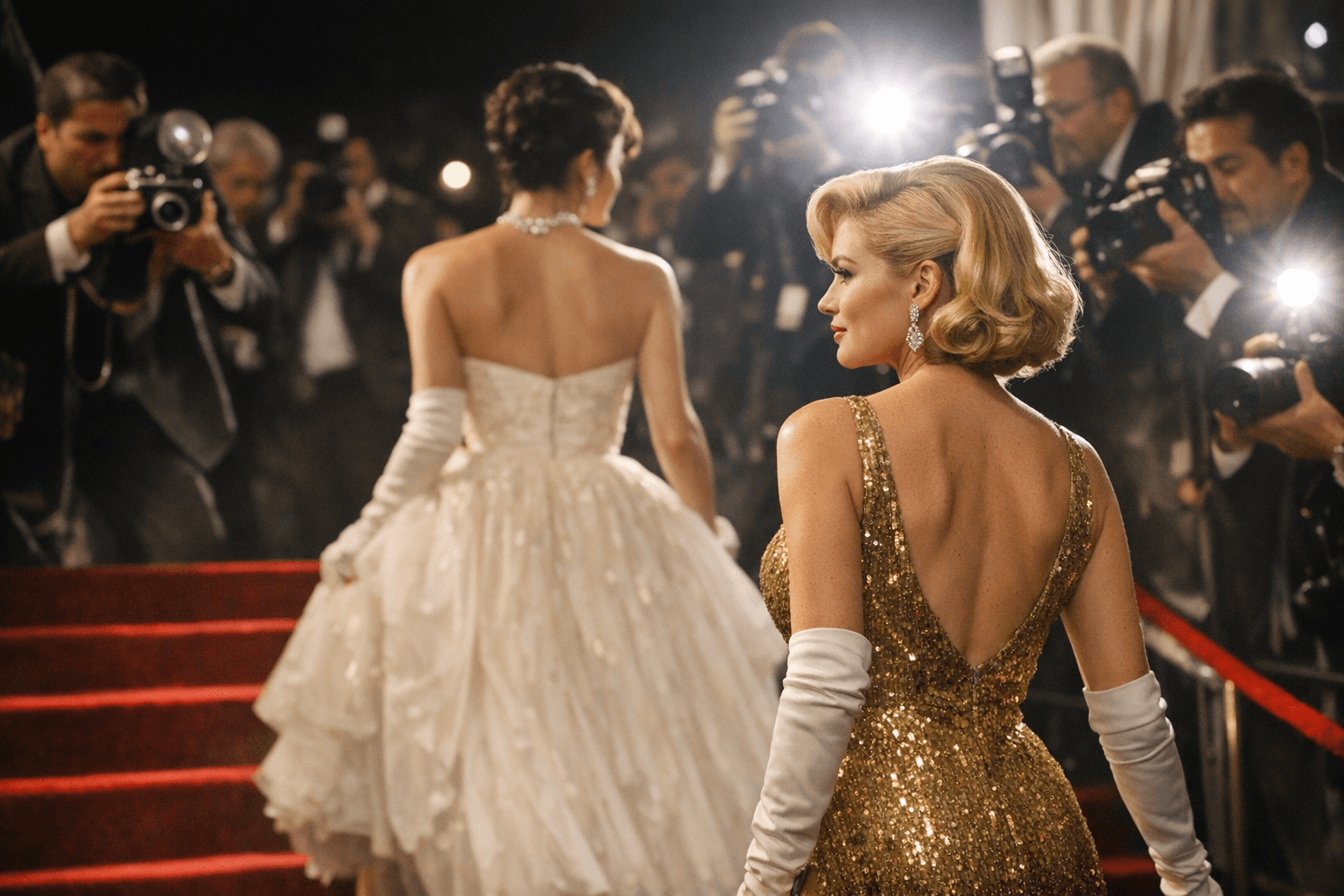
Nowhere was this season's shift more obvious than at the 2026 Golden Globes, held in January at the Dolby Theatre in Los Angeles. The night read like a love letter to Old Hollywood glamour, with several of the evening's most talked-about looks drawn directly from the past.
Odessa A'zion, star of Marty Supreme, arrived in an all-black Dolce & Gabbana look anchored by a vintage feathered, off-the-shoulder bolero jacket. The silhouette was dramatic and deliberately referential, the kind of entrance that makes a room stop. Kate Hudson shimmered beside her in a liquid-silver halter gown pulled straight from the Armani Privé 2007 runway, its molten drape looking as relevant now as it did nearly two decades ago. Jennifer Lopez went furthest back of all, wearing a sheer mermaid gown by Jean Louis Scherrer from 2003, a piece that moves like water and carries the particular authority of a garment that has already outlasted multiple trends. Together, these three looks in a single evening signaled something beyond personal style preference: vintage dressing had arrived as the red-carpet language of the moment.
A History Worth Revisiting
The foundations for this season's archival renaissance were laid by a handful of celebrities who understood early that the red carpet could be a platform for something more considered than newness.
Kim Kardashian offered one of the era's most striking archival moments when she wore a vintage Alexander McQueen "Oyster Dress" from 2003 to the 2020 Vanity Fair Oscars afterparty. The piece was considered a collector's item and had only ever been worn once before, on a runway. Kardashian's choice was a clear departure from her usual custom looks, and it demonstrated that archival fashion carries genuine resale and cultural value. It was, as one account framed it, a big win for second-hand fashion.
That same awards season, Joaquin Phoenix made a quieter but equally deliberate statement: he wore the same black Stella McCartney tuxedo to every major ceremony he attended, including the Oscars, the Golden Globes, and the SAG Awards. The repetition was intentional, and it worked. His commitment to outfit repetition sparked conversations worldwide about reducing fashion waste, particularly in menswear, a category where conscious dressing tends to attract far less scrutiny than womenswear.
Cate Blanchett has operated on a longer timeline than most, earning the title of the red carpet's reigning champion of rewear. She has re-styled her Armani Privé gowns multiple times across different events, including the Cannes Film Festival and the BAFTAs, treating her wardrobe as a living archive rather than a disposable rotation. Blanchett is an outspoken advocate for sustainable fashion, and her choices consistently frame circularity not as a compromise but as an aesthetic philosophy.
Natalie Portman took a different approach at the 2020 Oscars, where she wore a Dior cape embroidered with the names of female directors who had been snubbed by the Academy that year. The garment itself was not vintage, but the gesture extended the same principle: using what you wear to say something that matters, aligning fashion with activism in a way that made the look impossible to ignore.
Emma Watson has perhaps built the most sustained record of eco-conscious red-carpet dressing. From the Met Gala to the Golden Globes, she consistently chooses upcycled, ethically sourced, or vintage pieces. In 2016, she arrived at the Met Gala in a custom Calvin Klein gown made from recycled plastic bottles, a moment that demonstrated eco-fashion could be genuinely beautiful rather than merely virtuous. As an ambassador for the Green Carpet Challenge and a UN Women Goodwill Ambassador, Watson has spent years arguing through her wardrobe that sustainable dressing belongs under the brightest lights in the industry.
Archival vs. Re-Created: A Critical Distinction
Not every look that references the past is a true archival pull, and the distinction matters. Guttersen notes that custom re-creations of historic runway looks remain far more common than the real thing, and the reason is practical: "Re-creations are safer for brands because they reference history without risking damage to the original." A house can celebrate its own legacy and generate press without putting an irreplaceable piece on the line.
That logic is understandable, but Guttersen is clear about where her preference lies. "There's nothing more electric than seeing a piece of history step back into the spotlight." She has expressed hope that the 2026 Oscars will deliver at least a few genuine archival moments, where the garment walking the carpet is the actual artifact and not a loving approximation of it.
Why the Trend Resonates Now
The sustainability dimension of archival dressing is not incidental. With sustainability increasingly central to conversations about the fashion industry, archival dressing offers celebrities a way to quite literally recycle fashion while still signaling red-carpet prestige. Wearing a 2003 Jean Louis Scherrer gown or a feathered Dolce & Gabbana bolero from a prior era is, in the most direct sense, an act of reuse. It bypasses the production of a new garment entirely while simultaneously communicating taste, knowledge, and intention.
The most compelling thing about this moment is that it has made sustainability look effortless. The women at the Dolby Theatre in January were not dressed in a way that signaled sacrifice or compromise. They were dressed in a way that stopped conversation. That combination, of environmental consciousness expressed through genuine beauty, is exactly what makes this trend more than a season's novelty. If the 2026 Oscars deliver on Guttersen's hopes and serve up even a handful of true archival moments alongside the season's re-creations, the red carpet will have made its most sophisticated argument yet for keeping fashion's past very much alive.
This article was produced by Prism’s automated news system from verified source data, official records, and press releases, then run through automated quality and moderation checks before publishing. The system is built and supervised by the people who set the standards it runs under. Read our full AI policy.
Did this article answer your question?