Why the French chore jacket became a workwear staple
The French chore jacket became a staple because its blue twill, patch pockets, and boxy cut still define workwear.
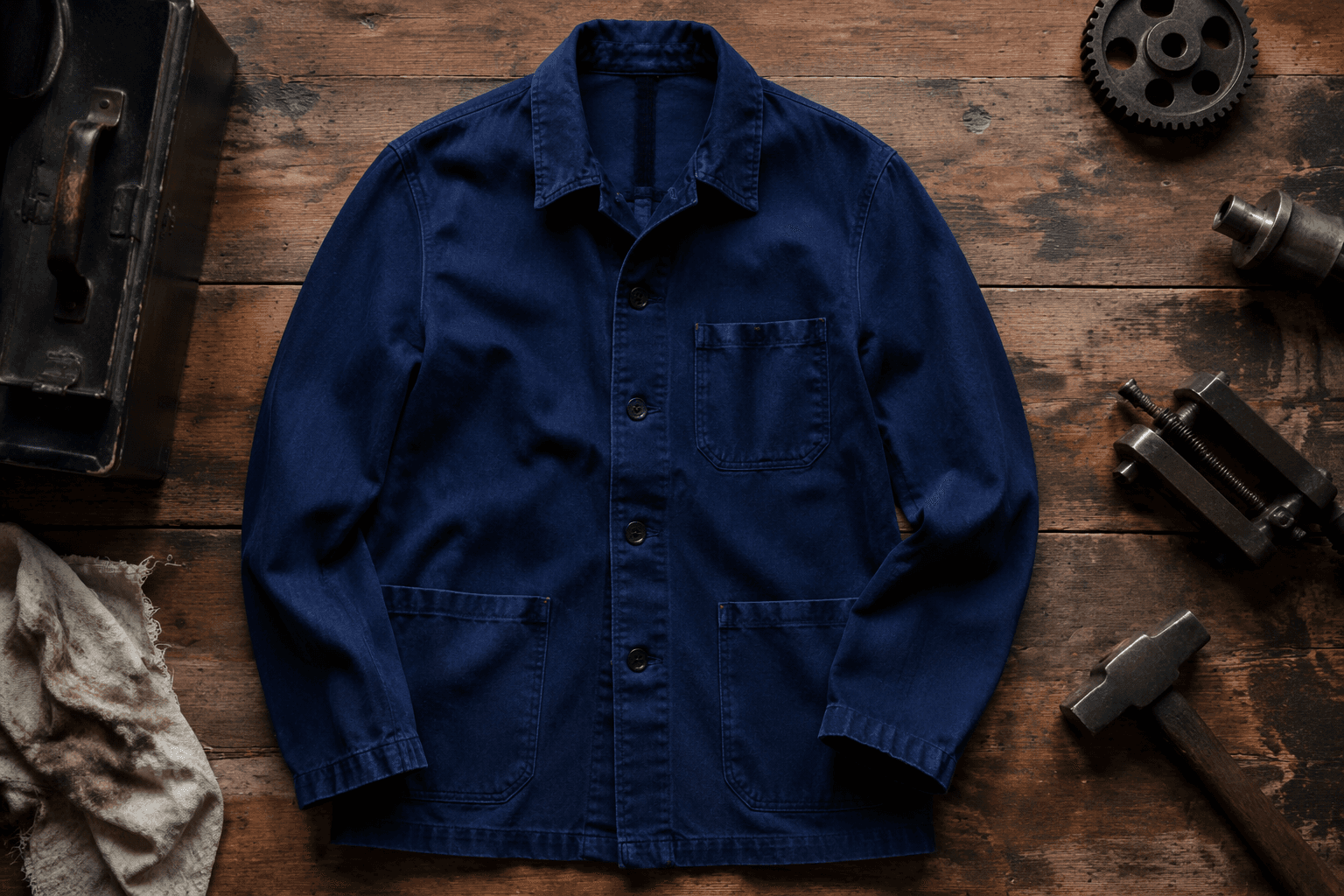
The French chore jacket looks so right because it was never trying to look right. Built for railway engineers and construction workers in late-19th-century France, the bleu de travail was a hard-wearing answer to industrial labor, with blue cloth chosen to hide dirt, sleeves easy to roll, and patch pockets sized for tools. That original logic is still the whole appeal: it reads clean, but it never lost the grime.
The blueprint was utility, not styling
Strip away the romance and the chore jacket is a brutally practical object. The core formula is tough twill or moleskin, a sturdy cotton build, a boxy cut, and that deep indigo tone that made soot and dust less visible in daily wear. Large patch pockets are not decoration here, they are the point. They sit flat, hold gear, and give the jacket its unmistakable front, the kind of front that modern labels keep copying because it already solved the problem.
That shape matters just as much as the fabric. The easy body and rolled sleeves let the jacket move with the wearer instead of fighting the body, which is why it still feels fresh next to more structured outerwear. A chore jacket can behave like a dressed-down blazer, a light layer, or a rugged substitute for a cardigan or overshirt, and that flexibility is exactly why it migrated from worksite to wardrobe.
Industrial France made the silhouette possible
The jacket did not appear in a vacuum. Nineteenth-century Europe was being reshaped by industrial society, and rail transport was part of that bigger transformation. Once railways, workshops, and construction sites expanded, clothing had to keep up with repetitive motion, abrasion, and real dirt. The bleu de travail was the answer: a uniform built for wear, movement, and visibility of use.
That is the key reason the jacket still feels legible now. You can look at one and immediately read the signals, the indigo utility, the durable cloth, the pockets, the utilitarian cut. It does not pretend to be luxury, but it slides easily into modern wardrobes because the design is so well resolved that fashion keeps circling back to it. The jacket’s appeal is not nostalgia alone, it is the fact that the original solution was sharp enough to survive.
Le Mont Saint Michel turned workwear into a reference point
If the chore jacket has a house name attached to it, Le Mont Saint Michel is the one that keeps coming up. The brand says it was founded in 1913, and its official history places Pontorson at the origin of its workwear tradition. That matters because it gives the jacket a lineage you can actually trace, not just a vague French accent pasted onto a modern product page.
Le Mont Saint Michel also treats the work jacket as a century-spanning emblem of French workwear, which is why its vintage examples from the 1930s and 1940s still carry weight. A 1950s advertising claim that the jacket was “3 times more resistant” is the kind of line that sticks because it captures the whole fantasy and fact pattern at once: this was clothing meant to outlast the job. Even the brand’s own history frames the jacket as something that moved beyond its original function and into style and sophistication.
Why archives and museums matter here
The chore jacket is not just a retail category. The Musée des Arts Décoratifs in Paris says its fashion and textile collections began forming in the 1860s, ahead of the 1864 creation of the Union centrale des Beaux-Arts appliqués à l’industrie. That puts workwear in the same conversation as design history, material culture, and the broader story of French dress.
That museum angle is important because it explains why the jacket reads as more than a trend piece. It belongs in the same visual archive as uniforms, artisan clothing, and the practical garments that modern fashion keeps raiding for ideas. Once a work jacket is preserved in that kind of context, it stops being a one-note utility item and becomes a design language.
How to read the jacket now
- sturdy cotton or a similarly dense cloth
- a rich blue or indigo tone
- a boxy, easy cut
- large patch pockets
- sleeves that can be rolled without collapsing the silhouette
If you want to recognize the real thing, look for the details that made it work in the first place. The best versions still carry the same code:
Those details are why the jacket keeps reappearing across workwear labels and fashion brands. When a modern piece has the right pockets but loses the structure, it drifts toward overshirt territory. When it keeps the boxy shape and the utility, it still feels like a chore jacket, even if the styling is cleaner or the fabric is updated.
That is the master key part. The French chore jacket gave workwear its template, and most of what gets called workwear now is still negotiating with that original silhouette. It is the piece that made sturdy cotton, indigo utility, and practical pockets look so good that fashion never stopped borrowing them.
This article was produced by Prism’s automated news system from verified source data, official records, and press releases, then run through automated quality and moderation checks before publishing. The system is built and supervised by the people who set the standards it runs under. Read our full AI policy.
Did this article answer your question?