10 clever ways to reuse empty filament spools in your workshop
Empty spools can clean up a bench fast when they become cable reels, parts bins, and refill hubs instead of another pile of plastic.
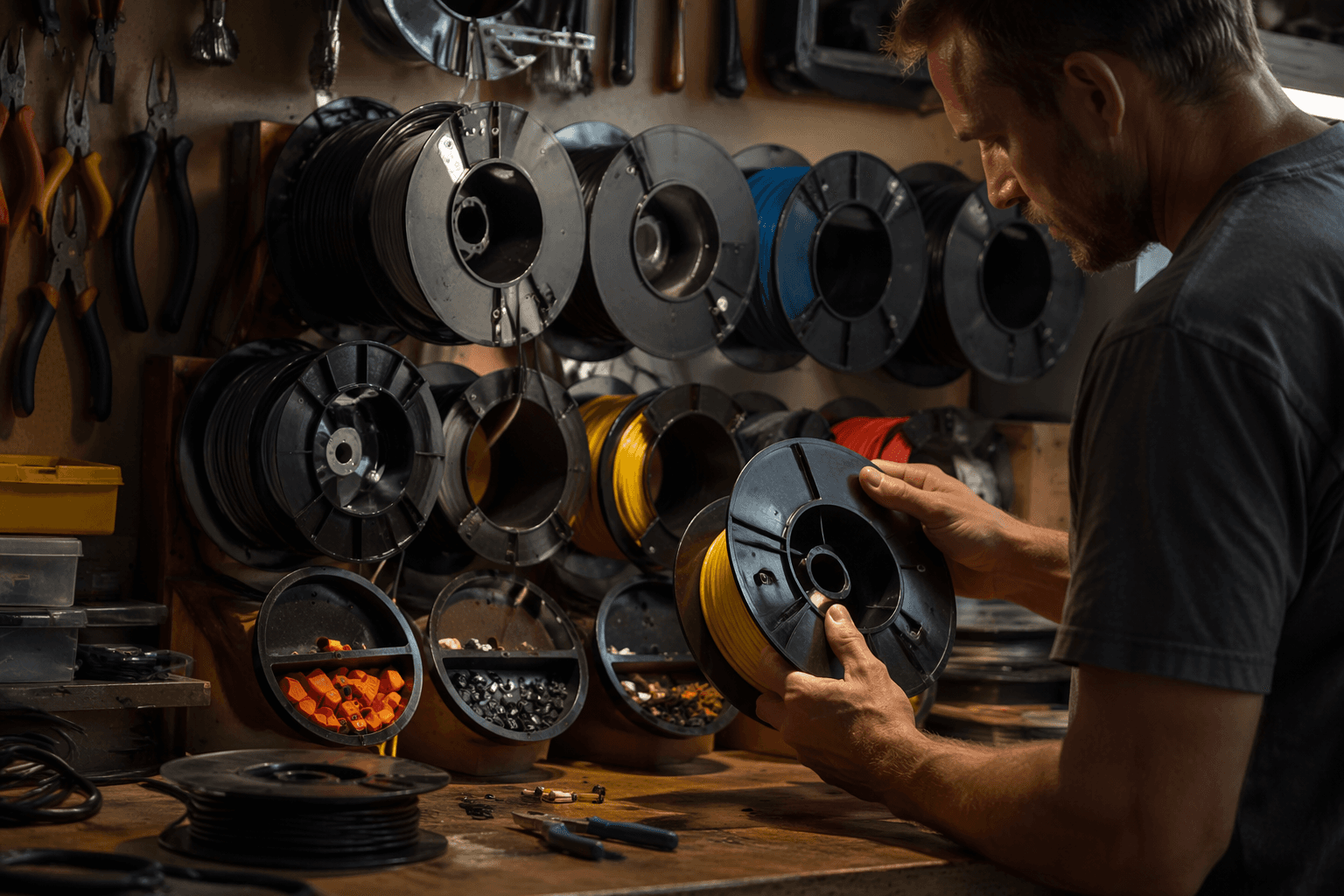
Empty filament spools are the kind of shop clutter that grows by stealth, then starts eating shelf space. The best reuse ideas turn them into cable reels, parts bins, and material-handling tools, which is why this question keeps resurfacing in the hobby, from a 2019 Prusa forum thread about the “tons of empty spools created all the time” to a 2020 UltiMaker discussion asking for “systemic” ways to repurpose them. That same instinct shows up in broader sustainability talk around 3D printing, where Formlabs frames the technology around resource efficiency, waste reduction, and localized production.
Cable reels that tame the bench
A spool is already a reel, which makes it a natural home for USB leads, printer power cords, soldering iron cables, and short extension runs that otherwise tangle on the bench. In a shop where multiple materials or colors are in rotation, the thing is easy to grab, easy to label, and easy to park back on a hook when the printer job is done. This is exactly the kind of low-stakes, same-day fix that turns an empty consumable into real workflow.
Tape and twine where you can actually reach them
In homes, garages, schools, and maker spaces, empty spools can keep painter’s tape, masking tape, twine, and hook-and-loop ties from disappearing into drawers. The flange gives the roll a boundary, while the core lets it spin without a print-heavy custom part, which means the project works without expensive hardware, exotic materials, or deep technical knowledge. That practicality is the point: you get organization, not another decorative object.
A fastener sorter that keeps hardware from wandering
Fasteners are where an empty spool earns its keep fast, because washers, screws, heat-set inserts, and bearing races all want a shallow, ringed home. Label the rim and you can keep project hardware separate without buying stackable bins or printing a whole drawer system. The appeal is the same one that kept the spool question alive for years, it solves a real bench problem with something already at hand.
A drill-bit and driver carousel that sits on the worktop
Slide a dowel through the hub and a spool becomes a compact drill-bit or hex-driver carousel that lives right on the worktop. Prusa’s 2021 Prusament PLA Recycled announcement is a reminder that spool design itself is already a materials question, with a cardboard core and lightweight plastic sides chosen after fully cardboard versions proved unsuitable. That makes the empty plastic spool feel less like trash and more like a structural component waiting for a second job.
A sample library for filament swatches and offcuts
Short offcuts and swatches fit neatly around the rim, so a spool can turn into a color and material archive for the bench. One common answer in the hobby is refill systems like Masterspool, while cardboard spools can go with regular cardboard waste, which gives you a clean rule for what stays in rotation and what leaves the room. If you test a lot of filaments, that little library saves you from hunting through unlabeled bags.
A refill-ready station for Master Spool workflows
MatterHackers framed the Master Spool as a way to cut plastic waste from leftover spools, and RichRap’s “Reduce, Reuse, Recycle” philosophy is built into the idea. In practice, that means keeping a few empty hubs in circulation as refill cores instead of tossing every spool the moment the filament runs out. It is the one reuse project here that changes the whole consumption pattern, not just the bench.
A portable parts carrier for classes and assembly work
With a simple printed cap or tray, a spool turns into a portable carrier for screws, magnets, nozzles, or small kit parts that need to move between stations. That is especially useful in schools and maker spaces, where multiple materials or colors may be in rotation and where a part bin has to survive a trip from one table to another. The spool’s shape does the stabilizing for you, so the project stays cheap and quick.
A winding station for leftover filament and scrap
Leftover filament lengths, purge strips, and other odd bits are easier to manage when they are wound onto a dedicated empty spool instead of stuffed into a drawer. That fits the broader maker-culture push toward reducing waste and reusing plastics, the same current that makes a simple shop object feel more useful than a new purchase. Formlabs’ sustainability framing of 3D printing as resource-efficient and waste-reducing gives the logic a wider industry backdrop without changing the on-bench math.
A sanding-disc tower that keeps abrasives sorted
Round abrasives are a quiet menace to shop order, and a spool can keep sanding discs, polishing pads, or foam finishing wheels separated by grit. The trick works because the spool already gives you a rigid, stackable form with a visible edge, which means you can reach for the right finish without rifling through envelopes or plastic sleeves. It is the kind of same-day, low-stakes fix that makes a bench feel manageable after a long print session.
A clean sorting point for cardboard spools
Not every spool deserves a second life in the shop. Prusa says it uses a smart spool design with a cardboard core and lightweight plastic sides for Prusament PLA Recycled, and it tested fully cardboard spools before deciding they were not suitable, so cardboard reels make more sense in the recycling stream than on the bench. If the payoff is not storage, cable management, or material handling, the cleanest move is to sort the spool with regular cardboard waste and let the useful plastic ones keep working.
This article was produced by Prism’s automated news system from verified source data, official records, and press releases, then run through automated quality and moderation checks before publishing. The system is built and supervised by the people who set the standards it runs under. Read our full AI policy.
Know something we missed? Have a correction or additional information?
Submit a Tip