3D-Printed Super Foam Absorbs Up to 10 Times More Energy
Texas A&M's 3D-printed "super foam" absorbs up to 10x more energy than conventional padding by embedding elastic struts directly inside open-cell foam.
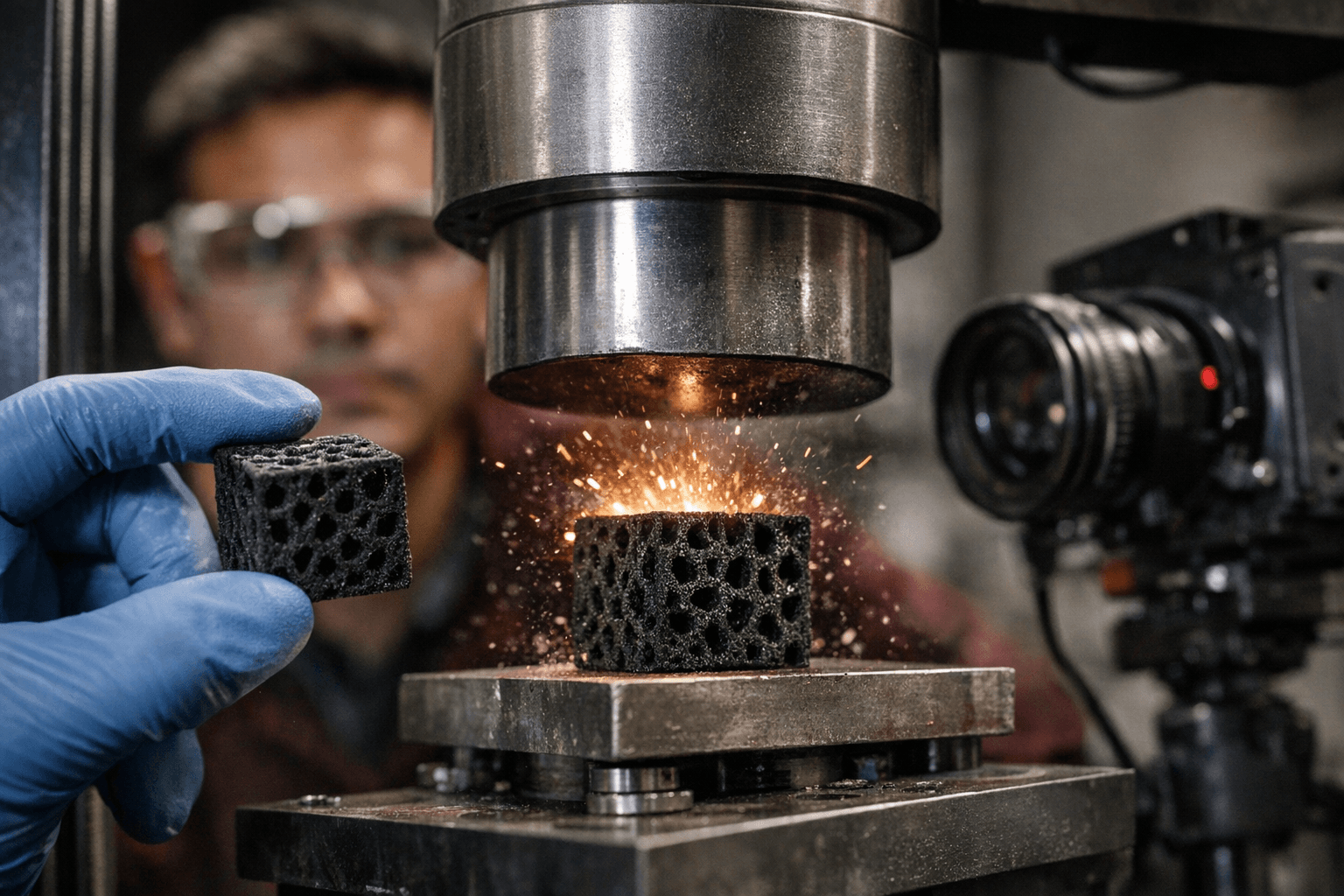
A research team at Texas A&M University and the DEVCOM Army Research Laboratory has developed a hybrid "super foam" that absorbs up to 10 times more energy than conventional padding, using a 3D printing technique that builds an elastomeric skeleton directly inside ordinary open-cell foam. The composite, described in the journal Composite Structures, could reshape protective gear from military helmets to motorcycle helmets, car bumpers to blast-resistant seat cushions.
The innovation hinges on a process the team calls In-Foam Additive Manufacturing, or IFAM. Standard open-cell foam works by collapsing tiny air pockets under pressure to dissipate energy, but its random internal structure caps how efficiently it can do that job. Engineered lattice materials improve on that geometry but are expensive and difficult to manufacture at scale. IFAM sits between those two options: computer-controlled 3D printing lays down a network of flexible elastomeric struts, or plastic columns, directly inside existing foam so the two materials work together under compression rather than independently.
"IFAM is a simple, computer-driven manufacturing process that allows us to build an elastomeric skeleton inside of a conventional open-cell foam," said Dr. Eric Wetzel of the Army Research Laboratory. "The diameter, spacing, angle and elasticity of the elastomer can be selected to achieve a wide range of properties. The IFAM process combines the best of both worlds, providing a low cost, customizable, high performance composite energy absorber."
That tunability is one of the more practically interesting aspects here. By adjusting strut thickness, spacing, angle, and elasticity during the print, researchers can dial in different performance profiles from the same base foam without switching to an entirely different material system. The Texas A&M press release, published March 6, explicitly frames the composite as "tunable, lightweight and ultra-durable."
The work was led by Dr. Mohammad Naraghi, director of the Nanostructured Materials Lab at the Texas A&M College of Engineering, with Wetzel as the Army Research Laboratory collaborator. The project is funded by the military, and the defense applications read like a logical first deployment: the energy-absorption numbers matter a lot when you are talking about helmets on a battlefield or seat cushions rated for blast loading in a vehicle.
The "up to 10 times more energy" claim is consistent across every source covering this research, though the published materials do not include raw test metrics, units, or the specific test conditions used to reach that figure. Take the relative performance number as a meaningful signal, but expect the full Composite Structures paper to carry the experimental specifics that would let you evaluate it rigorously.
Beyond impact protection, Naraghi sees potential in a direction that would surprise most people reaching for a piece of foam padding: acoustic control. "It would be possible to modify the foam's properties to turn it into an excellent sound absorber capable of attenuating, or even completely eliminating, certain frequency bands and specific vibrations," he said. "Acoustic applications are still in the early stages of research, but we would like to explore this property further to turn the foam into an active acoustic filter that is more effective than current materials."
The acoustic work is early-stage by the team's own description, but the concept of a single printable composite handling both impact energy and targeted sound frequencies in one material is worth watching. For now, the more immediate story is a 3D printing process that turns commodity foam into a high-performance energy absorber without the cost penalties that have historically kept engineered lattice structures out of mass-market applications.
This article was produced by Prism’s automated news system from verified source data, official records, and press releases, then run through automated quality and moderation checks before publishing. The system is built and supervised by the people who set the standards it runs under. Read our full AI policy.
Did this article answer your question?