3D-Printed Titanium Chainmail Mimics Cloth, Yet Stays Strong and Lightweight
Titanium that flows like cloth is real, but the bigger story is lattice design, not a desktop-printable stunt. The demo shows how DMLS and interlocking geometry can turn metal into a new kind of structure.
What the viral titanium chainmail really shows
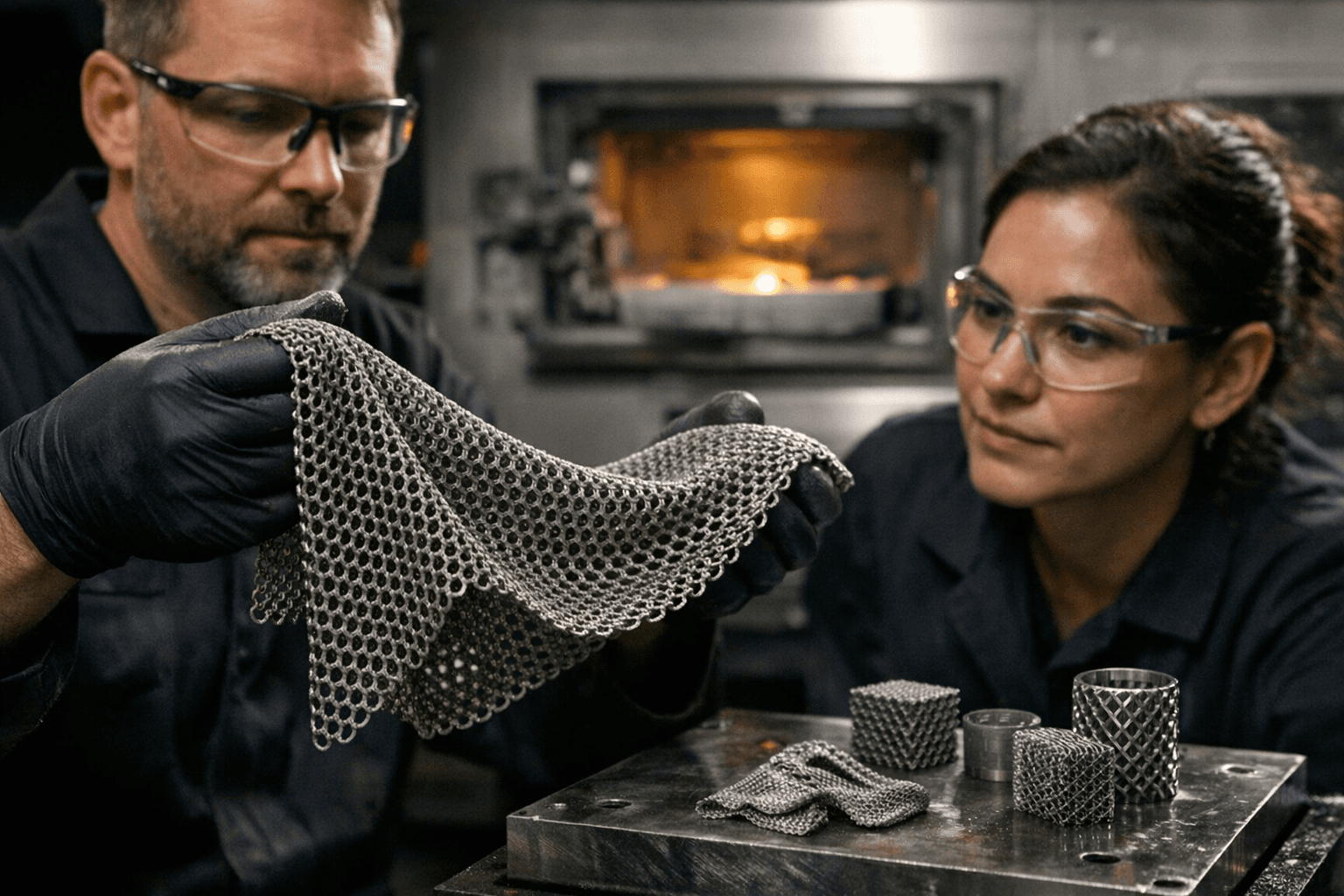
A titanium fabric that ripples and folds like cloth is the kind of clip that stops a scroll cold. The real surprise is not that metal can look flexible, it is that thousands of interlocking titanium links can be built into a single chainmail-like sheet that still feels lightweight, durable, and heat-resistant.
That is the part worth paying attention to if you live around printers, slicers, and materials charts. This is not a party trick for a garage machine. It is a demonstration of what happens when additive manufacturing is used to design geometry first and material second.
How the fabric is made
The process named in the demo materials is Direct Metal Laser Sintering, or DMLS. Instead of forging links by hand or assembling them one at a time, DMLS fuses titanium powder layer by layer with a high-powered laser until the interlocking structure emerges as one printed part.
That matters because DMLS is a metal powder-bed process, not a desktop plastic workflow with a different nozzle. The build environment, powder handling, laser control, heat management, and post-processing all sit in a different league from the tools most makers keep on the bench. The magic here is not just that titanium is being printed, but that it is being printed with enough precision to preserve a repeating link geometry that can move like fabric.
The material in the clip is presented as flexible fabric made entirely from titanium, and the visual effect comes from the way the links articulate against one another. Each connection acts like a tiny hinge, but the whole sheet stays coherent because the geometry was designed to share motion instead of fighting it.
Why the interlocking geometry is the whole story
The reason this works is not simply that titanium is strong. The real design lesson is that interlocking structures can redirect force, spread stress, and avoid the sharp weak points that ruin ordinary joints. A 2022 Scientific Reports paper on additive layer manufacturing of interlocking structures looked specifically at joined components and how interlocking forms can reduce stress concentration along the edges of a typical lap joint.
That is the same principle hiding inside the cloth-like titanium sheet. The links are not there for decoration. They are there to let the material deform in a controlled way, so the structure can bend without behaving like a brittle plate.
If you are used to thinking about 3D printing as a way to copy an object, this is the mindset shift. The interesting part is not the shape of a single link, it is the load path across the whole lattice. That is why the demo reads less like a maker project and more like a materials and structures lesson.
What the titanium research already says
The chainmail clip sits on top of a real body of titanium research, and the pattern is consistent: print the alloy, tune the microstructure, and you can unlock combinations that conventional processing does not make easy. A 2022 Nature Materials paper showed that additive manufacturing can create unusual titanium microstructures with attractive mechanical properties, including as-built defects that can be reshaped through heat treatment into internally twinned nanoprecipitates.
That sounds like lab jargon, but the takeaway is straightforward. 3D printing does not just build shape, it changes the internal structure of the metal in ways that matter for strength and toughness. In 2023, Nature described designer titanium alloys created using 3D printing, showing that the field is moving beyond simple geometry toward custom alloy design as well.
Then came the February 2024 RMIT-led result: a 3D-printed titanium lattice that was reported as 50% stronger than a WE54 aerospace alloy at similar density. That is exactly the kind of comparison that makes the technology hard to ignore. It says the advantage is not only about making something light, but about making something light without giving up the kind of strength people usually expect from denser metals.
Later work pushed the picture further. A Nature Communications paper reported a 3D-printed titanium alloy with a work hardening rate of 5.7 GPa, uniform elongation of 9.3%, and yield strength of 1030 MPa. Those numbers point to a metal that can resist load, deform usefully, and keep enough ductility to matter in real service.
Why titanium keeps showing up in these demos
Titanium is not the cheapest metal in the drawer, and that is exactly why it keeps getting chosen for high-value applications. Its appeal comes from a strong strength-to-weight ratio and heat resistance, which makes it a natural candidate for parts that need to be light, durable, and thermally stable at the same time.
That is also why the viral chainmail framing lands so well. When metal behaves like cloth, the mind jumps to armor, wearable technology, robotics, and other complex components that need flexibility without sacrificing structural integrity. The point is not that you are about to print a titanium scarf at home. The point is that designers are learning how to make metal parts act more like engineered systems than chunks of stock material.
A 2025 RMIT report pushed the practical angle even harder, saying 3D printing allows faster, less wasteful, and more tailorable production. The same coverage also noted that industry still leans heavily on legacy alloys like Ti-6Al-4V, which is a good reminder that the manufacturing world moves slower than the demo reel.
What to take away if you print parts yourself
If you run a desktop printer, the useful lesson is not to chase the exact material. It is to pay attention to structure. The titanium chainmail works because the geometry is doing the heavy lifting, and that idea translates cleanly to parts you can actually make on a home machine.
A few practical takeaways stand out:
- Interlocking forms can turn a rigid material into something compliant without sacrificing integrity.
- Lattice design matters as much as material choice, sometimes more.
- Stress concentration is the enemy, whether you are printing a joint, a brace, or a wearable part.
- The next jump in additive manufacturing is not just stronger metals, but smarter structures.
That is why the cloth-like titanium demo matters. It is not a near-term maker project, and it is not meant to be. It is a clean look at where additive manufacturing is headed when design, microstructure, and process control all line up: metal that behaves less like a block and more like a built system.
This article was produced by Prism’s automated news system from verified source data, official records, and press releases, then run through automated quality and moderation checks before publishing. The system is built and supervised by the people who set the standards it runs under. Read our full AI policy.
Did this article answer your question?