3D Printing Moves Beyond Prototypes, from Music to Hospital Care
3D printing is already making drums, motorcycles, and hospital workflows, and the real lesson is how much design and material thinking matters.
The show floor changed the question
The most useful thing on the RAPID + TCT floor was not a flashy prototype. It was the proof that 3D printing is already solving problems in places where legacy manufacturing is awkward, expensive, or too rigid. At RAPID + TCT 2026, held April 13-16 at the Thomas M. Menino Convention & Exhibition Center in Boston, the event billed itself as North America’s largest additive manufacturing and industrial 3D printing event, with more than 400 exhibitors in the event materials and over 450 in pre-show coverage.
That scale matters because it puts the projects in context. These were not isolated maker tricks. They were examples shown in front of engineers, buyers, researchers, and clinicians, inside a city that lives and breathes life sciences. The healthcare programming was especially strong, with sessions on surgical planning, surgical guide creation, medical education, and the infrastructure needed to fabricate safely in a hospital environment.
A drum kit that uses airflow as a design tool
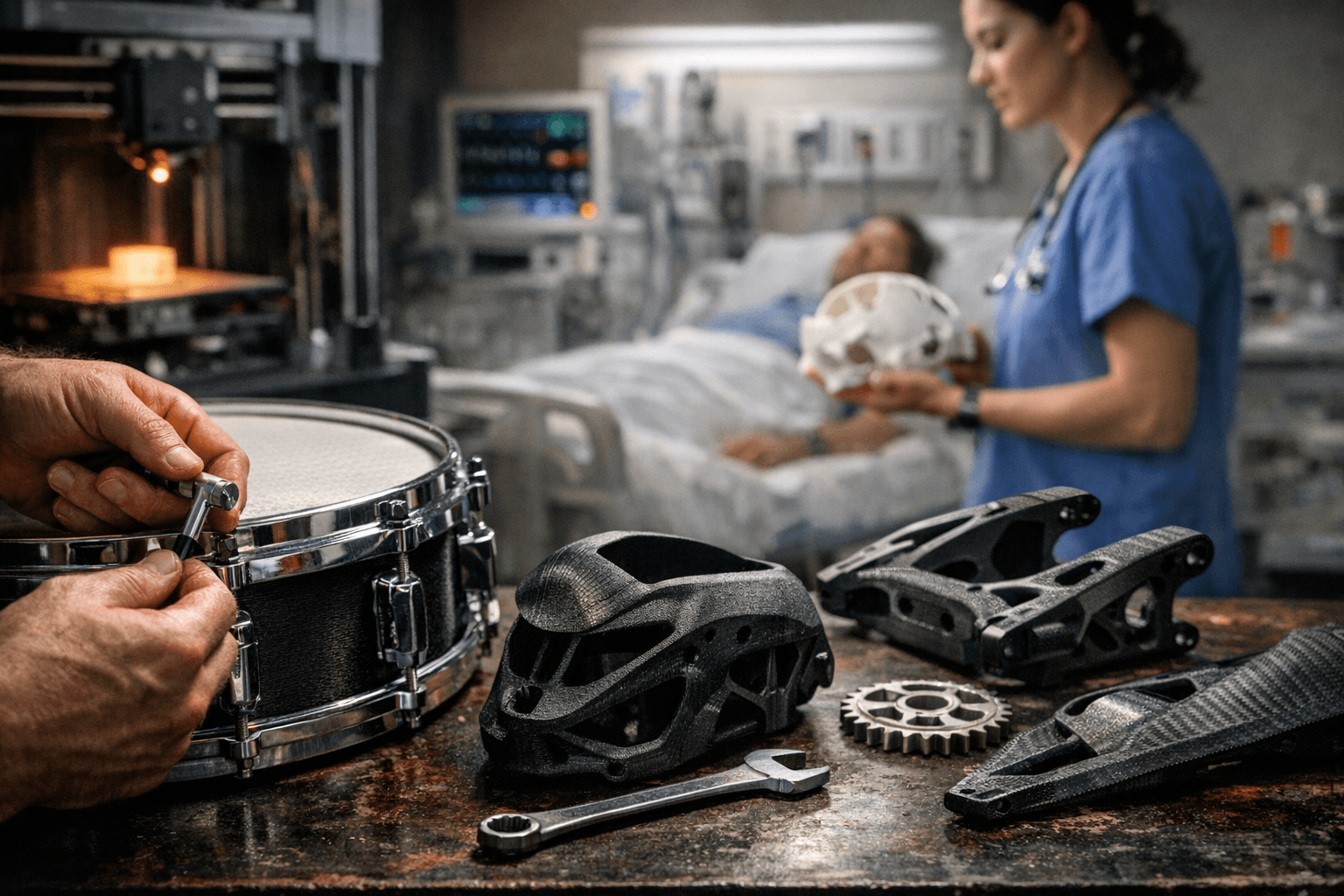
The cleanest reminder that 3D printing can do something traditional manufacturing struggles with came from Voxel Percussion, the Akron, Ohio company making digitally manufactured custom snares with Polymaker. The standout piece was a drum kit built with internal funnels and inserts that shape airflow inside the shells, so the part is doing acoustic work, not just looking custom.
That is the part worth borrowing. If you are printing for music, cosplay, robotics, or any other home project, the real win is often hidden inside the part. Voxel Percussion’s approach turns internal geometry into performance, and that is why the result matters more than a pretty outer surface. Modern Drummer identified Markus Vogl as the mastermind behind the design approach, and the company’s 3D-printed drum also showed up as a 6x14-inch custom shell.
The numbers tell you this is not a quick weekend print. Coverage said the kick drum alone takes six days to print, while a full set averages around 80 hours. The payoff is a tonal profile that sits between wood and metal, plus the kind of personalization that gets impossible fast in traditional production, including a player’s name printed directly into the shell.
The motorcycle case is a workflow lesson, not a stunt
Pantheon Design’s Pantheon Combo took the same logic into a much tougher category: a fully 3D printed motorcycle built in Vancouver from roughly 100 pounds of printed parts over ten days. Pantheon says its long-running goal has been to print as much of a motorcycle as possible, and the Combo is a clean expression of that ambition rather than a one-off showpiece. The company’s earlier Compo work, including variants like Enduro Compo and CompoRR, shows this has been an ongoing development path.
The important detail for makers is that the bike was not printed from one magic plastic. Pantheon used carbon-filled nylon for structural parts, glass-filled nylon for aesthetic parts, carbon-filled PETG for water-exposed parts, and TPU for the seat. That is the real lesson: treat materials as a system, not a single default spool.
Pantheon’s HS-Pro printer is what made the functional bike possible, and its own documentation says the machine can print 1-2 kg per day at production quality. The company also says a printed brake lever matched OEM Honda cast-aluminum strength at 1,039N versus 1,063N for the original aluminum part. That is the sort of comparison that changes the conversation from “Can you print it?” to “How close does the part need to be to the original, and where can you actually beat it?”
Pricing and availability underline why this landed as a serious industrial case. Related coverage describes the HS-Pro as a high-speed, high-strength industrial printer, with some retail listings around $35,000 and lead times of roughly 6-8 weeks. In other words, this was not a garage-gimmick build. It was a validation of what happens when a printer, materials, and workflow are all pushed toward end-use hardware.
Hospital care is where the credibility lives
If the drum kit shows what 3D printing can do for form and sound, the hospital examples show where it earns trust. Boston Children’s Hospital has increasingly used 3D printing for surgical planning, pre-surgical rehearsal, and medical education, and that makes the medical work shown at RAPID + TCT much more than a feel-good side story. Nick Provenzano and Mike Silver were scheduled to present that hospital work at the event.
The healthcare track also pointed toward the next step for desktop-minded makers: process discipline. Surgical planning models and surgical guides only matter when the workflow is repeatable, safe, and useful to the people cutting, stitching, and teaching in the room. That is why the infrastructure side of the programming matters just as much as the models themselves.
For anyone printing at home, this is the takeaway: the best medical printing does not start with a dramatic scan file, it starts with a workflow. You need reliable part orientation, predictable material behavior, post-processing you can repeat, and a clear reason the object exists in the first place.
What to steal from these projects now
The hobby-level lesson is not “build a drum kit” or “print a motorcycle.” It is to copy the thinking behind them.
- Use internal geometry on purpose. Voxel Percussion’s shells are interesting because the inside of the part changes the result.
- Match the material to the job zone. Pantheon’s mix of nylon, PETG, and TPU is a good model for multi-material thinking even if you are only printing one part at a time.
- Treat strength as a target, not a vibe. The 1,039N brake lever comparison is the right way to talk about printed parts that need to do real work.
- Build for a workflow, not just a render. Boston Children’s approach shows why repeatability, safety, and planning matter as much as the final object.
That is the real reality check. 3D printing is past the stage where its best argument is “look what we can prototype.” The stronger argument now is that it can make music differently, build machines differently, and fit into hospital care in ways that conventional manufacturing still cannot copy cleanly.
This article was produced by Prism’s automated news system from verified source data, official records, and press releases, then run through automated quality and moderation checks before publishing. The system is built and supervised by the people who set the standards it runs under. Read our full AI policy.
Did this article answer your question?