All3DP tests AI image-to-model tools for printable meshes
All3DP’s latest AI mesh test says the real win is cleaner printable geometry, not instant magic. Meshy, Tripo, and Hi3D still need cleanup before the slicer.
The promise is speed. The reality is cleanup. All3DP’s June 2 guide on image-to-model tools makes that split plain by testing Meshy, Tripo, and Hi3D through a printable-first lens, not a glossy demo lens. The verdict is practical: AI can get a maker from a photo or concept to usable geometry faster than before, but the best workflow still pairs those tools with general AI and human judgment so the final mesh can survive real print settings, supports, and slicing.
How All3DP is judging the tools
The key change in this guide is the standard. All3DP is not asking which tool makes the prettiest render on screen. It is asking which one delivers a mesh that is watertight, close to the right wall thickness, fast to repair, and ready for a slicer without sending the maker into hours of manual surgery.
That matters because the current wave of AI modelers is no longer just a novelty for concept art. It is creeping into figurines, busts, cosplay props, custom enclosures, and one-off replacement parts, where the difference between a cool preview and a printable file is everything. All3DP’s conclusion is refreshingly grounded: AI generation is the first pass, not the finish line, and the real value comes from how little cleanup is left afterward.
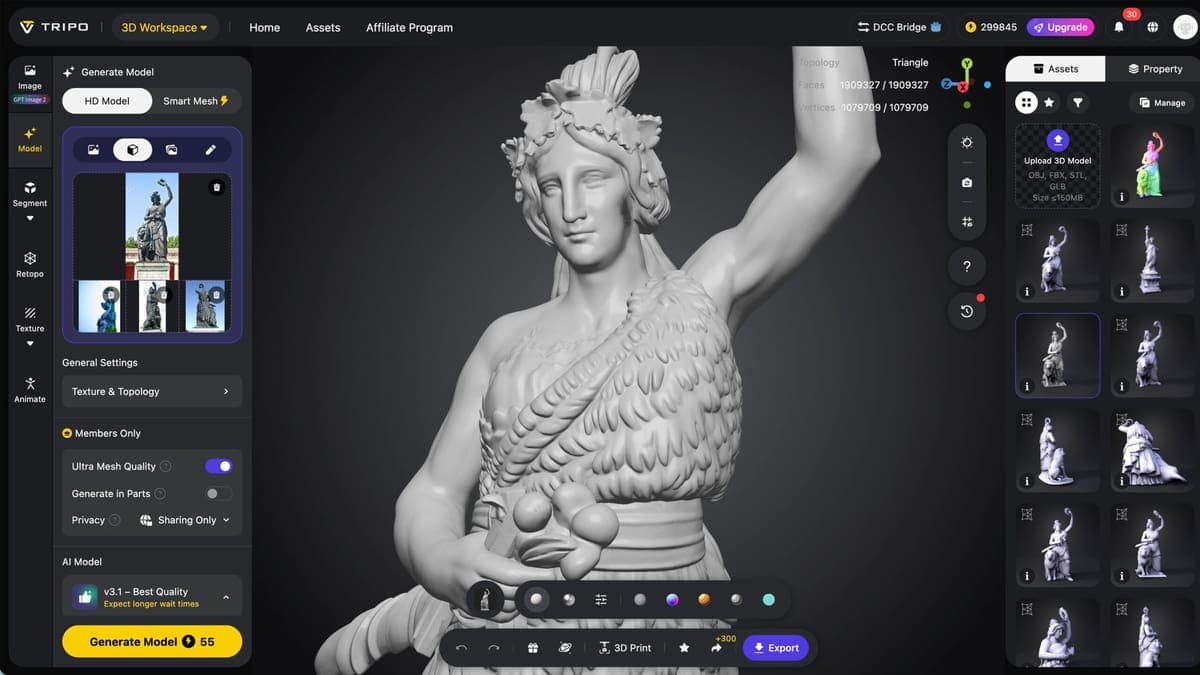
The guide also fits into a fast-moving comparison cycle. On March 6, All3DP pushed Meshy 6 through difficult real-world tests, including the Bavaria statue and five-legged unicorns, to see whether the STL output held up to the hype. On May 9, it returned with a Tripo comparison that highlighted in-platform editing and Nano Banana 2 integration, letting users tweak, fix, and export 3MF files without leaving the app. By June 2, the question was no longer whether these systems could generate something impressive. It was whether they could generate something a printer could actually use.
Meshy: the quickest start, not the last mile
Meshy’s pitch is speed. Its image-to-3D workflow says it can generate a model in about a minute, and it supports export formats including STL, along with FBX, OBJ, GLB, USDZ, and more. It also includes remesh and print options, which is exactly the kind of handoff a maker wants when testing a concept fast.
That said, Meshy is also the clearest reminder that speed does not equal print readiness. All3DP’s earlier Meshy 6 test showed the tool being stress-tested against challenging shapes rather than easy hero shots, and the print-focused comparison notes that watertightness, STL quality, repair time, and slicer compatibility are the real measures that matter. In practice, Meshy looks best when you need a fast starting mesh and you are willing to spend time fixing the result before it reaches the bed.
Tripo: the strongest edit-in-place workflow
Tripo’s value is different. Its picture-to-3D workflow emphasizes structured output, organized topology, and export-ready geometry, with STL, OBJ, and FBX export built in. That alone makes it feel more maker-oriented than a lot of flashy image generators, because topology is where printable ambition either becomes usable or falls apart.
The May 9 All3DP comparison added another important layer: Tripo’s upgrades, plus Nano Banana 2 integration and in-platform editing, let users adjust the model and export 3MF files without hopping between apps. That is a real time saver for anyone who hates the round trip from generator to repair tool to exporter. Tripo’s own checklist still warns that AI-generated meshes are rarely print-ready and that retopology is non-negotiable, so it does not pretend to remove the cleanup step. It just shortens the path to it.
Hi3D: the most ambitious reconstruction story
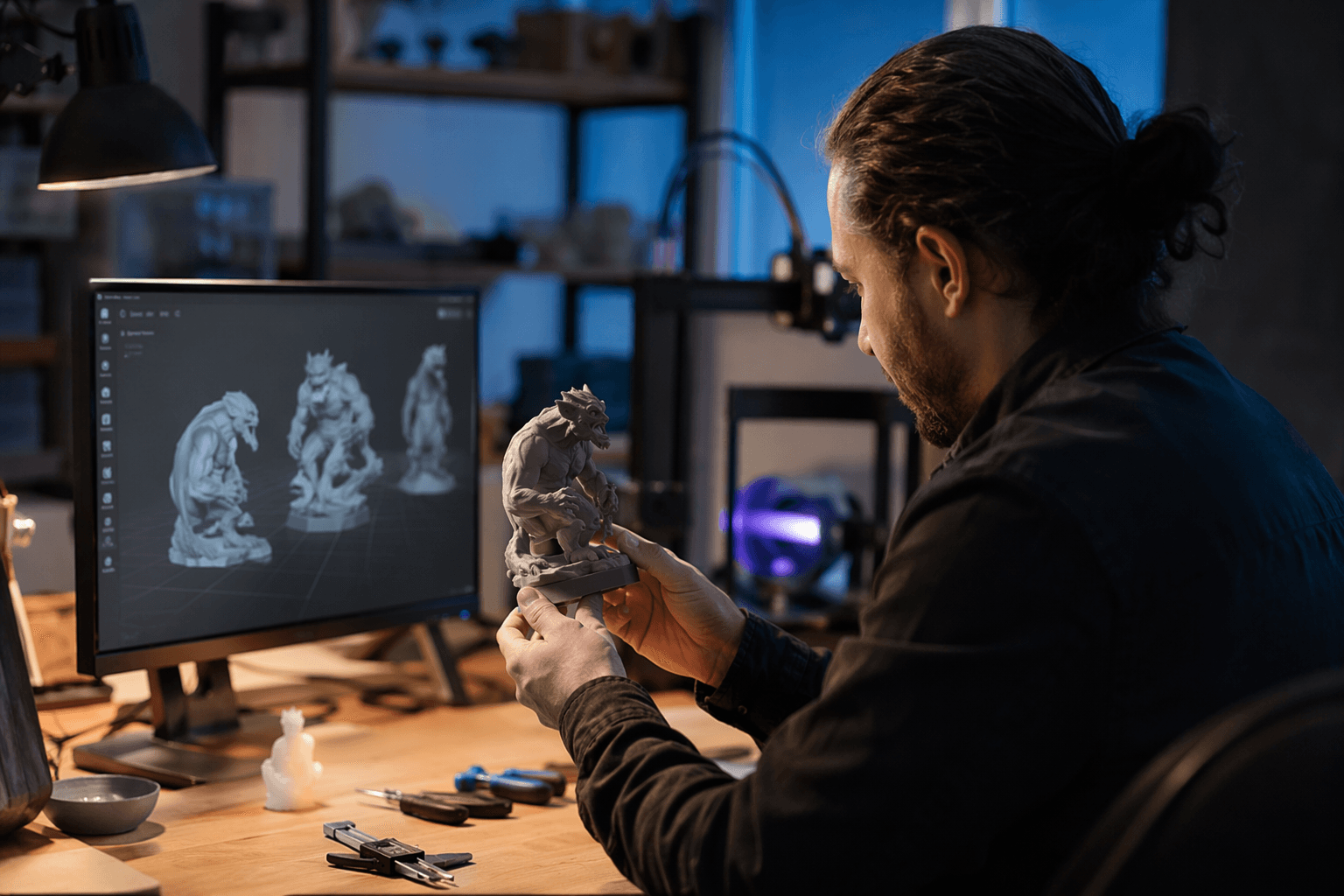
Hi3D brings a different promise to the table. Built on Sparc3D and Ultra3D, it says it can reconstruct invisible parts and aims at production-ready 3D models with printable structures, thickness, and support accuracy. That makes it especially interesting for incomplete or tricky source images, where a modeler is not just filling in surface detail but guessing at what the back side or hidden underside should look like.
For a printable-first workflow, that is where Hi3D’s pitch becomes useful and risky at the same time. The promise of reconstructed geometry is attractive, but the real test is whether the resulting shell is watertight, thick enough where it matters, and sensible for support strategy once it lands in the slicer. In other words, Hi3D sounds like the tool most focused on completing the shape, but completion is not the same thing as printability.
Why image-to-3D beats text-first for makers
The bigger lesson in All3DP’s guide is that image-to-3D is simply more practical than text-to-3D for reconstruction from photos. A photo gives the modeler a visual anchor, which usually improves accuracy and makes the result more printable than asking a system to invent a form from a sentence alone. That is why these tools make sense for organic shapes like miniatures, busts, props, and sculptural pieces.
For functional parts, the boundaries stay clear. A CAD solid still beats an AI mesh when the part needs tight fits, exact dimensions, or mechanical reliability. AI meshes are better for organic geometry and visual forms, while the more exacting jobs still belong to traditional modeling tools. That is not a failure of the AI tools. It is the dividing line that keeps the print from becoming a repair project.
The blunt takeaway for makers
If the goal is a fast first pass, Meshy gets you there quickly. If the goal is to cut down on tool switching and export friction, Tripo saves the most real time because the editing happens inside the same workflow. Hi3D is the most ambitious on reconstruction, but it still has to prove itself in the same place as the others: the slicer, the supports, and the first-layer reality check.
That is the real story All3DP is telling here. AI image-to-model tools are good at getting you from inspiration to geometry, but the maker still owns the part where geometry becomes a printable object. The screen may look finished in a minute. The printer knows better.
This article was produced by Prism’s automated news system from verified source data, official records, and press releases, then run through automated quality and moderation checks before publishing. The system is built and supervised by the people who set the standards it runs under. Read our full AI policy.
Know something we missed? Have a correction or additional information?
Submit a Tip