AM Solutions updates M1 with compact automated finisher for 3D-printed parts
AM Solutions relaunched the compact M1 vibratory finisher, replacing the M1 Basic with a 550 × 150 × 130 mm envelope, divider for three parallel steps, and a dedicated material cart for higher throughput.
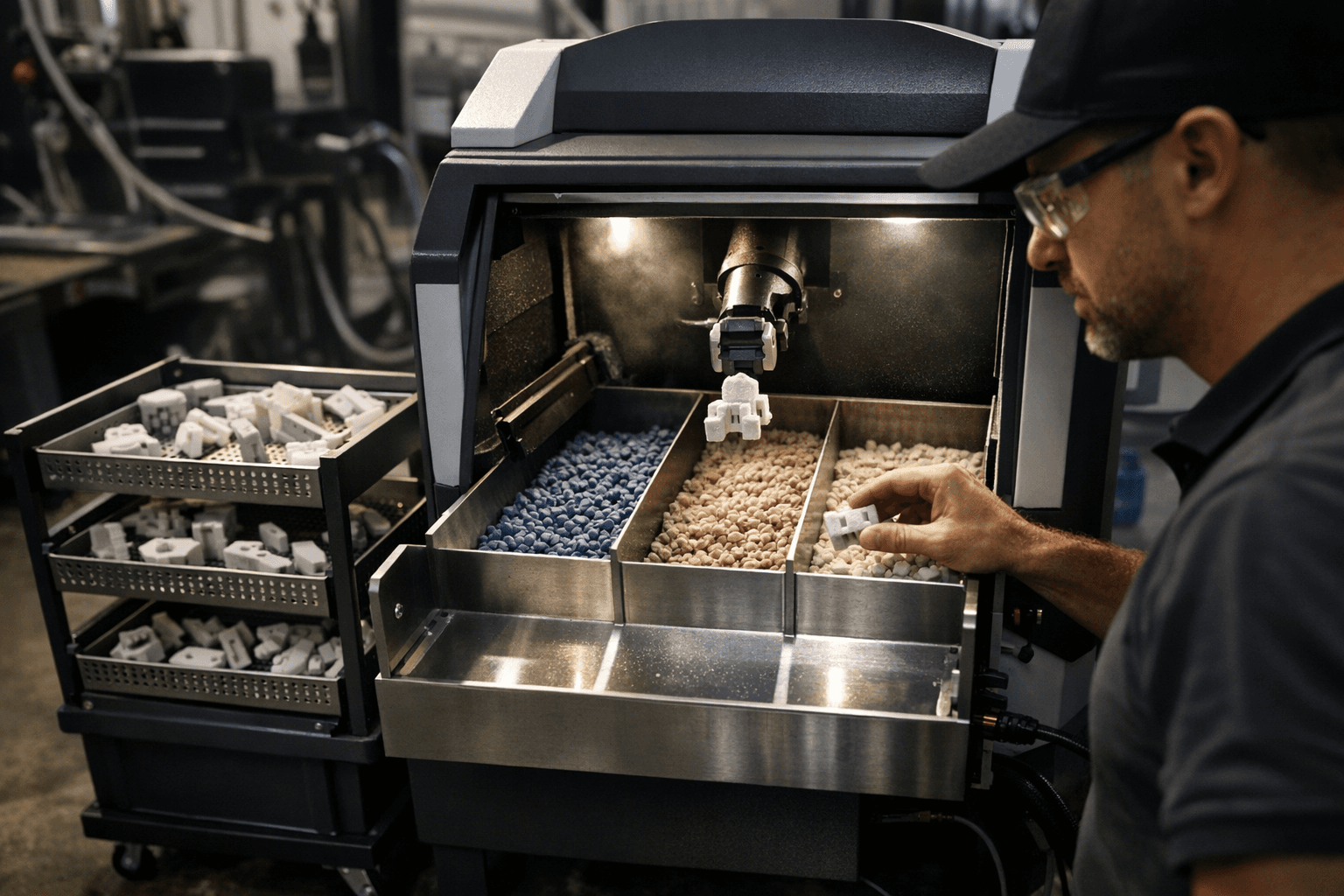
AM Solutions, a brand of the Rösler Group, has launched an upgraded compact M1 automated vibratory surface-finishing system for metal and polymer 3D-printed parts, replacing the earlier M1 Basic and targeting small-scale production and in-cell integration. The machine accepts parts up to 550 × 150 × 130 mm and can run individual components or small batches while keeping a mobile, plug-and-play footprint intended to sit alongside printers or inside existing finishing cells.
The new M1 adds a redesigned processing trough with end-side profiling and extra partitions, an integrated settling tank, and an extra freshwater connection for use with AM Solutions’ Keramo-Finish. Users can configure water management for closed-loop process-water recirculation or freshwater operation depending on quality and productivity demands, and the control surface is a modern HMI with menu navigation. DEVELOP3D reported low noise levels and the compact dimensions retained despite the hardware additions.
Workflow changes are the headline practical upgrades. A divider system lets operators run up to three process steps in parallel without changing media, enabling multi-stage finishing recipes for smoothing, grinding, polishing, and deburring on a single vibratory platform. Media and part separation have been shifted onto a dedicated material cart to smooth workflow and increase throughput, a change 3DPrint highlighted when noting the M1’s production-oriented redesign.
Colin Spellacy, Head of UK Sales at AM Solutions, framed the upgrade as a direct response to customer needs: “For many AM users, the real bottleneck isn’t printing, it’s finishing. With the relaunched M1, we’re giving them a robust, repeatable and economically attractive way to turn rough builds into market-ready products, without jumping straight to a large, fully automated line. It closes the gap between R&D and industrial production.” Spellacy added industry feedback shaped the redesign: “The first M1 Basic proved how powerful vibratory finishing can be for additive… But our customers asked for more flexibility, better ergonomics, and even higher process stability. The new M1 is our answer. It turns what used to be an entry-level solution into an advanced production tool.”
The launch was announced in a ManufacturingTomorrow press release datelined 11 February 2026 from Knowsley, United Kingdom, and covered by DEVELOP3D and 3D Printing News Briefs later in February. Industry context included an adjacent 3DPrint roundup quote from Quickparts CEO Avi Reichental about the broader challenge of moving from validation to production without losing quality or time.
Practical buyer notes: the M1’s core specs and divider capability make it a mid-range finishing option between bench-scale cells and fully automated lines, but suppliers did not publish pricing, measured noise in dB, cycle times, power and water requirements, or throughput figures. Request the machine datasheet, measured noise level, representative cycle times, plumbing options for closed-loop operation, and lead times from AM Solutions before committing to a purchase. The relaunch keeps the M1 compact while stepping up process flexibility for teams that need production-grade surfaces without deploying a full automated lane.
This article was produced by Prism’s automated news system from verified source data, official records, and press releases, then run through automated quality and moderation checks before publishing. The system is built and supervised by the people who set the standards it runs under. Read our full AI policy.
Did this article answer your question?