CAD-Based Part Identification Method Eliminates Costly Vision Model Retraining in 3D Printing
KU Leuven, Materialise, and Iristick's CAD-based method identifies printed parts without retraining vision models each time a new part type enters production.
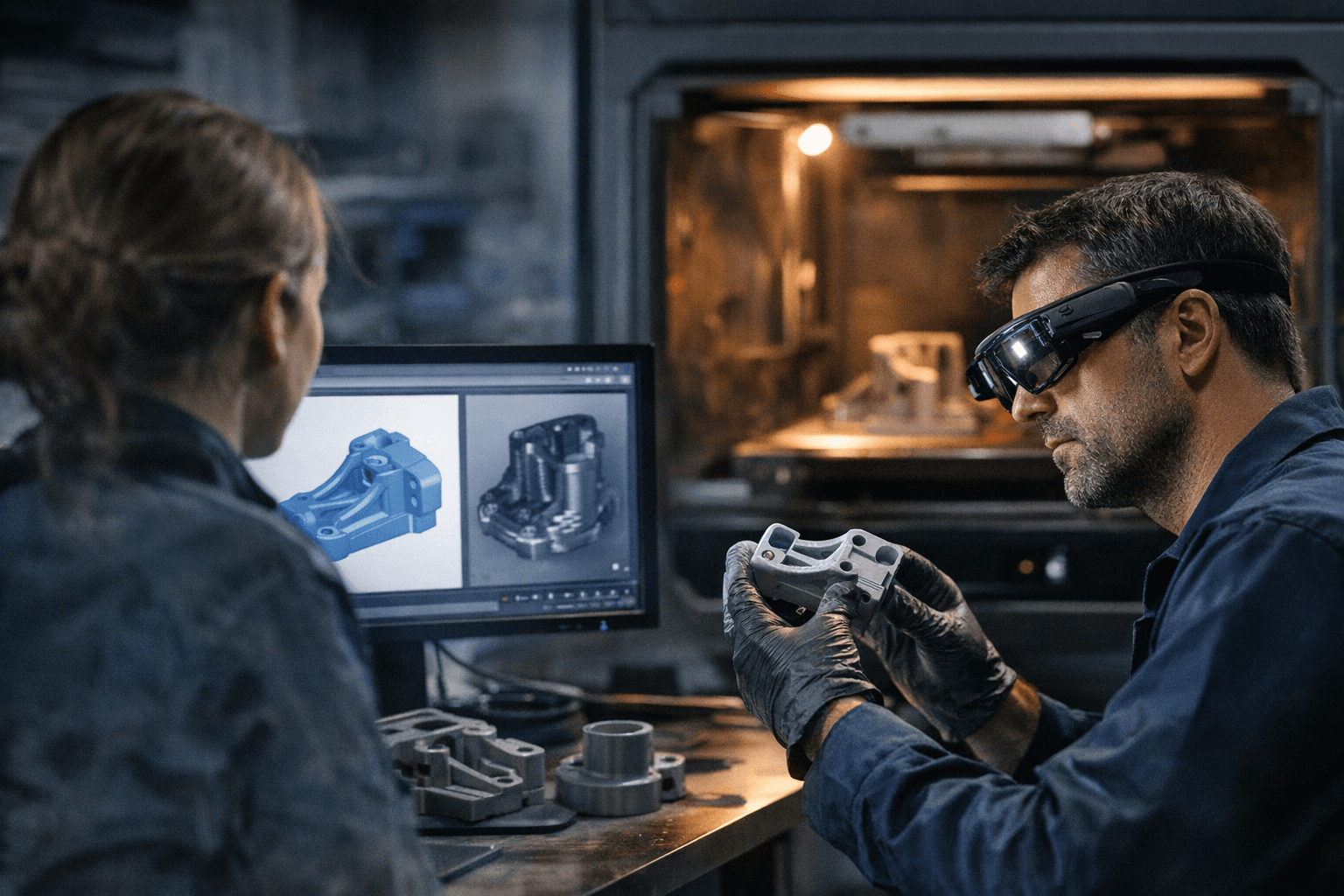
Retraining a vision model every time a new part hits your print farm is exactly as painful as it sounds: it costs real money, halts production workflows, and scales poorly the moment your part catalog grows. A research team from KU Leuven, Materialise, and Iristick published a method on March 18 that directly attacks that problem, using CAD geometry itself as the identification backbone rather than relying on a trained vision model that needs constant updates.
The core insight is straightforward but significant. Instead of feeding a neural network thousands of labeled images of each new part and waiting for it to learn what a freshly printed bracket or manifold looks like, the CAD-based approach uses the existing design file as the reference. When a new part enters the production environment, the system can work from its CAD data rather than requiring a full retraining cycle to recognize it.
For anyone running a production-scale 3D printing operation, Materialise being one of the co-developers here is not a small detail. Materialise operates at industrial scale across service bureaus and manufacturing environments, which means this research is not a lab curiosity built around a handful of demo parts. The involvement of Iristick, which develops smart glasses hardware, points toward a practical deployment context: part identification happening at the point of post-processing or quality inspection, likely in a hands-free wearable workflow rather than a fixed camera station.
The retraining problem is one of those friction points that feels manageable at small volume but becomes genuinely expensive as part variety scales. Every new geometry that enters a production line traditionally required collecting new training images, labeling them, running the training pipeline, validating accuracy, and then deploying the updated model. That process disrupts operations and introduces a lag between when a new part design is approved and when the vision system can reliably handle it on the floor.
A CAD-based identification method sidesteps that pipeline almost entirely. The design file exists before the first part is ever printed, which means identification capability could be available the moment production begins rather than after a separate and costly model update cycle.
The research represents a meaningful collaboration between academia and two companies that live inside the industrial 3D printing world daily, and the practical framing suggests the team built this with deployment friction squarely in mind.
This article was produced by Prism’s automated news system from verified source data, official records, and press releases, then run through automated quality and moderation checks before publishing. The system is built and supervised by the people who set the standards it runs under. Read our full AI policy.
Did this article answer your question?