Chulalongkorn University Transforms Ghost Fishing Nets Into 3D Printing Filament
Dr. Nuttapol Risangud's team at Chulalongkorn University turned ghost fishing nets into nylon 3D printing filament, targeting motorcycle components as the first high-tech application.
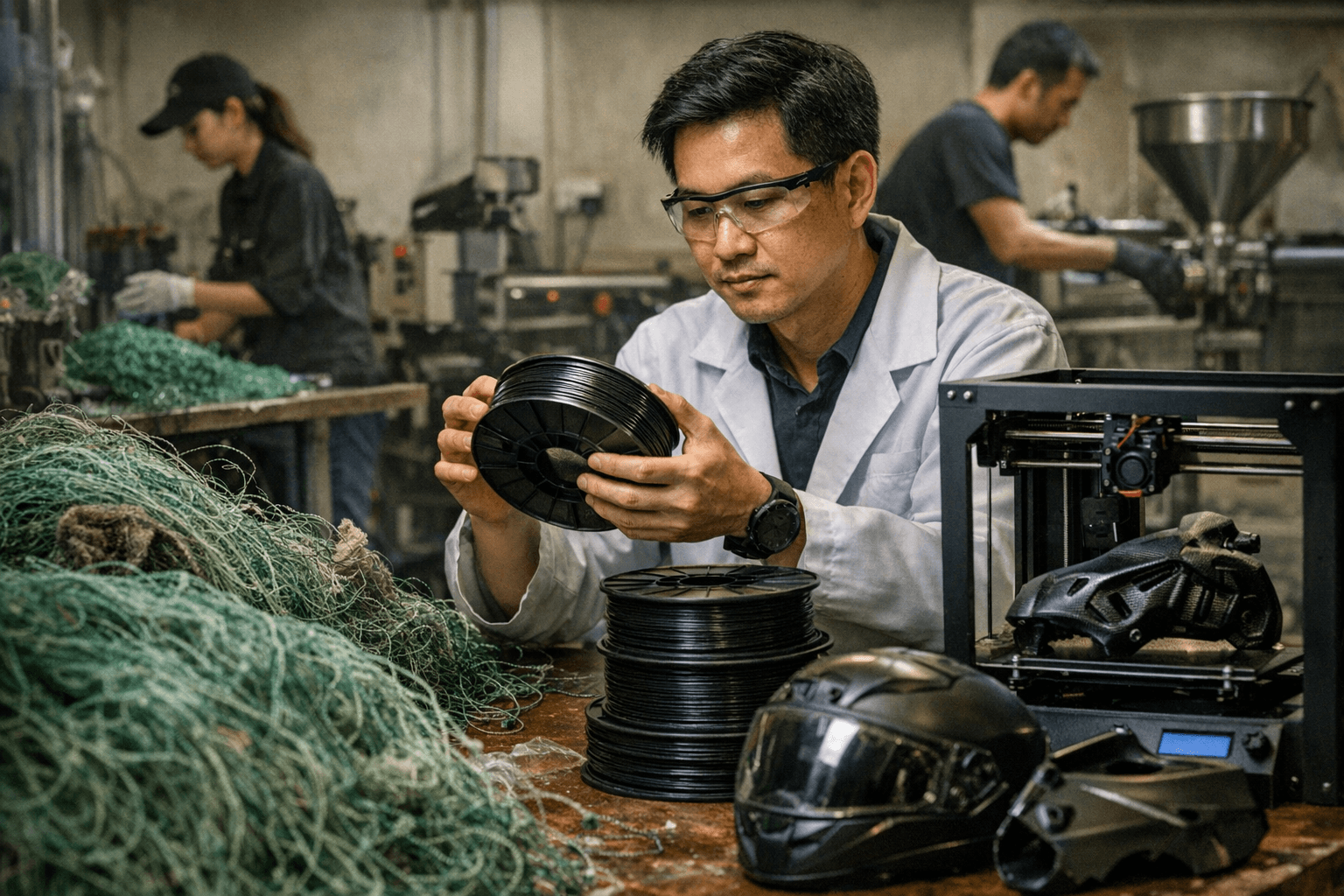
Ghost nets are one of the ocean's ugliest problems: abandoned fishing gear that keeps killing marine life indefinitely, breaking down into microplastics that work their way up the food chain. Dr. Nuttapol Risangud, a polymer chemist at Chulalongkorn University's Petroleum and Petrochemical College in Bangkok, decided that his expertise gave him no excuse to ignore them.
The project, formally titled "Development of a Prototype Innovation for Recycling Nylon from Fishing Nets in 3D Printing Technology," launched in June 2025 with funding from the Center of Excellence on Petrochemical and Materials Technology (PETROMAT) and in collaboration with Ube Technical Center (Asia) Co., Ltd., which supplied recycled nylon pellets sourced from fishing nets along with materials expertise. The goal is to take discarded nylon nets, often described simply as "ghost nets" by coastal communities in Thailand, and convert them into filament suitable for FDM printing.
The processing chain involves at least three documented stages: cleaning the nets to strip out lead, organic debris, and salt; grinding the material into uniform plastic flakes; and compounding those flakes with specialized additives to produce high-standard recycled pellets. A fourth stage is referenced in project documentation but has not been publicly detailed. The pellets then feed into filament production, which is where the additive manufacturing angle gets interesting.
Thailand already has an informal recycling economy built around old fishing nets. Fishermen sell discarded nets to dealers who process them into basic recycled pellets, but the material has historically found only low-value applications. Dr. Nuttapol's research targets the gap between raw recycled nylon and premium end-use products. "While basic recycling of nets exists, we are pushing this material into high-tech applications," he said. "By creating a market for 3D printing filaments, we increase the value of waste, incentivising the removal of nets from our oceans."
The team's immediate target market is the automotive sector, specifically lightweight, high-strength components for motorcycles. That's a demanding application for any recycled thermoplastic, and the project's published test results have not yet been made available with full mechanical data in the public record. The filament's polymer grade is identified as nylon in most project documentation, with PA6 cited in some reporting. Quantitative properties, print settings, and filament diameter specs remain to be confirmed publicly.
Dr. Nuttapol's broader research background sits in medical 3D printing materials, including hydrogels for tissue engineering and flexible materials for medical devices, which gives the team a strong foundation in processing polymer materials for demanding applications. He sees the filament work as just the first product off the recycled pellet base. "Once we have high-quality raw materials and a well-established supply chain, we can expand into many other products, not limited to filament for 3D printing," he explained.
The commercial story here goes beyond spool sales. A 3D-printed object made from ghost nets recovered off the Thai coast carries a provenance that virgin nylon simply cannot. If the full chain of custody becomes part of the product narrative, from the fishermen who collected the nets to the community processors to Dr. Nuttapol's lab, that traceability could function as a genuine market differentiator rather than just a feel-good footnote.
For now, the filament remains at early market stages. But the technical foundation is being laid, the supply chain already partially exists, and the environmental case is hard to argue with.
This article was produced by Prism’s automated news system from verified source data, official records, and press releases, then run through automated quality and moderation checks before publishing. The system is built and supervised by the people who set the standards it runs under. Read our full AI policy.
Did this article answer your question?