Cornell Develops Underwater 3D Printing to Repair Harbor Infrastructure
Cornell's underwater concrete printer could let crews patch harbors without dewatering sites, and the team was racing DARPA toward a March arch demo.
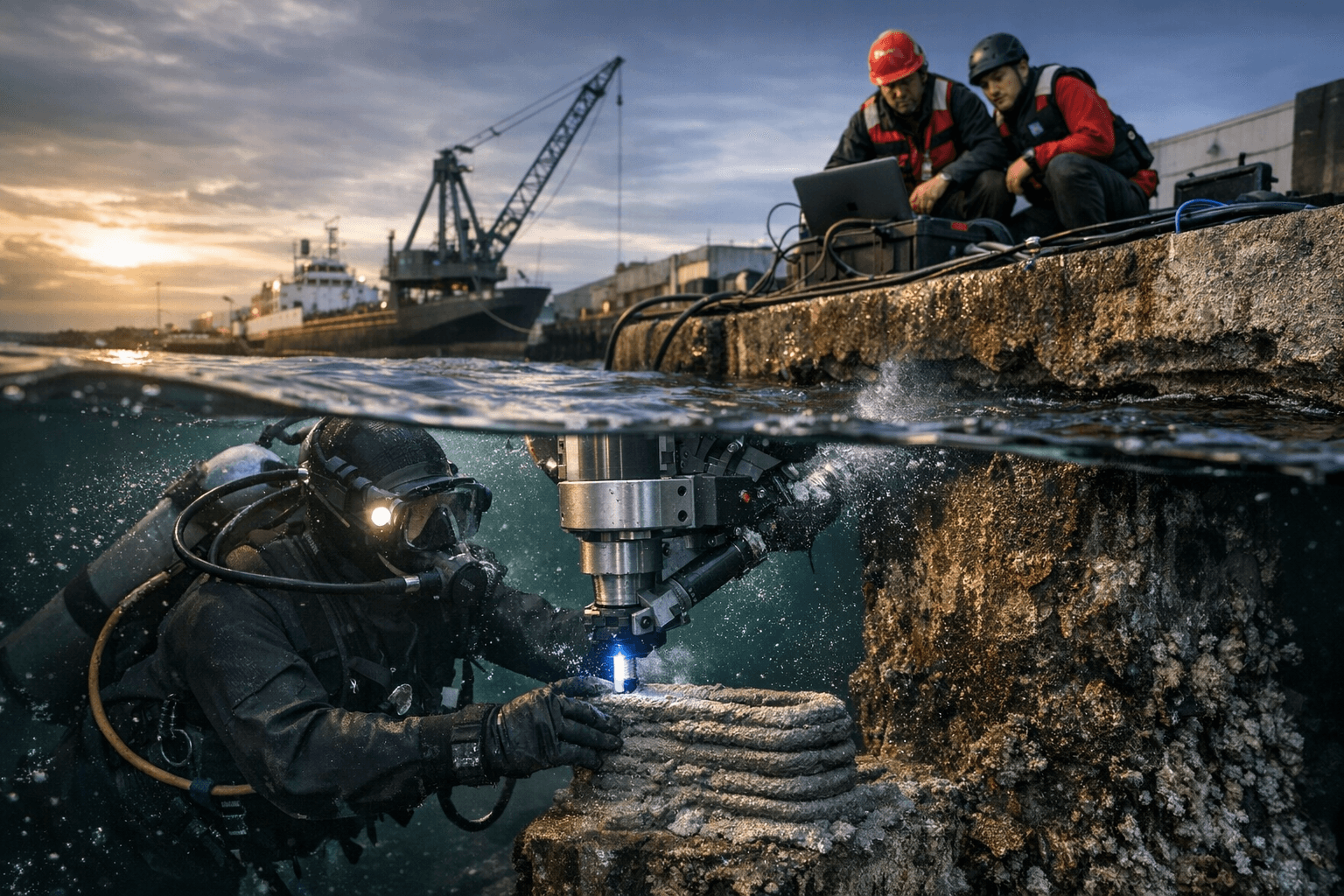
Cornell University researchers are testing a way to print concrete underwater that could let harbor walls, piers and other coastal infrastructure be repaired without draining the site or building huge temporary enclosures. Sriramya Nair, an assistant professor of civil and environmental engineering, said the aim is simple: “We want to be constructing without being disruptive.”
The project started in fall 2024 after the Defense Advanced Research Projects Agency asked for 3D-printable concrete that could be deposited several meters underwater. Cornell landed a $1.4 million grant in May 2025, with the one-year award tied to performance benchmarks. Nair leads the effort with doctoral student Caleb Lunsford and an interdisciplinary team split between material design and fabrication. Cornell is one of six teams in the DARPA challenge.
The printing itself is happening in a large tank of water with a roughly 6,000-pound industrial robot, a setup that gives the team a controlled way to see what survives underwater and what falls apart. The main problem is washout, when cement particles do not bind properly once the mix hits the water. Cornell has been balancing pumpability against anti-washout additives while also trying to satisfy DARPA’s requirement that the concrete rely mostly on seafloor sediment with minimal cement content.
That sediment-heavy requirement is more than a laboratory constraint. It is meant to make the process practical in the field, where hauling in truckloads of material is expensive and slow. Cornell reported progress toward those high-sediment-content targets during a September 2025 visit by DARPA officials, and the team is also developing sensor systems to monitor print quality in real time because turbid water makes visibility poor.
The broader bet is that underwater 3D printing could change the way crews handle ports, bridges, pipelines and undersea cables. DARPA says printing concrete at the point of need can reduce material use and transportation costs, and a successful underwater system would go a step further by cutting surface disruption too. The challenge’s next big test was a March 2026 demonstration in which competing teams were expected to print underwater arches, a harsh proving ground for extrusion control, material stability and the kind of field repair work that has long been difficult to do cleanly beneath the waterline.
Know something we missed? Have a correction or additional information?
Submit a Tip