DTU patents movable optical resin printing system for greater precision
DTU’s patent moves the cure point instead of blasting a whole layer, a setup that could sharpen resin details and cut peel issues if it ever becomes a printer.
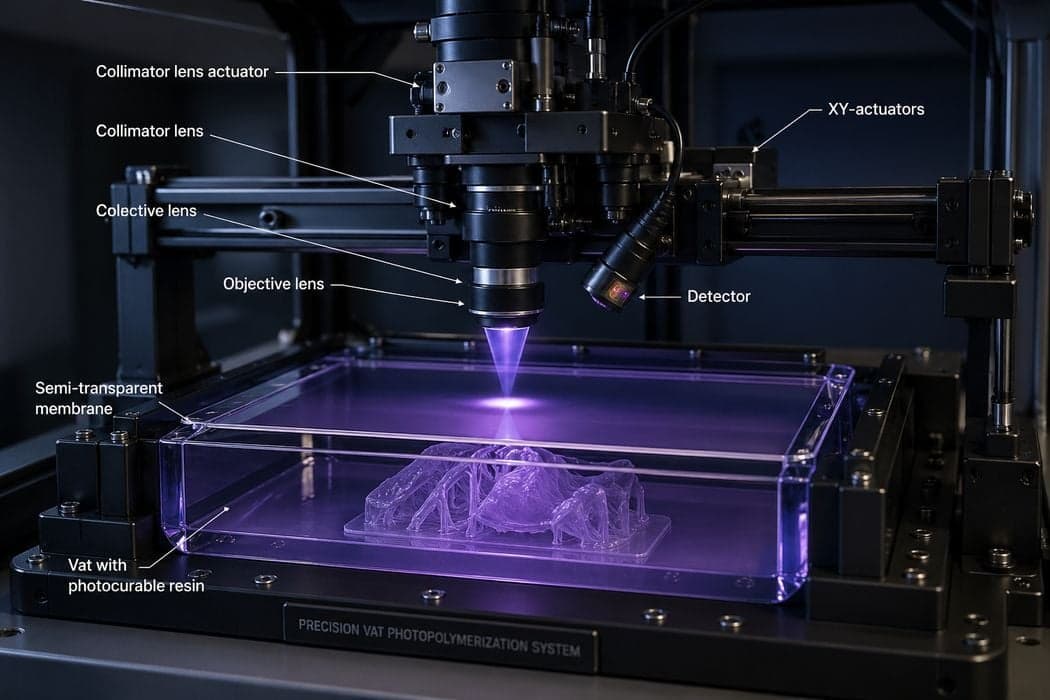
A new Danish patent is pointing resin printing toward something more deliberate than today’s full-layer exposure workflows. Instead of lighting an entire slice at once, the concept from Danmarks Tekniske Universitet uses a movable optical unit so the cure point can be positioned where it is needed, which could give vat photopolymerization far tighter control over how each layer forms.
The patent, WO2025061685A1, titled “Method and system for 3d printing,” was published on March 27, 2025. DTU is listed as the applicant, and Martin Voss, En-Te Hwu, Tien-Jen Chang and Roman Slipets are named as inventors. Its abstract describes a resin container with a wall that is transparent or semi-transparent to part of the first radiation, a first radiation source that cures the resin, a second radiation source that does not cure the resin, and a step for determining information during printing.
In plain language, that means the system is built to do more than just shine light. It is meant to move the optics in the XY plane, control where the focal point lands, and monitor what is happening in the vat while the print is underway. That sits between the familiar desktop resin families. SLA scans a laser, DLP projects an entire image, and MSLA uses an LCD mask. DTU’s idea tries to split the difference by scanning with more targeted control rather than depending on one fixed exposure pattern.
For resin users, the appeal is straightforward: more local control could help with small details, sharp edges and repeatability. It also sounds aimed at the headaches that show up around tricky geometry, resin depth, the membrane interface and cure behavior close to the build surface. If a future printer can watch the process and adjust exposure as it goes, that could mean fewer failed supports, cleaner peel behavior and more consistent results when dialing in a tough resin or a delicate miniature.
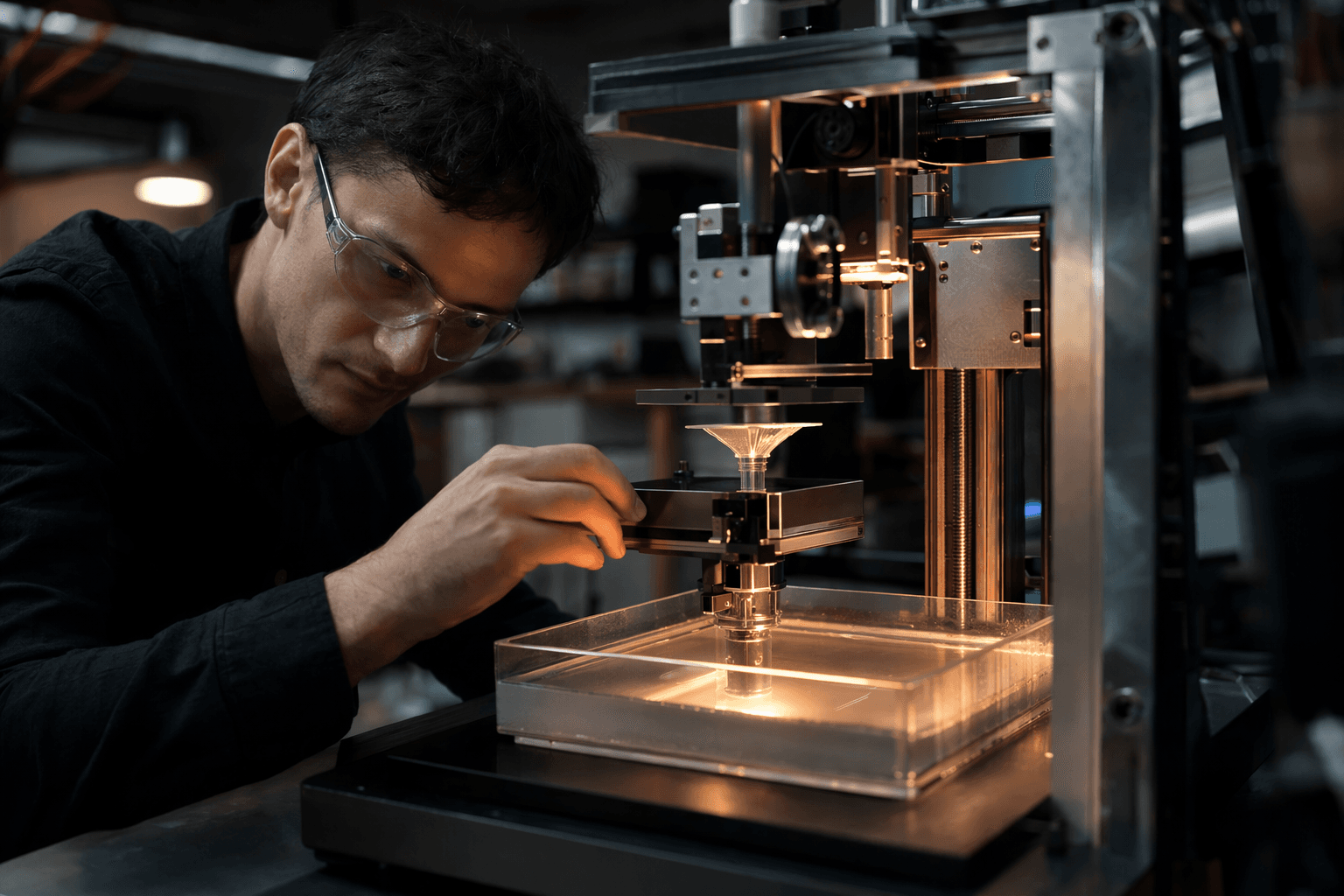
That promise still lives on paper. This is a patent, not a product announcement, so there is nothing to buy yet and no reason to assume a desktop machine will suddenly appear with this exact setup. But DTU’s own vat photopolymerization research explains why the direction matters. Its thesis says MP VPP can deliver microscale resolution and is already used in orthopedics, dental implants and hearing aids, while also noting that proprietary restrictions can limit access to machine controls and slow technological evolution. The same research reports a reliable minimum pixel pitch of 7.56 m on an open-architecture platform.
The broader trend is clear: resin printing is moving toward feedback-driven exposure, not just brighter light or bigger screens. A Stratasys stereolithographic patent has already described scanning the build window, measuring changes in layer properties and modifying the next layer’s energy based on that data. DTU’s filing fits that same arc, and it is exactly the kind of precision-focused idea resin builders will want to keep on the radar.
This article was produced by Prism’s automated news system from verified source data, official records, and press releases, then run through automated quality and moderation checks before publishing. The system is built and supervised by the people who set the standards it runs under. Read our full AI policy.
Did this article answer your question?