Vine-inspired 3D-printed robot grows through tight spaces autonomously
FiloBot is a vine-like 3D-printing robot that grows as it moves, hinting at smarter extrusion, toolpath control, and off-bed fabrication in cramped spaces.
Why this weird lab robot matters to 3D printing
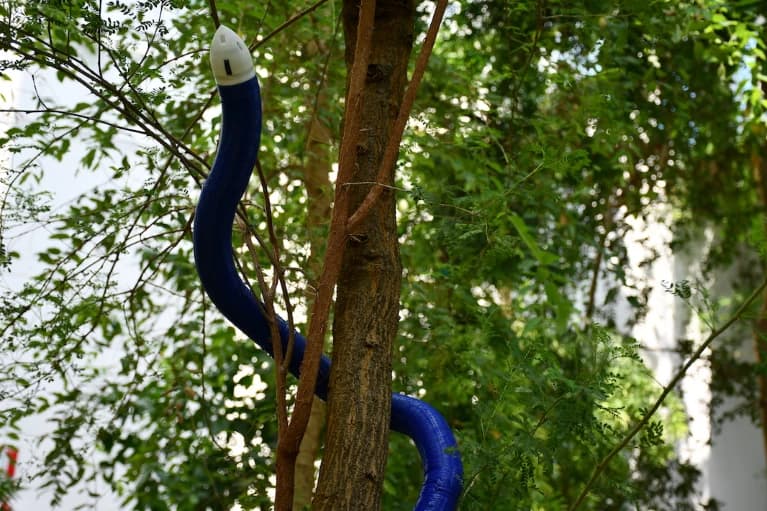
FiloBot is the kind of project that makes you stop scrolling because it feels half science fiction and half slicer nightmare in the best way. Instead of rolling in on wheels or planting itself on a bed, this soft robot grows by 3D printing its own body as it advances, which gives you a very different way to think about extrusion, path planning, and what “printing” even means when the build area is no longer a flat bed. The practical hook is not just that it moves, but that it moves by adding material where it needs it, inside spaces that are too tight, too irregular, or too awkward for conventional robots to handle.
That is the real reason 3D printing people should care. FiloBot is not just a robotics novelty from a lab shelf. It is a test case for continuous fabrication, for printing while moving, and for getting material to the nozzle tip in environments where you cannot simply level the bed, home the axes, and let the machine do its thing.
What FiloBot is actually doing
In Science Robotics, the team describes FiloBot as an autonomous growing soft robot inspired by climbing plants. The robot uses an embedded additive-manufacturing mechanism and a sensorized tip to coordinate adaptive growth, which is a very different proposition from the stationary Cartesian machines most of us live with every day. The published paper, released on January 17, 2024, appears in volume 9, issue 86 as article eadi5908, with Emanuela Del Dottore and Alessio Mondini listed as equal contributors alongside Nick Rowe and Barbara Mazzolai.
The setup matters. The sensorized tip is not just decoration; it helps steer the robot as it grows, while external stimuli such as gravity, light, and shade influence the direction of motion. Nature described the system as growing like a vine and responding to gravity and light, which is a good shorthand for what makes it interesting: the robot does not merely extend itself, it negotiates its environment as it extends.
For anyone who has watched a spool run cleanly for three hours and then blow the print because of a tiny pathing error, that adaptive aspect is the important part. FiloBot is not proving that “robots can print.” It is showing a way to coordinate deposition with sensing so growth and steering happen together.
The material trick is the part worth stealing
The most useful idea here is not the vine aesthetic. It is the way the robot can change its printing parameters to suit the terrain. According to the paper, FiloBot can grow a lighter body for faster movement and twining on supports, or a tougher body that can self-support and cross gaps. That is exactly the kind of material-switching logic the desktop 3D printing world keeps circling around with variable infill, adaptive wall thickness, and multi-material parts, but here it is tied directly to locomotion.
That distinction is huge. On a regular machine, “stronger” usually means slower or heavier in terms of print time and material use. In FiloBot, strength and weight are not just part properties, they are mobility choices. A lighter body helps the robot move and wrap around vertical supports; a tougher body helps it bridge space without collapsing. If you are thinking like a printer nerd, that is basically live tuning of mechanical response based on geometry and route, not just part geometry after the fact.
This is why the project feels relevant to continuous-printing research. It suggests a future where extrusion systems do not just lay down filament in preplanned layers, but modulate composition and stiffness mid-motion to deal with the next obstacle, the next gap, or the next change in support.
Why tight spaces are the whole point
The paper frames the challenge plainly: growing and moving in heterogeneous 3D spaces is still difficult for self-growing robots. That sounds academic until you translate it into the kinds of jobs where hobby-grade machines and common robot platforms hit a wall. Confined channels, cluttered structures, and irregular interiors are exactly where a standard wheeled bot gets stuck, a legged bot loses stability, and a flying bot burns battery and precision trying to hover in place.
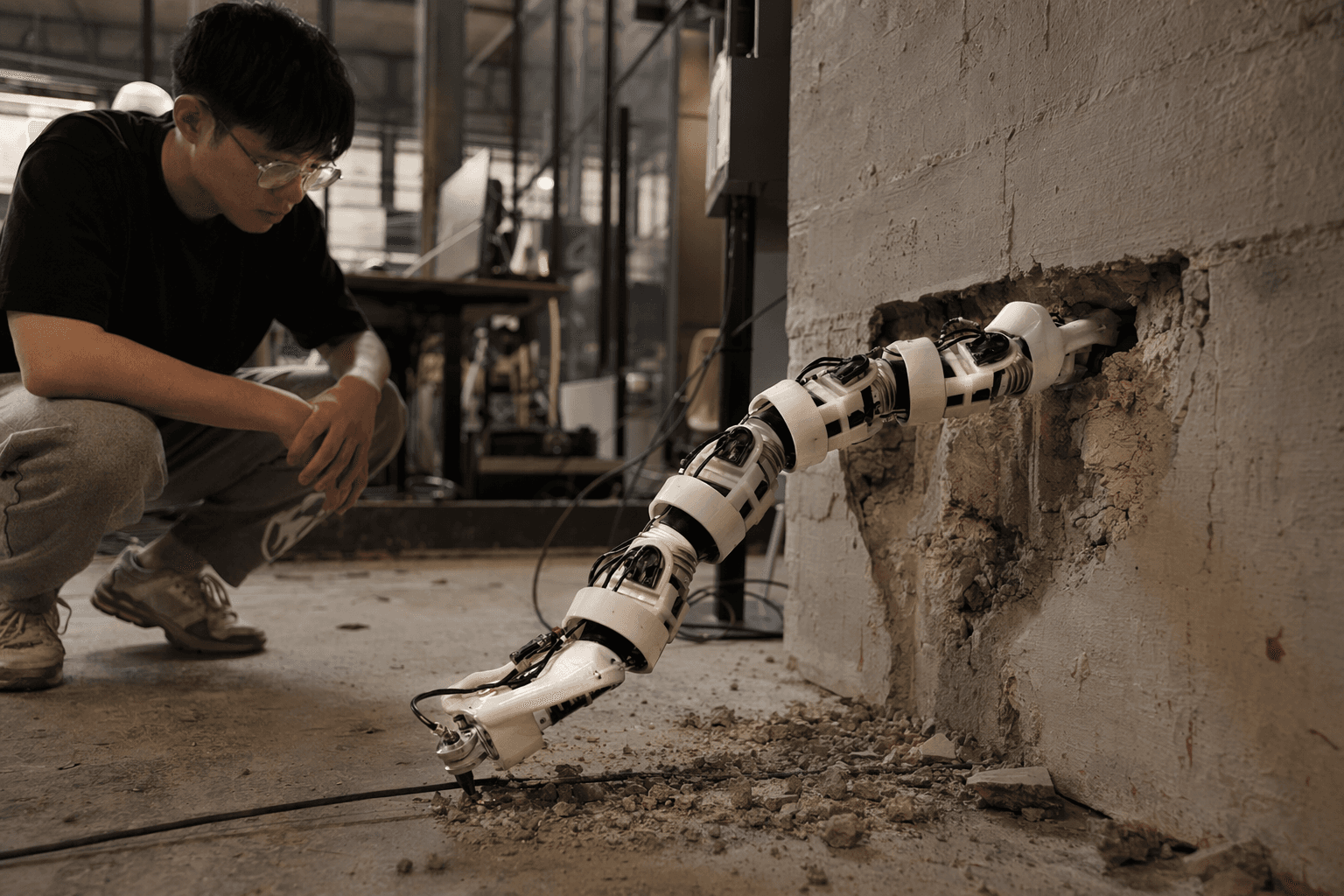
FiloBot is designed to navigate, explore, and colonize unstructured environments, and the paper also points to uses in monitoring and interacting with those spaces. Nature’s coverage adds another layer by pointing out the robot’s vine-like growth and sensitivity to gravity and light, which makes the system easier to picture as a model for plants moving through dense terrain rather than a generic soft robot.
For 3D printing, the takeaway is simple: if the build volume itself becomes the environment, then motion planning starts to look a lot more like path negotiation than layer stacking. That could influence everything from off-bed deposition to robotic toolheads that print inside ducts, around pipes, through scaffolds, or into partially enclosed assemblies where access is the whole problem.
What this hints at for extrusion and toolpath control
If you care about nozzle-to-bed setup, FiloBot points toward a future where the nozzle might not care about a bed at all. The robot’s embedded additive manufacturing mechanism is effectively a mobile extrusion system, and that matters because it pushes the conversation from “How do I keep the first layer stuck?” to “How do I keep material delivery reliable while the machine itself is changing position in space?” That is a much harder problem, and also a much more interesting one.
There are a few obvious directions this opens up:
- Continuous printing that is not locked to a flat plane
- Toolpaths that react to sensed obstacles instead of following a fixed slice
- Material profiles that change on the fly for stiffness, speed, or bridging
- Additive manufacturing in confined or hazardous spaces where conventional access is poor
None of that means you should expect a desktop FiloBot upgrade next month. The paper is still a lab proof of concept, built by researchers at the Bioinspired Soft Robotics Lab at Fondazione Istituto Italiano di Tecnologia in Genova, Italy, working with AMAP at Univ Montpellier, CIRAD, CNRS, INRAE, and IRD in Montpellier, France. That institutional spread says a lot about how interdisciplinary this work is: soft robotics, plant biology, embedded sensing, and additive manufacturing all have to cooperate before the idea becomes practical hardware.
What remains far from desktop use
The biggest gap is still control and robustness. A desktop printer can be annoying, but it is at least operating in a bounded, predictable space. FiloBot has to sense, steer, grow, and decide how its own body should change while negotiating uncertain terrain. That is a much messier control problem than tuning bed temperature or calibrating Z offset.
The second gap is materials. A robot that can alternate between a lighter body and a tougher self-supporting body is impressive, but hobbyists should read that as a direction, not a shopping list. Today’s consumer filament setups are nowhere near autonomous climbing, adaptive stiffness switching, and navigation through unstructured environments as a single integrated system.
Still, this is exactly the kind of strange, overengineered lab robot worth paying attention to. Not because you will print one on your bench next quarter, but because it sketches where extrusion might go once printing stops being about standing still and starts being about moving through the world while building itself.
This article was produced by Prism’s automated news system from verified source data, official records, and press releases, then run through automated quality and moderation checks before publishing. The system is built and supervised by the people who set the standards it runs under. Read our full AI policy.
Did this article answer your question?