Eco-Friendly 3D Printing Filaments: PLA, PHA, and Recycled PETG Explained
PHA biodegrades in as little as 3 months, recycled PETG cuts CO2 by 35%, and a PLA-hemp blend outperforms most commercial polymers — the eco filament landscape is more nuanced than any single "green" label suggests.
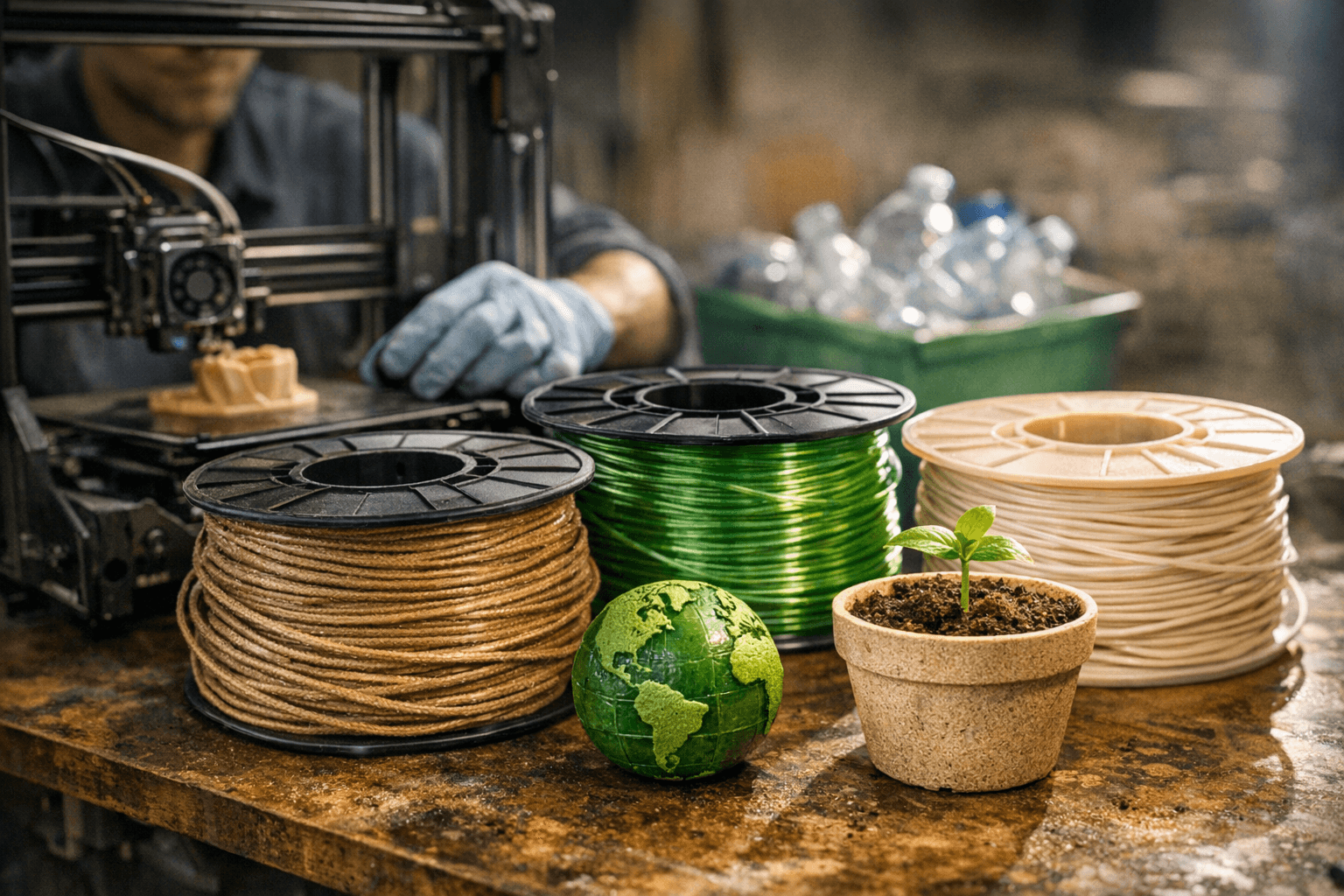
The phrase "eco-friendly filament" gets thrown around a lot in the community, but the reality behind what makes a filament genuinely sustainable is far more layered than a green logo on a spool. The landscape currently breaks into two distinct philosophies: materials designed to disappear, and materials designed to be reclaimed. Understanding both — and their real limitations — is the most important thing you can do before pulling the trigger on a spool marketed as "sustainable."
PLA: The baseline and the caveat
Polylactic acid has been the default "green" choice for desktop FDM for years, and for good reason. Unlike PHA, PLA requires industrial composting facilities operating at 58°C or above and takes years to degrade in natural conditions, often leaving microplastics behind. According to 3dadept, PLA is derived from corn, sugars, and microorganisms, which gives it a bio-based origin story, but that origin alone doesn't make every PLA print environmentally benign once it leaves your print farm. The composting conditions that actually activate its degradation are rarely available in a standard household setup. The environmental benefits of bio-based filaments depend on proper disposal and composting infrastructure; without industrial composting, most biodegradable 3D printing materials will persist in landfills or natural environments for decades.
The more interesting development is what happens when you add hemp to the mix.
PLA-hemp: The composite that earns its eco credentials
As 3dadept notes, combining PLA with hemp "makes it one of the most eco-friendly options" currently available for FFF printing. Since PLA is already derived from renewable biological sources, pairing it with hemp amplifies both the sustainability story and the functional performance. The composite prints at a lower temperature than standard PLA, which translates to less energy consumption per print and a wider window of compatibility with entry-level machines. More importantly, it "demonstrates better mechanical properties than many other conventional commercial-grade polymers," which means you're not trading strength for a sustainability badge. The printability is described as "impressive," making the PLA-hemp blend one of the rare eco materials that doesn't demand compromises on the hardware side.
PHA: The filament that actually disappears
Polyhydroxyalkanoate is where the biodegradability conversation gets genuinely exciting. PHA biodegrades completely in all environments, including soil, freshwater, marine, and home compost, breaking down within weeks to months into CO2 and water with zero microplastic residue. According to 3dadept, PHA "can degrade through depolymerization within three to nine months in general," synthesized naturally by microorganisms through a biological fermentation process. That last detail matters: this isn't a petroleum product with a bio-derived additive grafted on. The resulting material is 100% biobased without chemical modification, produced through entirely natural bacterial processes.
From a printability standpoint, PHA has historically carried a reputation for being finicky, but that's changing rapidly. PHA blends exhibit 30–50% lower viscosity than PLA at low shear rates, ensuring improved processability. The trade-off is that it needs careful thermal management: PHA has a lower melting temperature than many conventional plastics, meaning it consumes less energy, but most PHA types also require longer cooling periods to facilitate crystallization, typically requiring stronger blowing fans and a cold print plate. ColorFabb dominates the PHA filament market with two distinct product lines; their allPHA represents 100% pure PHA available in Natural, Black, and White, priced at $63–66/kg in 750g spools, requiring strict cold bed printing at 190–200°C nozzle temperature with 100% cooling.
3dadept describes PHA as "steadily becoming more commercially and industrially available because of its good printability, thermal stability and low melting point," and the market reflects that trajectory. It'd be naive to say PHA will replace PLA, but having more sustainable and even less toxic solutions are extremely valuable.
Recycled PETG: The pragmatic workhorse
Not every application calls for a material that dissolves in a compost bin. Functional brackets, waterproof enclosures, medical device prototypes — these are contexts where durability is the brief, not biodegradability. That's where recycled PETG earns its place. As 3dadept puts it, "recyclable 3D printing materials may not be as sustainable as their biodegradable counterparts, but they remain a crucial consideration for Additive Manufacturing applications." Since they are "generally more water-resistant and long-lasting, they have more commercial, industrial and biomedical use cases."
The carbon math on recycled PETG is compelling on its own terms. KIMYA, the additive manufacturing materials subsidiary of French printing and coating firm ARMOR, concluded that using recycled PETG filaments can significantly reduce CO2 emissions; their Life Cycle Analysis indicates that recycled PETG filaments help reduce CO2 emissions by up to 35% compared to their non-recycled counterparts. KIMYA conducted LCA tests on both its recycled and standard PETG filaments; the resulting data indicates the recycled filaments emitted 4.08 kgCO2, while their standard PETG filament produced 6.27 kgCO2 of emissions.
On the printer, recycled PETG is sourced from industrial PETG resin once destined for the landfill and is suitable for prototyping and large-format 3D printing thanks to its high flow rate, a wide range of printing temperatures, and superb layer adhesion. Research reveals that recycled PETG demonstrates comparable elastic behavior to virgin material, though slightly lower maximum strength. Keep your spool dry — R-PETG is hygroscopic, and wet filament will string and underperform just like its virgin counterpart.
Wood and hemp blends: Natural fills with real limits
Beyond the PLA-hemp composite, the broader category of natural-fill blends, including wood-filled filaments, round out the eco filament survey. These materials trade some structural performance for aesthetic and sustainability appeal. The high compatibility of PHA with organic fillers like hemp, oyster shells, and coffee waste allows creators to produce pieces that offer a premium, non-plastic tactile experience. Wood-filled filaments typically require a 0.4mm or larger nozzle to avoid clogging and print at slightly lower temperatures than standard PLA, giving them a workflow profile similar to the PLA-hemp composite.
The greenwashing problem you need to know about
Here is where the eco filament conversation gets uncomfortable. As 3dadept bluntly states, "many existing filaments that are supposedly eco-friendly are far from it." A material can be partly derived from organic matter and still fail every meaningful biodegradability test. The mechanism is straightforward: "many will only decompose naturally in highly controlled environments or industrial composting facilities," and most finished prints will never see those conditions. A PLA bracket thrown in a kitchen compost bin isn't going anywhere for a very long time.
The use of recycled materials in 3D printing lowers carbon emissions by over 50% compared to virgin plastics in some scenarios, but only if the material is actually reprocessed through a legitimate recycling stream. Labeling a product "eco" based on partial bio-derived content, without evidence of end-of-life viability, is a problem the community is increasingly calling out. According to 3dadept, "regulators and legislators will notice these issues," which suggests the labeling ambiguity that currently frustrates informed buyers is unlikely to persist indefinitely.
Choosing the right material
The practical split is this: if end-of-life matters and your application allows for it, PHA and PLA-hemp composites are the materials doing the most genuine environmental work. If you need durability, chemical resistance, and a lower carbon footprint versus virgin plastic, recycled PETG is a credible choice with real lifecycle data behind it. The key is to interrogate what "eco-friendly" actually means on any given spool: bio-based origin, industrial recyclability, and true home-compostable biodegradability are three very different claims, and only the last one means your print will actually leave the planet gracefully.
This article was produced by Prism’s automated news system from verified source data, official records, and press releases, then run through automated quality and moderation checks before publishing. The system is built and supervised by the people who set the standards it runs under. Read our full AI policy.
Did this article answer your question?