Five-Axis CoreXY Printer Archer Combines Toolchanger With Non-Planar Multicolor Printing
Maker multipoleguy's Archer printer ran 830 tool swaps on a single print using just 6g of purge waste, redefining what low-waste multicolor non-planar FDM can look like.

A three-color double helix print. Eight hundred and thirty tool swaps. Six grams of purge material. That benchmark from multipoleguy's Archer prototype flipped the script on what most people assume multicolor FDM requires: a tower of wasted filament the size of a small building.
Archer is a five-axis CoreXY desktop FDM machine that pairs a four-hotend automatic toolchanger with a tilting print bed mounted on three ball joints. The bed tilt delivers two additional rotational axes on top of the standard CoreXY X/Y/Z motion, bringing the total to five degrees of freedom. The practical result: the nozzle approach vector can be changed continuously throughout a print, which is exactly what non-planar deposition demands. The hardware was developed entirely by a community maker operating under the handle multipoleguy, and the project is explicitly aimed at the maker level rather than the industrial lab.
The toolchanger architecture is what makes the waste numbers remarkable. Conventional multicolor systems running an AMS or an MMU through a single hotend burn filament every time they switch colors, generating purge blocks or towers that can weigh tens of grams per session. Archer's four independently switchable hotends sidestep the single-nozzle flush cycle almost entirely. Eight hundred and thirty swaps producing roughly 6 grams total means each individual swap wastes less than 0.01 grams on average, a figure that changes the economics of multicolor printing at the desktop level.
The hardware, though, is only part of the story. multipoleguy also built MaxiSlicer, a dedicated software tool capable of generating non-planar toolpaths and managing the complex sequencing those 830 swaps required. That combination, functioning hardware plus a working slicer, is what moved Hackaday to note that Archer breaks the trend where "non-planar printers are rather rudimentary prototypes," treating it instead as a system with repeatable, workhorse-like results.
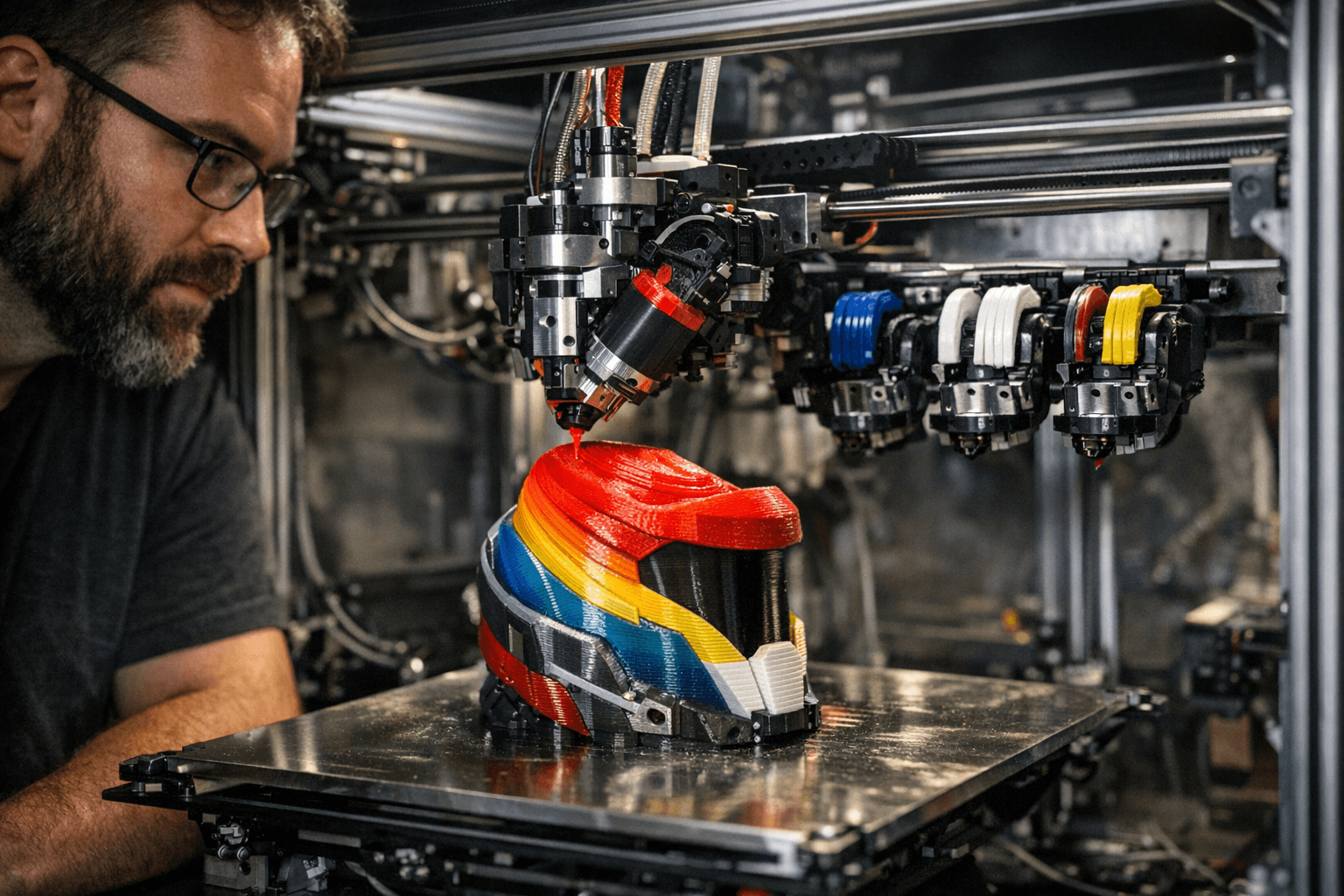
Non-planar toolpaths earn their complexity by solving two problems that planar slicing cannot. First, they eliminate or reduce the stair-stepping artifacts that make curved surfaces look layered rather than smooth. Second, because the nozzle can approach a surface from an angle rather than strictly from above, the printer can deposit material in orientations that conventional overhangs would require supports to reach. Fewer supports means less post-processing, less material waste, and stronger final parts where layer lines align with stress directions.
The honest caveat is that MaxiSlicer is still in development, and that gap is the real frontier. For five-axis non-planar printing to land in mainstream workflows, three things need to happen: mainline slicers like PrusaSlicer or Orca need to add non-planar toolpath generation as a first-class feature rather than an experimental plugin; calibration routines for tilting-bed kinematics need to become as straightforward as bed-leveling wizards already are; and collision detection for multi-axis moves needs to be baked into slicer previews so operators can catch gouges before they happen at the nozzle. These are trackable milestones, not abstract wishes, and the community already has prior art to pull from.
Archer will not ship as a kit next month. But it demonstrates, with actual benchmark prints rather than CAD renders, that combining five-axis motion, low-waste toolchanging, and non-planar deposition into a single desktop system is an engineering problem that has been solved at least once already. The remaining barrier is software, and software moves faster than gantries do.
This article was produced by Prism’s automated news system from verified source data, official records, and press releases, then run through automated quality and moderation checks before publishing. The system is built and supervised by the people who set the standards it runs under. Read our full AI policy.
Did this article answer your question?