Heatforge 3D Launches Free VOC Calculator for Safer FFF 3D Printing
Heatforge 3D's free web calculator estimates VOC concentrations from FFF printers using room size, printer count, and ventilation rate, covering ABS, PLA, nylon, HIPS, and PVA.
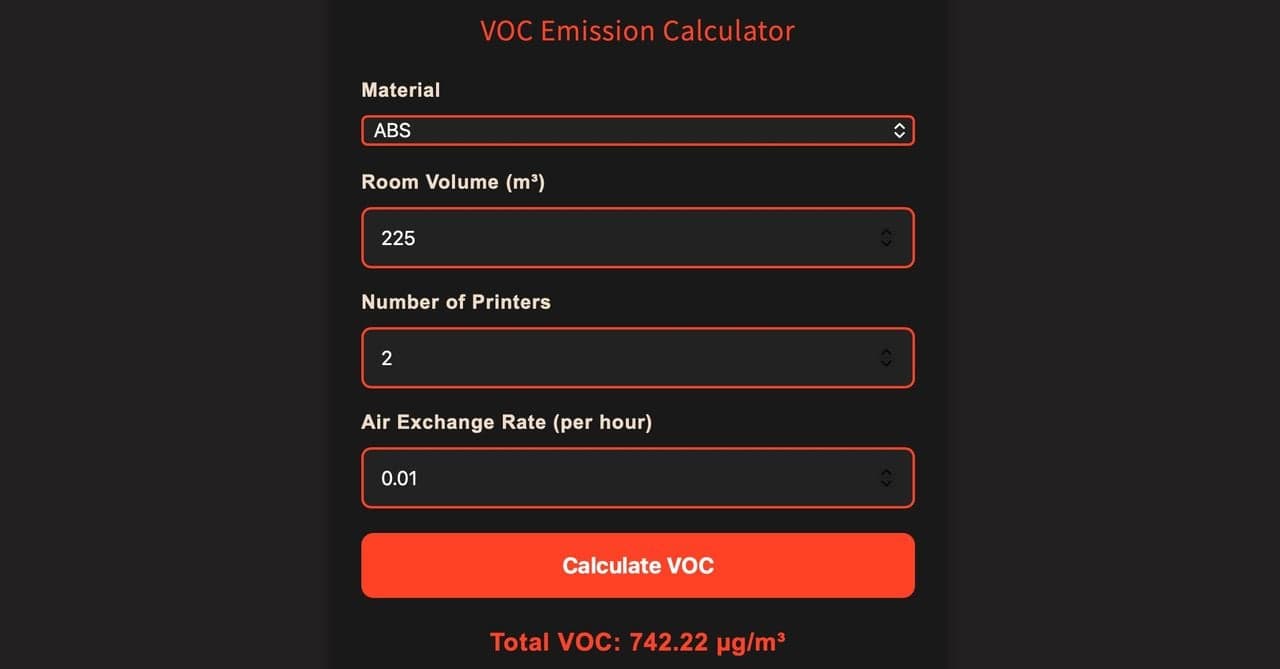
Heatforge 3D released a free web-based VOC calculator aimed squarely at desktop FFF printer operators. VOCs, or volatile organic compounds, are a mix of chemicals emitted during the heating of plastics, numbering in the hundreds of distinct compounds, each with its own toxicity profile. You cannot see them, and you usually cannot smell them either, yet every FFF printer produces them with every print.
Desktop FFF printers also emit nanoparticles, essentially chunks of material so small they become airborne and can be breathed in. The combination makes unventilated print rooms a genuine health concern, one the community has lacked practical tools to quantify until now.
VOC levels depend on material type, printing temperature, printer count, room size, and especially ventilation, and the calculator uses published emission data to estimate the total VOC concentration in a space under different conditions. The tool currently supports HIPS, PVA, ABS, PLA, and nylon (PA), and while plenty of other filaments exist, their VOC emissions tend to fall within a similar range to those already listed.
For a given material, the output can list a dozen or more VOCs, including formaldehyde, decanal, 1-butanol, and other compounds, all based on actual studies of emissions produced by desktop 3D printers. It is worth noting that the underlying peer-reviewed study assumes a deposition rate of around 11 g/h, while modern printers often operate at rates several times higher. To find your printer's actual deposition rate, slice a part and divide the material used by the print time.
The workflow is straightforward: choose a material, enter room volume in cubic metres, specify the number of printers running simultaneously, and input your ACH (air changes per hour) value. Natural ventilation in a typical home runs from 0.2 to 0.7 ACH, so 0.5 ACH is a reasonable default if you are unsure. An exhaust fan's ACH can be calculated by dividing fan airflow in cubic metres per hour by room volume; a 120 m³/h fan in a 30 m³ room produces 4 ACH. After clicking "Calculate VOC," the tool returns an estimated total VOC concentration and a breakdown of the specific chemicals associated with the selected filament.
The calculator benchmarks those concentrations against established regulatory reference levels. Styrene, a primary concern with ABS and HIPS, carries a residential limit of 220 µg/m³ according to the Japan Styrene Industry Association. Formaldehyde's OSHA standard (1910.1048) sets an 8-hour TWA at around 920 µg/m³, while caprolactam, relevant to nylon printing, has an 8-hour REL of roughly 1,020 µg/m³ per the New Jersey Department of Health. Lactide, the primary VOC from PLA and the compound identified in early research by Stephens et al. at emission rates of 4 to 5 µg/min, has no established guideline and is considered low toxicity. All figures are expressed in µg/m³ using the conversion formula: µg/m³ = 1,000 × ppm × (molecular weight ÷ 24.45).
Heatforge 3D notes that most published limits are designed for workplaces with short-term exposure in fully ventilated environments, whereas indoor hobby rooms typically require lower concentrations because exposure can be continuous and ventilation is weaker. Those limits are also rated for working adults and do not account for children, infants, elderly users, or people with existing health conditions.
Fabbaloo's Kerry Stevenson, who reviewed the tool, called it "the first time I've seen a way to estimate VOC pollution in a 3D printer workshop." Adjusting the ACH input is where the calculator becomes most instructive: higher ACH reduces VOC buildup and improves overall air quality, and the numerical difference between a poorly ventilated room and one with an exhaust fan is immediately visible in the output.
Anyone operating a desktop FFF printer, particularly in a small room, should run through the calculator to understand what ventilation is actually required to operate the equipment safely. The tool is free and accessible at heatforge3d.com.
This article was produced by Prism’s automated news system from verified source data, official records, and press releases, then run through automated quality and moderation checks before publishing. The system is built and supervised by the people who set the standards it runs under. Read our full AI policy.
Did this article answer your question?