HEZO Brings Scan-to-Print Custom Cycling Shoes to Market With Smartphone Technology
HEZO's FDM-printed cycling shoes start at €249 and use a smartphone app to capture 1,000 data points per foot, undercutting rivals like Lore Two by over $1,000.
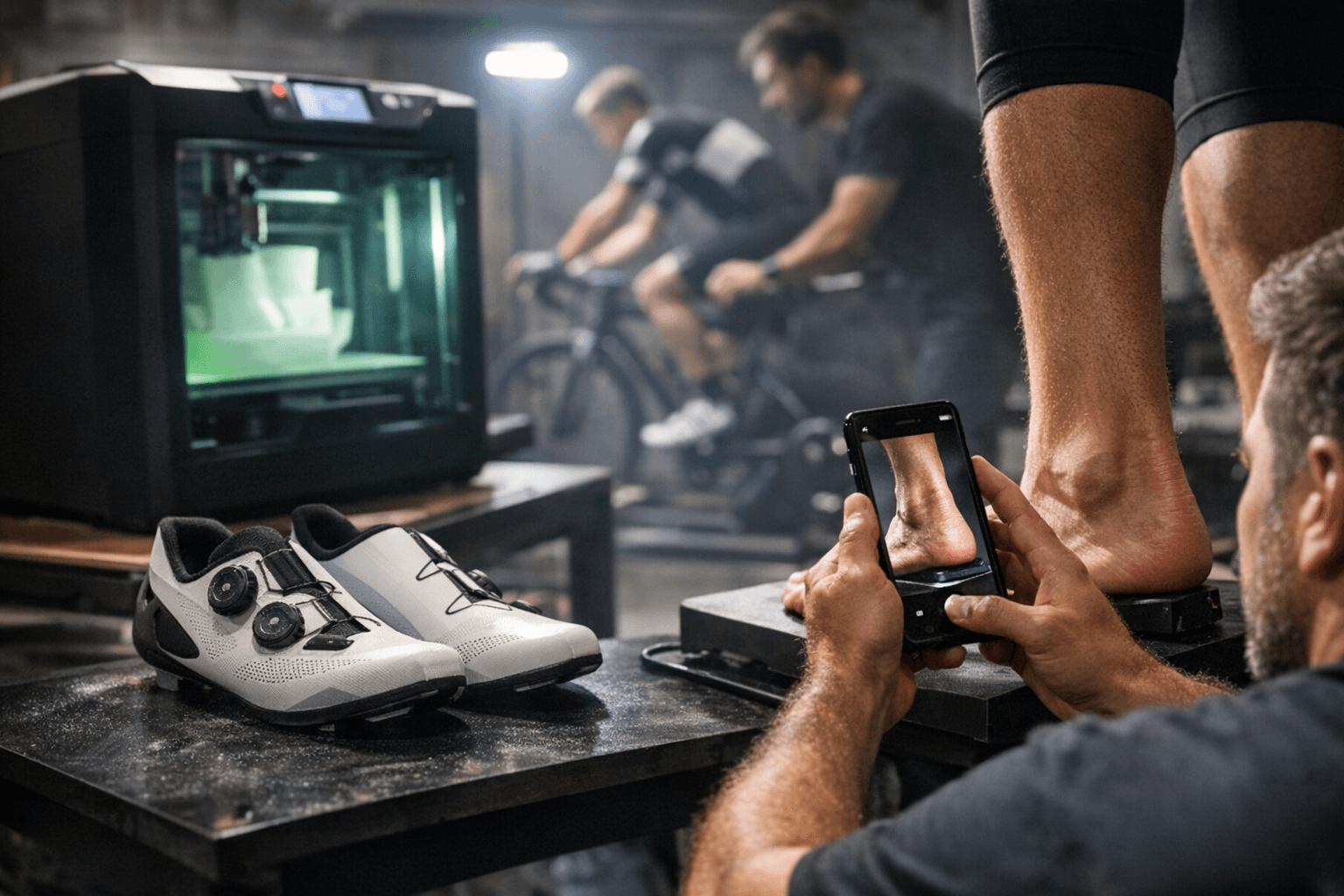
A German startup called HEZO has built a scan-to-print cycling shoe system that starts at €249 and goes toe-to-toe on customization with products costing five times as much. The company uses a smartphone app to capture around 1,000 data points per foot, runs those measurements through proprietary fitting software, and FDM prints each pair individually in Germany after the order lands, with zero inventory sitting on shelves.
The founding team behind HEZO reads like a deliberate cross-discipline build: Helen Wiehr holds a Master of Industrial Design and the whole concept traces back to her 2018 product design thesis; Carsten Kaldenhoff brings a Master of Engineering background and time as a competitive cyclist; and Dr. Nils Hasler holds a PhD in Computer Science. They registered the company originally as Gegenwind Sport GmbH in February 2022, launched their first shoe, the Helu One, in December of that year, and have since grown the lineup to include the Wolfland 01 for gravel, the Helu Two Carbon and Helu 03 for road, and the Oasis recovery slides.
The fit process is worth understanding in mechanical terms. Customers take three photographs using HEZO's mobile app, and the software extracts around 1,000 data points from those images, with a claimed 1-millimeter accuracy. That data drives the construction of a foamed TPU inner shoe contoured precisely to the customer's foot, which is then wrapped in a rigid printed outer shell the company calls the MonoShell. The design is zero-drop with expanded toe room, and because the inner is built to match individual foot geometry, traditional insoles are eliminated entirely. The shoes target riders with asymmetrical feet, wide forefeet, or chronic pressure issues, but the positioning also reaches performance-oriented cyclists who have simply never found an off-the-shelf fit that works.
On pricing, VoxelMatters puts gravel shoes starting at €249 (roughly $284) and road shoes at €279 (roughly $319), with the top of the range sitting at €359. The most direct competitor in this space is Lore Cycle, whose Lore Two, developed in partnership with Lubrizol, features a TPU upper tailored to individual biomechanics and starts at $1,349. Some custom printed cycling shoe options on the market reach $1,649. HEZO's entry point lands well below that band while still delivering a made-to-order, no-inventory production model assembled in Germany with recyclable FDM materials.
For anyone who has ever spent a long ride fighting a hot spot at the ball of the foot or dealing with the numbness that sets in around hour three, the math here is genuinely interesting. Custom-fit at a price that's closer to a premium off-the-shelf shoe than a boutique bespoke product is exactly the kind of gap that additive manufacturing was supposed to close.
This article was produced by Prism’s automated news system from verified source data, official records, and press releases, then run through automated quality and moderation checks before publishing. The system is built and supervised by the people who set the standards it runs under. Read our full AI policy.
Did this article answer your question?