ICON Opens Reservations for Titan 3D Printing Construction System
ICON opened $5,000 reservations for Titan, its rail-less multistory concrete printer, with first deliveries slated for early 2027 at roughly $20 per square foot.
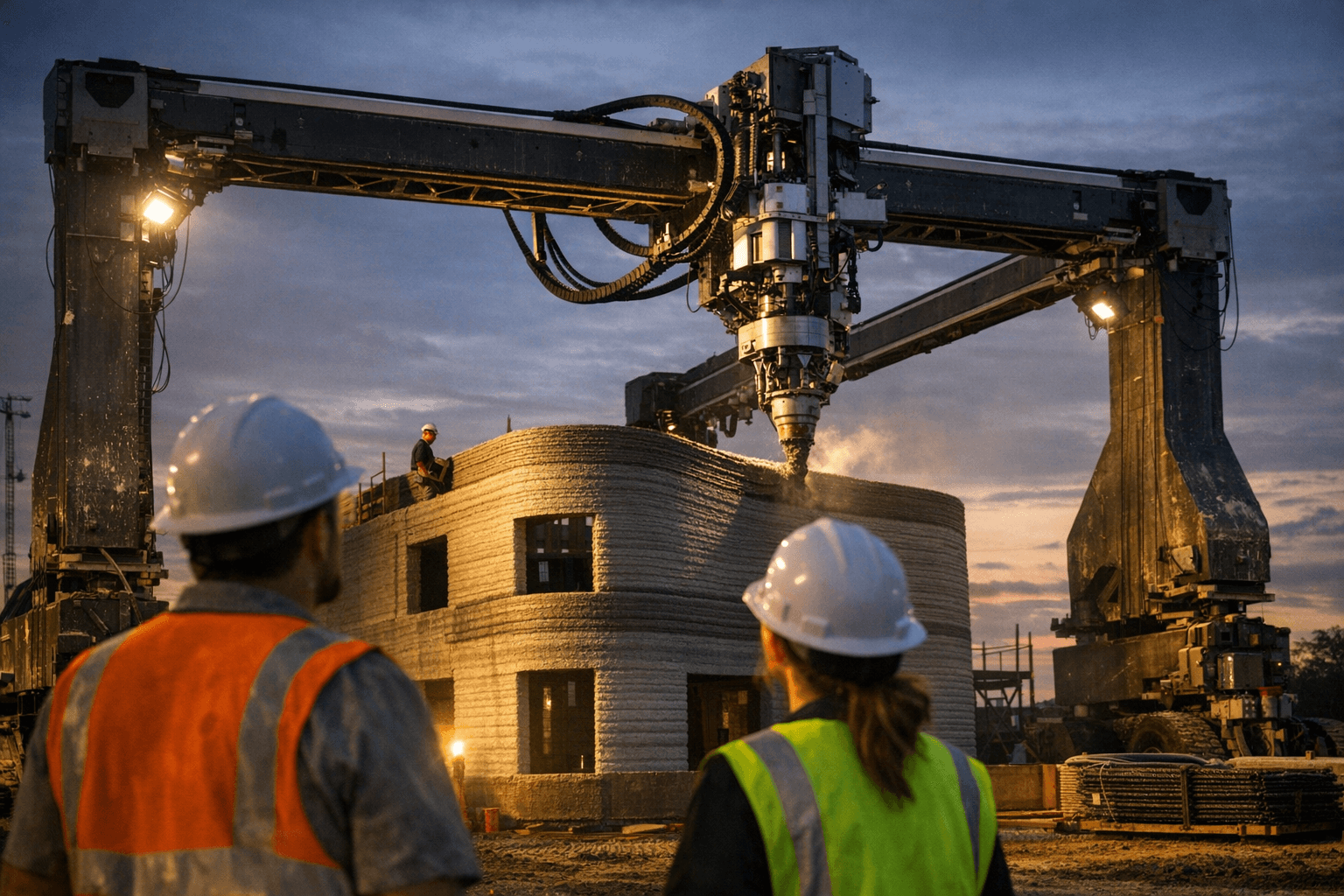
ICON officially opened commercial reservations for Titan, its large-scale robotic construction system, on March 11, 2026, marking the first time the Austin-based company has made its printing technology available for builders to purchase and operate themselves. Deposits are set at $5,000, with customer training scheduled to begin in Q3 2026 and first system deliveries expected in early 2027.
Titan is a rail-less, multistory-capable 3D concrete printing platform that extrudes specialized construction materials layer by layer to build reinforced wall systems. Unlike ICON's earlier Vulcan system, which the company deployed through its own projects and partnerships, Titan is explicitly designed for outside builders to own and run. ICON has printed more than 245 homes and structures across the United States and Mexico, but this is the first time that operational capability is being sold outright to the broader construction industry.
The economics ICON is pitching are hard to ignore. The company says Titan can build multi-story wall systems at roughly $20 per square foot, which it estimates represents up to a 40% cost reduction compared to traditional framing methods. That figure has tightened from the $25 per square foot or less that appeared on ICON's informal one-pager when it unveiled the Titan engineering prototype in 2024. At that point, ICON wasn't even planning a full commercial program: dozens of people paid a $1,000 reservation deposit off that single sheet with almost no supporting documentation.
The commercial rollout goes well beyond hardware. ICON is packaging Titan as a full ecosystem: the robot itself, software, materials supply, architectural design tools, a design catalog, project logistics support, permitting guidance, and workforce training. If something breaks on site, ICON says a field engineering "red team" will respond to get the machine back online, a support model the company compares to an F1 pit crew. As ICON leadership put it, "We don't see this as 'sell you a robot and wish you luck.' We see it as: you're part of the ICON team and family now, and we're going to support you."
Jason Ballard, ICON's co-founder and CEO, framed the launch as a turning point after nearly a decade of internal development. "After nearly a decade of research, development, and field operations, we believe it's time to put these technologies directly into the hands of other builders," Ballard said. He also described the commercial positioning directly: "The Titan program is for builders who don't want to choose between high quality, higher speed, and lower cost. These are tools for builders who are tired of the status quo, and want to be part of the solution."
Early deployments are already lined up. Titan will be used to print a 35-foot church at Mobile Loaves & Fishes' Community First! Village in Austin, as well as a 60-plus-home multistory residential development in the city. A separate 100-home development at Georgetown's Wolf Ranch Community is also associated with ICON's technology rollout, though sources vary on whether that project and the Austin development are distinct. Some early reservation holders are also planning to use Titan for rebuilding homes lost in the California wildfires, according to ICON.
Builder feedback from existing ICON projects has been strong. Charlie Coleman, Austin Division President at Lennar, which partnered with ICON on a prior project, said: "The strength of these homes, the strength of these wall systems is like no other homes that we typically build."
For anyone in the construction 3DCP space who has been watching ICON operate as its own developer for years, Titan's commercial launch is a significant shift in direction. The technical questions worth following: whether "two-storey" and "multi-story" reflect different tested capability thresholds, and exactly what the machine-level specs look like in terms of footprint, mobility, and cycle rates. ICON hasn't published a detailed hardware spec sheet yet, but with Q3 training approaching, that information will need to surface soon.
This article was produced by Prism’s automated news system from verified source data, official records, and press releases, then run through automated quality and moderation checks before publishing. The system is built and supervised by the people who set the standards it runs under. Read our full AI policy.
Did this article answer your question?