ICON's Phoenix 3D Printer Uses Tracks to Build 27-Foot Structures Faster
ICON's Phoenix construction printer runs on 70-foot-radius tracks and prints 27-foot concrete structures at half the cost of conventional builds — here's what its engineering actually means for desktop makers.
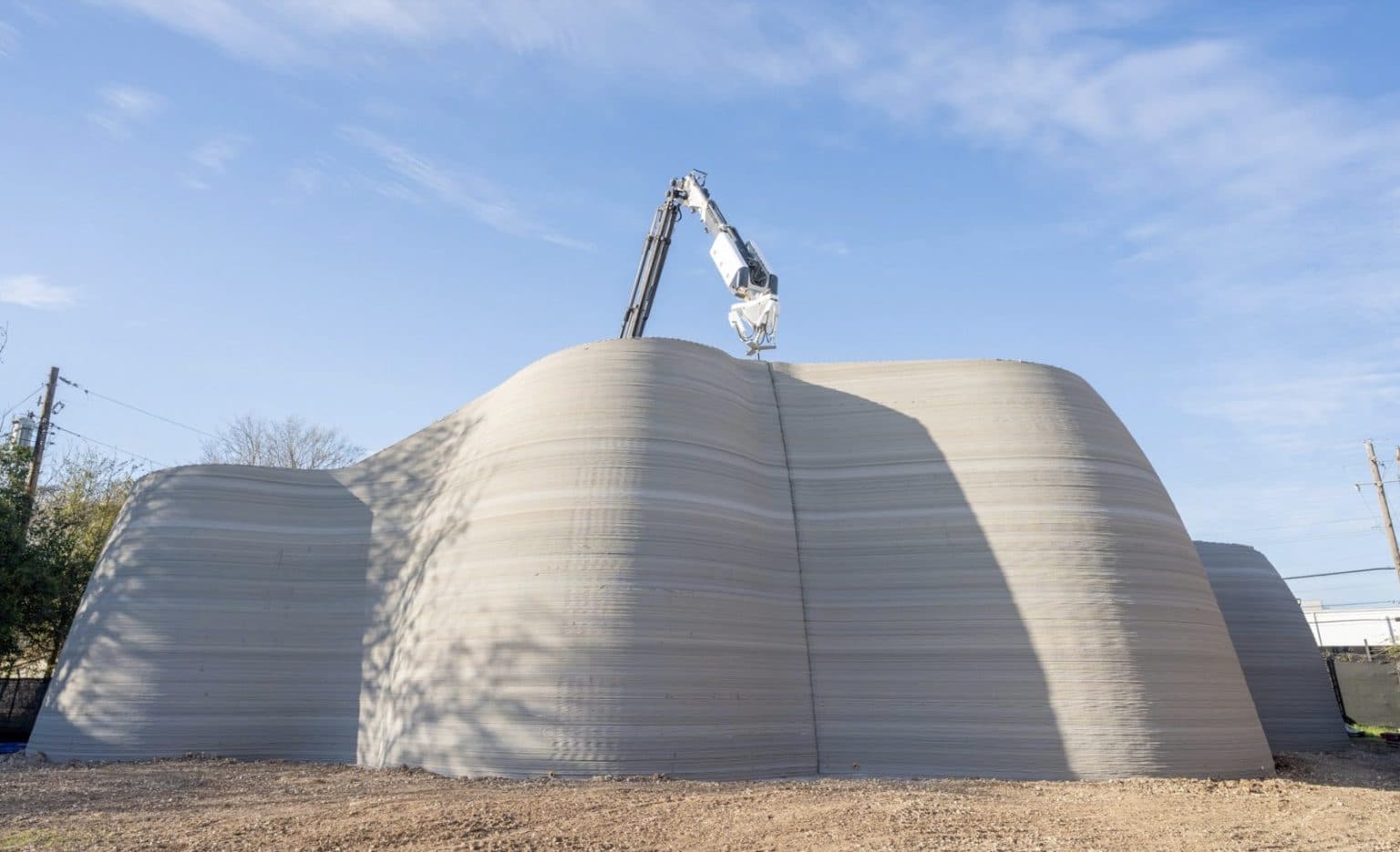
Cut your housing wall-system cost to $25 per square foot and you've just undercut conventional construction by enough to save $25,000 on an average American home. That's the claim ICON put behind its Phoenix construction printer at SXSW in Austin, Texas, on March 12, 2024, and the engineering deployed to get there is worth understanding if you run a Bambu or Voron at home.
Phoenix is a crane-like system that travels on circular tracks with a 70-foot radius. The crane itself stands 70 feet, and the print head hangs from it on a gyroscope-stabilized nozzle, depositing layer upon layer of Lavacrete, ICON's proprietary cementitious admixture. The key word in that sentence is "gyroscope." At the scale ICON is working, nozzle sway from wind, vibration, or mechanical flex would ruin a print the way a loose X-gantry belt ruins a Benchy. ICON's solution was to borrow stabilization hardware from camera-crane engineering. The track radius lets the print head sweep a full building footprint without repositioning the machine, which means Phoenix can cover multiple adjacent structures in a single setup, killing mobilization time per structure.
That mobilization math is where the engineering starts to matter for desktop makers. The reason Phoenix's costs drop is almost entirely operational: more volume per setup, fewer operators, fewer consumables since there is no formwork required. ICON says Phoenix will reduce its printing costs by half by "increasing speed and size and decreasing setup time and the number of required operators." If you run a print farm, you already understand the logic. Repositioning time is dead time. Building modular rail extensions for large-format CoreXY machines to print multiple parts in a single bed load, rather than babysitting sequential prints, follows the same principle. Phoenix does it at 27-foot height across thousands of square feet; you do it at 350mm.
Phoenix is capable of printing an entire building enclosure, including foundations, walls, and roof structures, in one continuous workflow. That is the structural analogy to printing a fully enclosed box with integrated supports in a single job instead of splitting it into eight separate prints and gluing them together. The more interesting question for desktop operators is fault detection. At ICON's scale, a failed concrete layer isn't a canceled print; it is a structural liability. ICON's previous Vulcan II ran a documented deposition rate of five to seven inches per second along the nozzle path, and Phoenix runs faster and taller, though ICON has not published a layer-rate figure for the new machine. The move to gyroscopic stabilization implies that layer geometry verification and real-time deviation correction were central to that engineering iteration. For hobbyists building large-format delta or CoreXY machines, automatic bed mesh compensation and resonance input shaping, both now standard in Klipper, are the desktop equivalent of that fault-detection philosophy. The lesson is not the hardware; it is the mindset: at scale, you cannot babysit every layer, so you instrument.
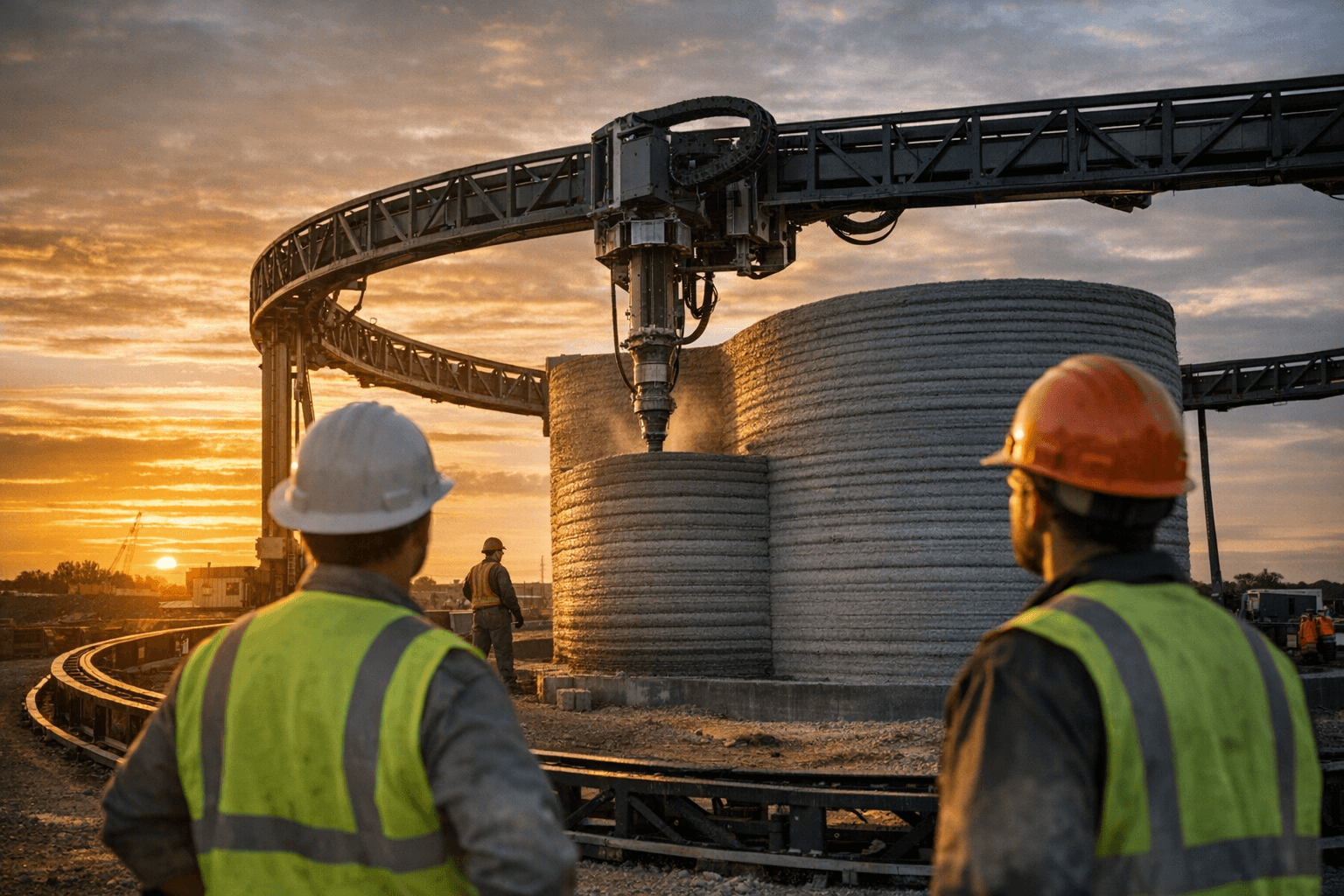
What will not trickle down is the material science. Lavacrete is Portland cement-based, mixed on a truck, and pushed through a pump at feet-per-minute throughput. No FDM filament, no pellet extruder, and no paste printer in the hobbyist tier operates in the same material regime. The wall thickness, layer adhesion chemistry, and cure dynamics of concrete are categorically different from PLA or ASA. Material substitution is not the lesson.
Alongside Phoenix at the same "Domus Ex Machina" presentation, ICON unveiled CarbonX, billed as the lowest-carbon residential building material ready for deployment at scale, with shipments to the field set for April 2024. ICON also announced an AI Architect tool for home design and project management and a digital catalog containing more than 60 ready-to-build residential designs. Orders for Phoenix projects opened immediately, with wall systems starting at $25 per square foot and full enclosures including foundation and roof starting at $80 per square foot. ICON says both figures undercut the most recent publicly available data for conventional construction.
For context on the scale gap: the Bambu Lab H2S, one of the largest desktop FDM printers on the market, offers a 340x320x340mm build volume, roughly the size of a carry-on bag. The Modix Big-180X, considered extreme in the enthusiast market, costs around $15,000 before modifications. Phoenix swings a 70-foot arm and prints 27 feet into the air, integrating structural engineering, civil code compliance, on-site material mixing, and real-time motion compensation into a single deployment. Desktop printers are still solving first-layer adhesion. The gap is enormous, but the underlying problem-solving vocabulary, motion system modularity, calibration pipelines, fault detection logic, and the relentless drive to eliminate setup time, is exactly the same language, just spoken at a very different volume.
This article was produced by Prism’s automated news system from verified source data, official records, and press releases, then run through automated quality and moderation checks before publishing. The system is built and supervised by the people who set the standards it runs under. Read our full AI policy.
Did this article answer your question?