Infrared nozzle preheating boosts PEI print strength without huge chambers
Infrared nozzle preheating could make PEI printing stronger and flatter without a giant heated chamber. That pushes ULTEM-class parts closer to advanced desktop machines.
Infrared heat is attacking the real PEI bottleneck
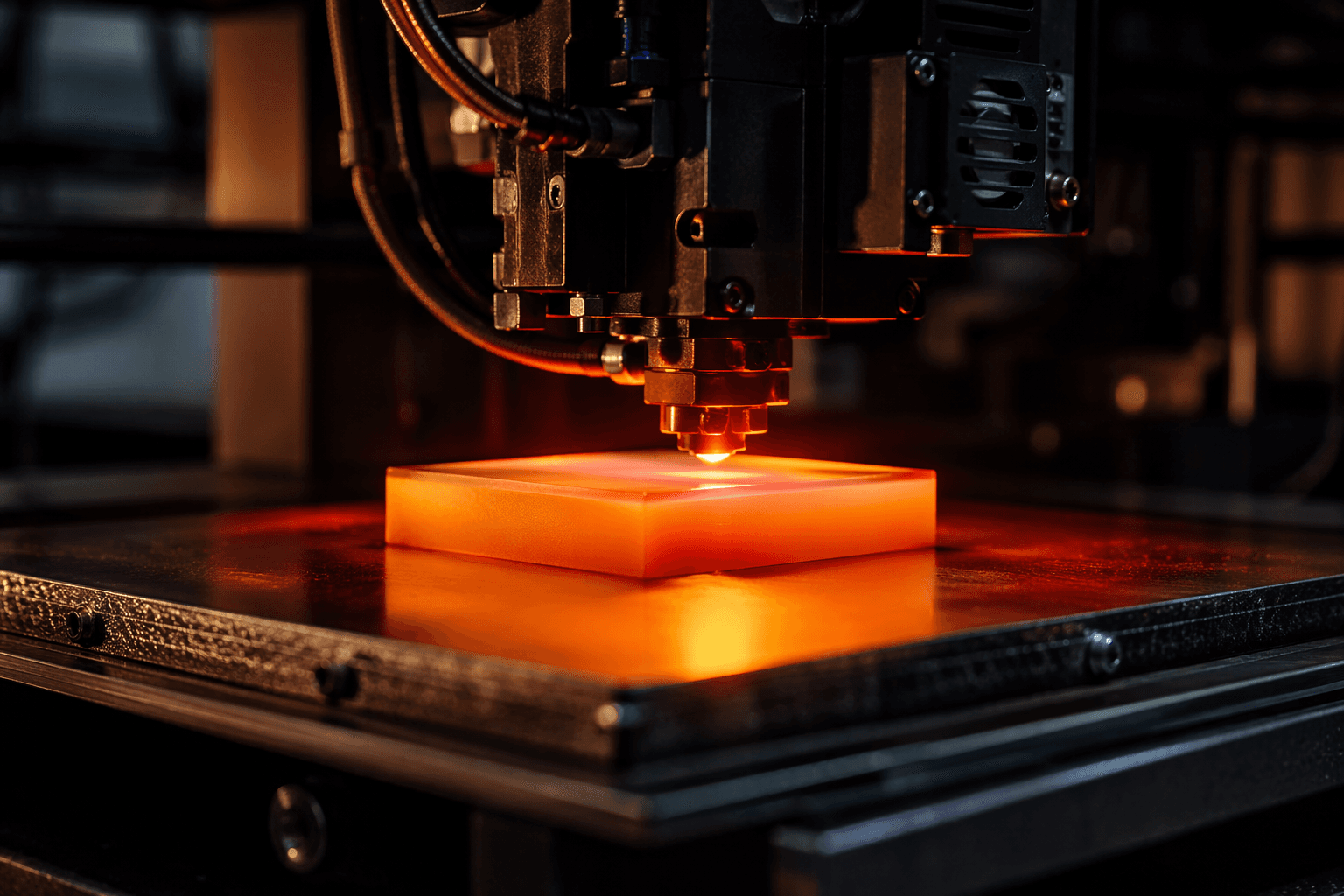
A pair of infrared emitters aimed at the nozzle is doing something that matters immediately to anyone chasing ULTEM-class parts: it is making PEI prints stronger and more stable without forcing the whole build space into a 200 C oven. That is a big deal because the hardest part of printing super-engineering thermoplastics has never been only nozzle temperature. It has been controlling the thermal window around the part long enough for layers to bond before the plastic locks up and warps.
The material under the microscope here is ULTEM 9085, a polyetherimide that has become a benchmark for high-performance FFF. It is also a serious one, not a novelty filament. ULTEM 9085 was the first 3D-printed thermoplastic qualified by the U.S. Federal Aviation Administration for high-performance aviation use, and it is prized for its strength-to-weight ratio, chemical resistance, and flame retardance. That makes the latest infrared approach interesting for more than one reason: it targets a material that already has real industrial credibility, while trying to remove one of the biggest barriers keeping it out of more desktop-scale workflows.
Why PEI printing usually demands so much hardware
PEI behaves like the kind of polymer that punishes weak thermal control. Even when the material is printable, the printed part can still fall short of the bulk material because layer bonding is not fully optimized. Earlier work cited alongside the new study showed just how sensitive the process can be, with a 20 C increase in ambient temperature delivering a 20% rise in strength. That kind of result explains why people keep building bigger enclosures, heavier chambers, and more elaborate thermal systems around high-temp extrusion.
The new approach shifts the strategy. Instead of making the entire machine behave like an industrial oven, the printer heats only the area that matters most, right at the road-to-road interface. That is the practical lure for advanced users: fewer gigantic chamber requirements, less all-over thermal mass to manage, and a clearer path to stronger PEI parts on equipment that still looks and feels like a printer, not a laboratory cabinet.
How the infrared system works at the nozzle
The system uses dual infrared emitters flanking the nozzle. One emitter preheats the previously deposited road just before contact, while the other maintains a warm micro-environment after deposition. That detail matters because it turns the print zone into a controlled bond window instead of relying on ambient heat alone. The lamps were adjustable from 6 to 69 W and placed 15 to 25 mm from the part, which gives a sense of how tightly the process is tuned.
The rest of the setup also tells you this was not a toy experiment. Printing was done at a 370 C nozzle temperature, an 80 C chamber temperature, and 60 mm/s print speed. That chamber temperature is far below the 120 C to 200 C range often associated with ULTEM printing, and that is exactly the point. The research is not trying to prove that PEI needs less heat overall. It is showing that the heat may need to be placed more intelligently.
Thermally, the effect is fast enough to matter. The interface crossed PEI’s glass transition temperature of about 177 C in roughly 0.05 seconds and stayed there for about 0.25 seconds. That is the kind of narrow timing window where polymer chains can interdiffuse and lock in a better bond. In plain printer terms, the part spends just long enough in the right state to fuse well, without sitting in a hot chamber forever.
What changed in the printed part
The strength numbers are where the story really gets practical. Without infrared, transverse tensile strength was 9.86 MPa. With infrared, that jumped to 38.5 MPa at 34 W, 39.5 MPa at 52 W, and 42.8 MPa at 69 W. That is not a small tuning improvement. It is a different class of result, especially for prints that have traditionally struggled across layer lines.
Longitudinal tensile strength also improved. It rose from 51.97 MPa to 73.62 MPa at 52 W, then eased to 65.59 MPa at 69 W. That pattern suggests there is a usable middle ground, not just a straight line where more heat is always better. For anyone tuning a high-temp machine, that matters because it hints that the best setting is likely to be process-specific rather than a universal maximum.
Warping control improved too. Spring-back angles dropped from about 8.1 degrees transverse and 6.9 degrees longitudinal without infrared to 2.7 and 2.4 degrees at 69 W. That is the kind of change that turns a part from “technically printed” into “actually usable.” In a PEI workflow, less spring-back means better dimensional stability, fewer failed fits, and less post-print correction.
What this could mean for advanced desktop printers
The big takeaway is not that every desktop machine should be fitted with a heater array tomorrow. It is that a targeted thermal treatment can solve part of the PEI problem without scaling the entire printer into a giant heated chamber. That is a meaningful hardware tradeoff. You add emitters, control logic, mounting, calibration, and safety considerations, but you may avoid the much heavier cost and complexity of running a 200 C chamber.
That tradeoff is exactly why this feels relevant to the community. It points toward a future where high-temp workflows do not depend only on larger enclosures, more insulation, and brute-force heat. Instead, the print path itself becomes smarter. If this direction keeps proving out, the likely beneficiaries are not just aerospace labs, but advanced users trying to print tough engineering parts in PEI, PEEK, and related polymers where layer bonding and dimensional stability matter more than speed.
For now, it remains a research result, not a shelf-ready upgrade kit. But the shape of the breakthrough is easy to see. If infrared preheating can deliver stronger PEI prints, lower warping, and better interlayer cohesion while sidestepping the full burden of a massive chamber, then the road to serious high-temp desktop printing just got a lot shorter.
This article was produced by Prism’s automated news system from verified source data, official records, and press releases, then run through automated quality and moderation checks before publishing. The system is built and supervised by the people who set the standards it runs under. Read our full AI policy.
Know something we missed? Have a correction or additional information?
Submit a Tip