Ivan Miranda builds suitcase-sized 3D-printed electric scooter
Ivan Miranda’s suitcase-sized scooter is a fully printed unibody build that still rides on real tires, brakes, and tool batteries.
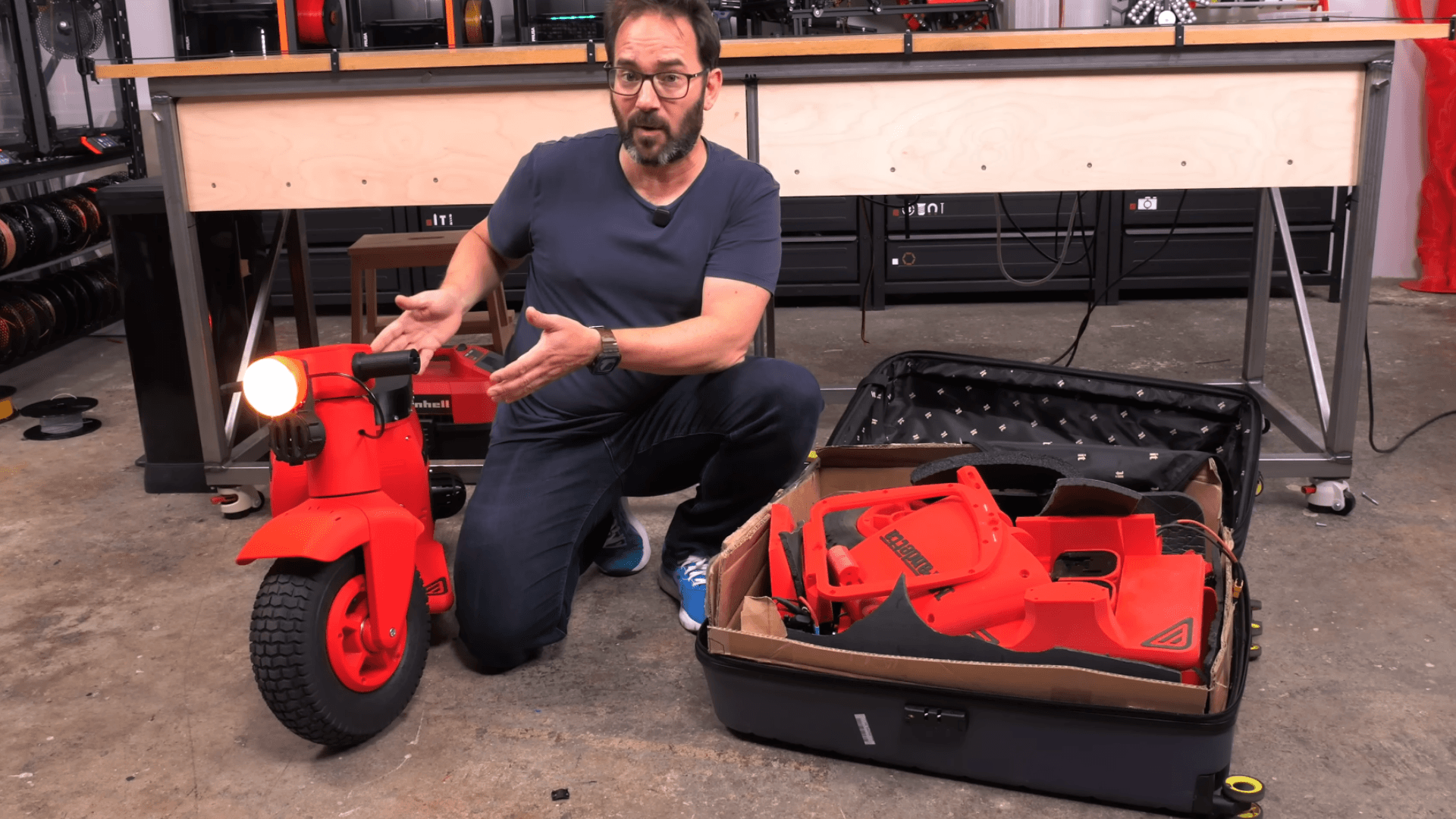
Ivan Miranda has turned a travel problem into a very usable piece of maker engineering: a rideable electric scooter that breaks down enough to fit in a suitcase. The part that makes it land with the 3D printing crowd is not just the size, but the discipline behind it, a mostly printed machine that still leans on real hardware where it matters.
A printed frame built for travel
Miranda’s machine is more accurately an electric scooter than a motorbike, even if he describes it with both labels in different places. The big idea is simple and ambitious at the same time: the entire structure is a 3D-printed plastic unibody, not a metal frame with some decorative printed panels bolted on after the fact.
That choice changes everything. Instead of treating 3D printing as skin deep, the build asks printed parts to carry the load, survive handling, and come apart cleanly enough for travel. The good news for anyone thinking about a similar project is that the printable pieces can be produced on any machine with at least a 300 by 300 mm bed, which puts it far closer to the reach of a normal hobby shop than a giant custom printer would. In other words, the design is unusual, but the hardware requirement is not absurd.
The parts he printed, and the parts he did not
Miranda did not try to print every single thing, and that restraint is what keeps the project in the realm of serious fabrication instead of novelty art. The tires and brake discs remain standard parts, which is exactly where most people would want them to stay on a rideable vehicle. The wheels themselves are printed, and even the axles are printed, which pushes the build into territory that most suitcase projects never touch.
The drivetrain is familiar if you have ever pulled apart a small e-scooter or a go-kart: a rear hub driven by a motor through a belt, with throttle control handled by an ESC. That is the right kind of familiar here, because it means the engineering novelty sits in the structure and packaging, not in some one-off electrical science experiment that nobody else could service.
Power comes from tool batteries rather than a custom scooter pack, and that is one of the smartest choices in the whole build. Tool batteries are easy to source, easy to replace, and already live in a maker’s ecosystem, which makes the scooter feel more like something you could actually maintain than a one-off show prop.
The file package is meant for reuse
The project is not locked away as a trophy piece. Miranda’s shop lists it as “MIRANDETTA 3D PRINTED MOTORBIKE” for $40.00 USD, and the package includes STL and 3MF files for every component, a readme with tips and tricks, a mostly complete bill of materials, and a Fusion 360 link so the original source files can be exported and modified.
That matters because it tells you what kind of build this is supposed to be. It is not just an impressive video; it is meant to be a starting point. Miranda’s channel also says he tries to provide enough information for other makers to replicate his projects, which is exactly why this one resonates with the community instead of disappearing into the usual pile of social-media spectacle.
Why Maker Faire Prague was the perfect test
Miranda said in a YouTube video that he built the mini motorbike in the days before Maker Faire Prague, which fits the project’s whole identity: fast turnaround, portable design, and a machine made for showing up in person. Maker Faire Prague 2026 also had a “Bring your suitcase” challenge for projects that are largely 3D-printed and fit entirely into carry-on luggage, so this build was aimed straight at the brief.
Prusa’s Maker Faire Prague recap says Ivan Miranda took first place in that contest. That is the cleanest possible validation for a project like this, because the judging logic lines up with the engineering problem he solved: make it compact, make it printable, and make it real enough to ride.
The bigger pattern in Miranda’s work
This scooter is not an isolated stunt. Miranda previously built a 3D-printed go-kart that he said fit in a suitcase and weighed 23 kilograms, so the suitcase-sized transport idea is clearly part of a continuing line of work rather than a one-off joke. His channel description backs that up too, listing electronics, hardware, digital fabrication, woodworking, instrument making, and metalworking as part of the mix.
That broader skill set explains why the scooter works as a maker project. It is not just about printing a chassis and hoping for the best. It is about knowing where plastic can carry the load, where off-the-shelf parts save the build, and where portability becomes the real design constraint.
Open Sauce 2026, scheduled for July 17 to 19, 2026 at the San Mateo County Event Center in San Mateo, California, is exactly the kind of stage this machine was built for. The festival describes itself as a three-day showcase of homemade robots, backyard rockets, and weird internet experiments, and Miranda’s suitcase scooter fits right into that world, a travel-ready machine that is clever because it solves a real logistics problem first and a display problem second.
This article was produced by Prism’s automated news system from verified source data, official records, and press releases, then run through automated quality and moderation checks before publishing. The system is built and supervised by the people who set the standards it runs under. Read our full AI policy.
Did this article answer your question?