Lance Cpl. Eirick Schule 3D-printed MUOS replacement antenna mast, Camp Lejeune
Mobile User Objective/System antenna masts 3D-printed at II MEF Innovation Campus saved the Marine Corps an estimated $600,000, producing roughly 107 replacements at about $10 material and ten hours each.
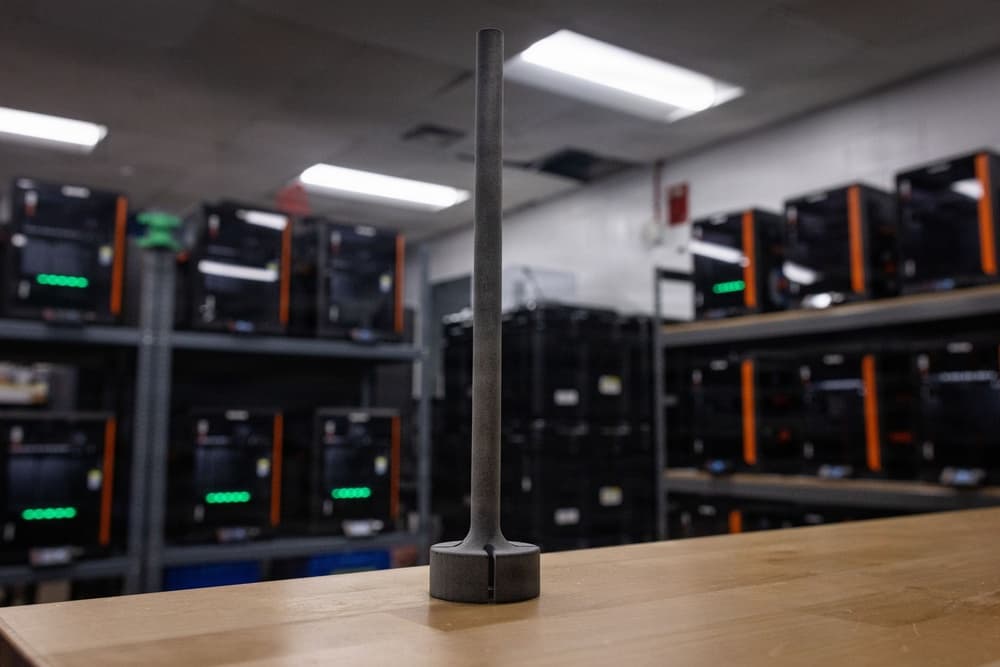
Mobile User Objective System communications antenna repairs turned into a textbook field fix when Lance Cpl. Eirick Schule designed a 3D-printed replacement mast at the II Marine Expeditionary Force Innovation Campus at Marine Corps Base Camp Lejeune. The Marine Corps estimates the solution has saved approximately $600,000, and Voxelmatters reported the effort “eliminated the equivalent of more than 60 years of combined supply wait time,” with Schule’s work dated to late April 2025.
The on-site production shifted the per-part economics and lead time dramatically. LinkedIn reporting and 3dprint.com detail that the printed replacement uses about $10 in material and takes roughly ten hours to print, compared with the previous commercial replacement that “used to cost over $5,000 per replacement and could take up to 220 days to arrive through the supply chain.” The II MEF Innovation Campus produced 40 replacement antennas for units at Camp Lejeune and 67 for Marines at Camp Pendleton, California, an explicit combined count of 107 parts; a LinkedIn snapshot summarized the effort as “100+ antennas printed.”

Schule’s background is central to how the fix happened. 3dprint.com reports he was a CNC machinist by trade before enlisting in the Marine Corps in 2022, learned to use 3D printers in a course at Camp Lejeune, and “served as an AM instructor for much of last year.” Other reporting identifies him as an engineer equipment operator assigned to II MEF Innovation Campus and with 2nd Distribution Support Battalion, Combat Logistics Regiment 2, 2nd Marine Logistics Group, tying the technical work to logistics and forward repair capability.
The human element shows in contemporaneous commentary. Jeff Radcliff posted a LinkedIn snapshot that captured the operational detail and a line that resonated: “Innovation rarely starts in a boardroom... it usually starts with someone looking at a broken part and saying: 'There has to be a better way.'” The LinkedIn capture visible in reporting also included Radcliff’s on-post metadata showing 5,173 followers and the shorthand appraisal “100+ antennas printed. Faster repairs in the field. $600K saved so far.”

Technical and procurement questions remain to be formalized: sources use variant spellings and expansions for the system name, including MUOS and MOUS, and the methods behind the Corps’ $600,000 estimate and the “60 years” aggregate wait-time figure were reported but not published in detailed calculation form. Still, the concrete outputs are clear: late-April 2025 development at II MEF Innovation Campus produced roughly 107 printed replacement masts distributed to Camp Lejeune and Camp Pendleton, each made for about $10 in material and ten hours of print time, replacing an item that previously cost thousands and took months to procure. That combination of local additive manufacturing, a trained operator with machining experience, and rapid distribution produced a measurable logistics win for the Marine Corps.
This article was produced by Prism’s automated news system from verified source data, official records, and press releases, then run through automated quality and moderation checks before publishing. The system is built and supervised by the people who set the standards it runs under. Read our full AI policy.
Did this article answer your question?