LEAP 71 3D Prints Autonomous 20kN Methalox Rocket Engine in Under 3 Weeks
LEAP 71 says it took two autonomous 20 kN methalox engines from spec to first flame in under three weeks. One was a bell nozzle, the other a full-scale aerospike.
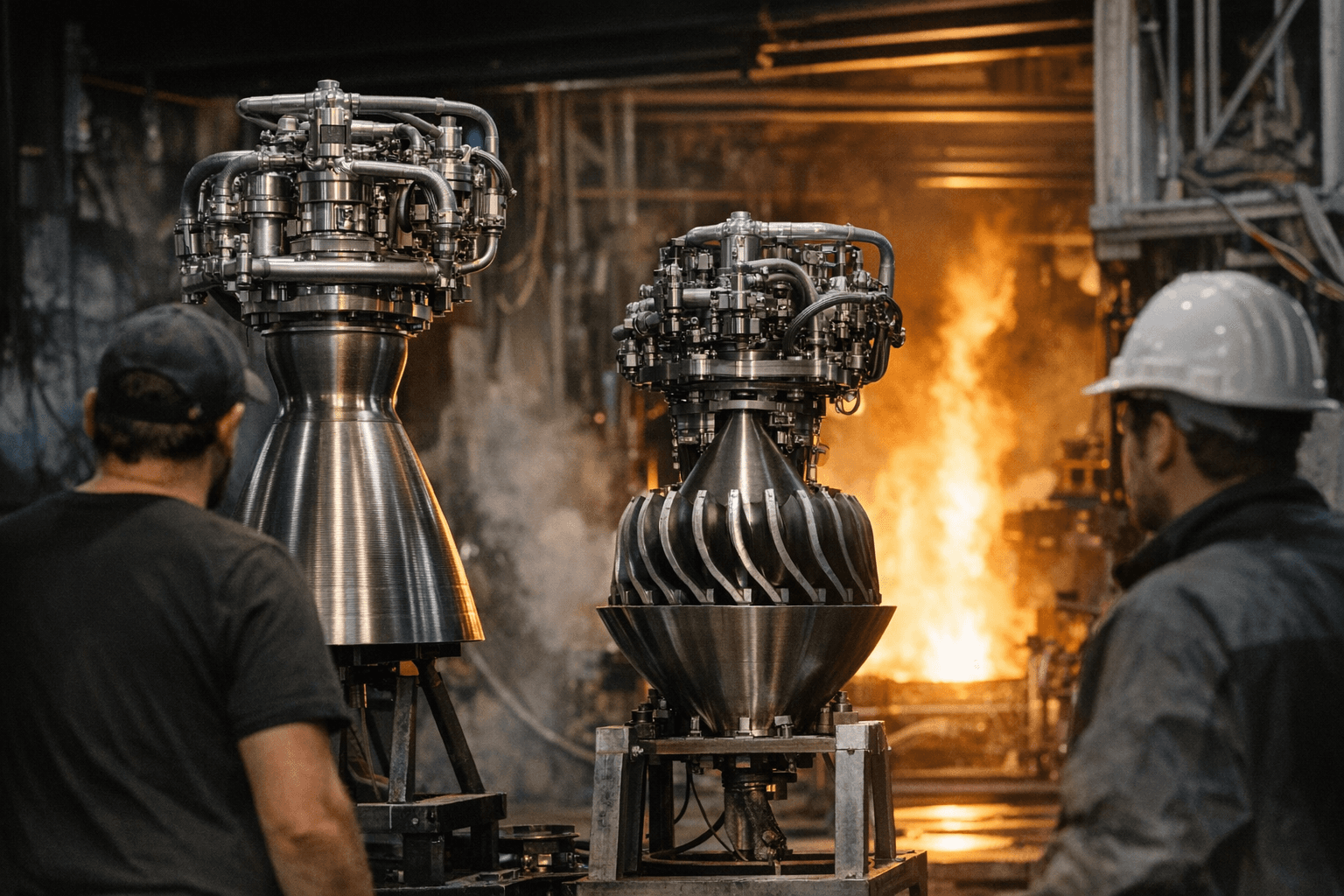
LEAP 71 said it hot-fired two radically different 20 kN methalox rocket engines after taking them from specification to first flame in under three weeks, a pace that makes the usual CAD-to-test slog look suddenly old. One engine used a conventional bell nozzle. The other was a full-scale aerospike. Both were designed entirely without human intervention by Noyron, LEAP 71’s computational engineering system, and both were shown ready to fire in video.
The company said each engine produced about 2 tons of thrust, or 4,500 lbf, while burning cryogenic methane and liquid oxygen. LEAP 71 also said the hardware was fully 3D printed in CuCrZr, a high-temperature copper alloy, by Aconity3D. For the 3D printing crowd, that detail matters as much as the thrust number: this was not a concept render or a one-off display piece, but a metal AM propulsion part pushed all the way to hot-fire in a workflow that started with software-generated engineering and ended on the test stand.
The December 11, 2025 announcement sat on top of a fast-moving propulsion arc. LEAP 71 said it successfully test-fired a liquid rocket engine created entirely through Noyron on June 18, 2024. By Formnext 2024, LEAP 71 and Aconity3D had already unveiled a 5 kN aerospike rocket engine, also designed autonomously by Noyron RP and manufactured with metal powder bed fusion. Then on June 26, 2025, LEAP 71 and Aspire Space announced a partnership to develop a large reusable launch vehicle capable of delivering up to 15 metric tons to low Earth orbit. On November 19, 2025, the two companies signed a formal agreement at Dubai Airshow to collaborate on the Oryx reusable rocketship, with UAE minister Dr. Ahmad Belhoul Al Falasi present.
The bigger story for the desktop and prosumer world is not that a garage printer is about to spit out a rocket engine. It is that parts of this workflow are starting to look transferable. Generative design, automated geometry optimization, rapid iteration, and machine-ready metal toolpaths are the pieces most likely to trickle down first into slicers and AM software. Copper printing at this level will stay in industrial systems for now, but the speed leap from engineering spec to test-ready hardware is the part hobbyists and small shops will watch closely. LEAP 71 later said on March 12, 2026 that it and HBD had produced a 200 kN 3D-printed aerospike engine, a scale jump that shows how quickly this software-first hardware model is moving beyond the 20 kN class.
Know something we missed? Have a correction or additional information?
Submit a Tip