Custom 3D-printed titanium implants show strong osseointegration, no loosening
Custom titanium implants kept every patient fully weight-bearing without loosening, and they cut distal chip fractures from 21.2% to zero.
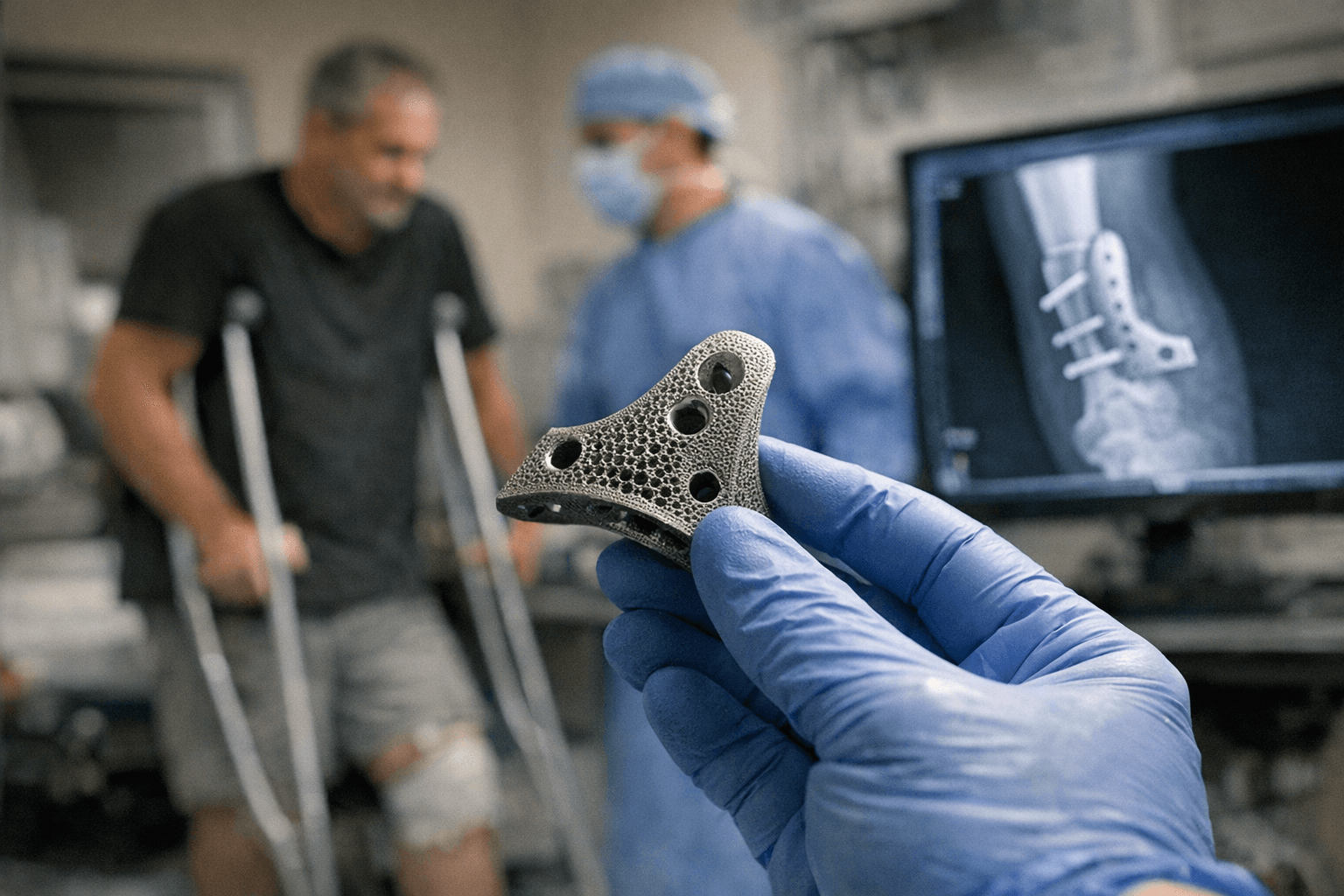
Custom 3D-printed titanium implants are looking less like a specialty exception and more like the practical answer when the bone does not fit the box. In a study presented in New Orleans at the American Academy of Orthopaedic Surgeons Annual Meeting, Hospital for Special Surgery researchers reported that patient-specific, electron beam melting 3D-printed implants reliably osseointegrated without loosening and delivered short-term functional results similar to press-fit options.
The retrospective review covered osseointegration procedures performed between May 2024 and March 2025, including transfemoral, transtibial and transhumeral cases. The custom implants had a 0% intraoperative distal chip fracture rate, while the historical control group receiving off-the-shelf osseointegrated implants posted a 21.2% rate. Every patient in the custom group progressed to full weight-bearing without loosening, and none had implant failures, deep infections or unplanned surgeries at an average follow-up of six months.
That is the kind of result additive manufacturing has been promising for years: not just “custom is possible,” but custom can perform as well as standard when geometry is the real problem. Osseointegration, which attaches a prosthetic limb directly to bone and eliminates the socket prosthesis, has always favored exact fit. That becomes especially important for residual limbs with unusual shapes, where a standard implant is more likely to force compromises during surgery.
The work also lands in the middle of a broader push at HSS. Taylor J. Reif, MD, and Jason Hoellwarth, MD, were among the researchers tied to the presentations, and HSS said its Osseointegration Limb Replacement Center and Limb Lengthening and Complex Reconstruction Service have performed more osseointegration surgeries than any other hospital in the United States, with more than 300 patients treated since 2017. In related 2026 presentations, HSS researchers reported 147 osseointegration procedures, 83 femur-level and 64 tibia-level, with substantial gains in mobility and patient satisfaction and no significant differences in adverse events.
The short-term patient-reported outcome measures improved significantly in the custom-implant group, which is the part that should matter to anyone watching medical 3D printing closely. The hardware did not just survive implantation; it stayed stable, supported weight-bearing and tracked well on function. For orthopaedic surgery, that is a strong signal that patient-specific titanium is moving from promising to proven in exactly the kind of one-off geometry where traditional manufacturing struggles.
Know something we missed? Have a correction or additional information?
Submit a Tip