Manchester Researchers Develop Neural Slicer for Multi-Axis 3D Printing
Manchester researchers built a neural slicer that curved layers around overhangs, hinting at support-free parts and a new path for multi-axis printing.
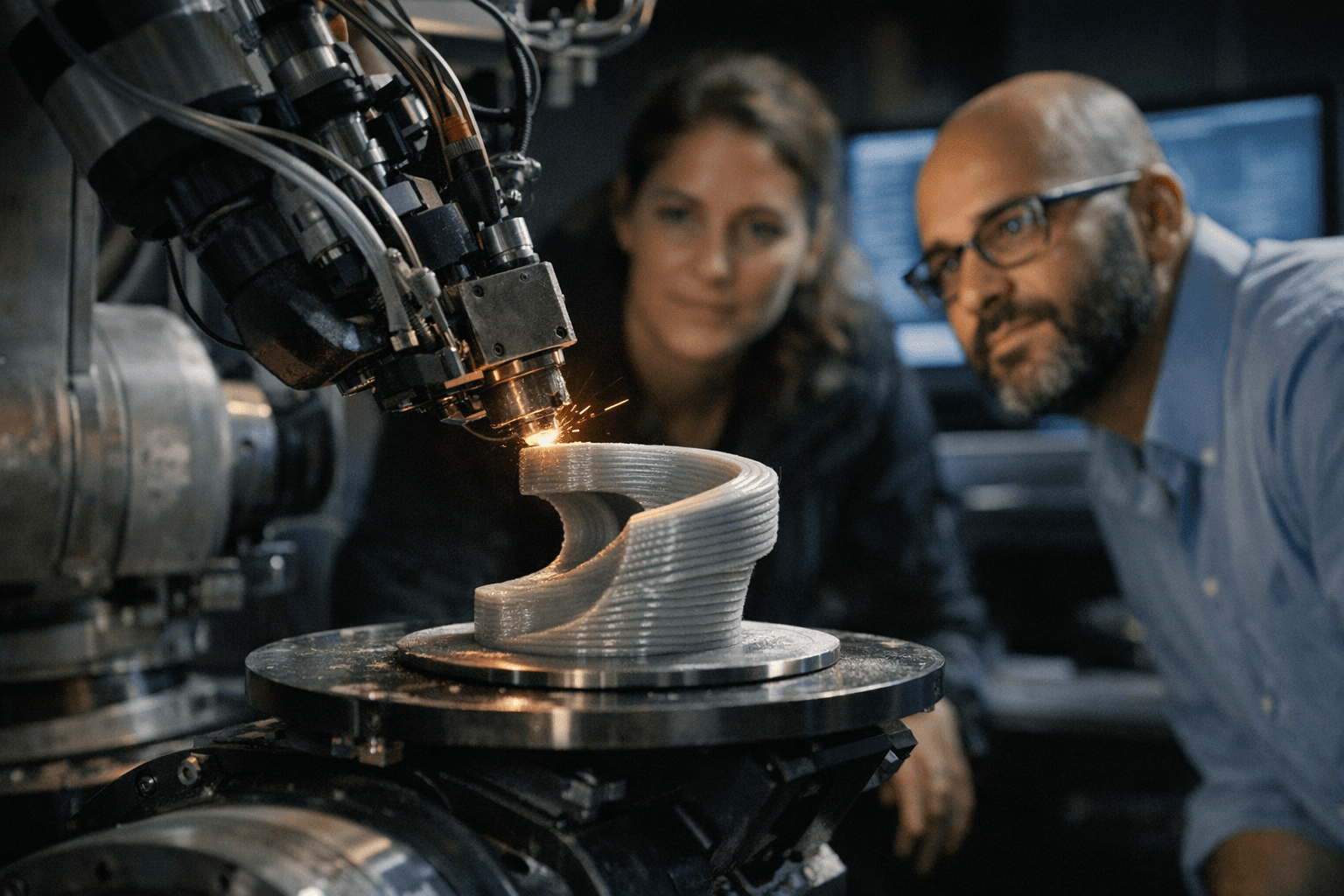
Supports, awkward part orientation and staircase scars on steep overhangs have long been the price of desktop 3D printing. A University of Manchester team pushed against all three with a neural network-powered slicer that generated curved layers for multi-axis printing instead of forcing parts into the old planar stack.
The paper, Neural Slicer for Multi-Axis 3D Printing, appeared in ACM Transactions on Graphics on July 19, 2024, with Tao Liu, Tianyu Zhang, Yongxue Chen, Yuming Huang and Charlie C.L. Wang listed as authors. It was presented in the SIGGRAPH 2024 orbit, where 844 submissions were pared down to 252 accepted papers, a sign of how crowded the field was and how far this work stood out.
The core idea was representation-agnostic slicing. Rather than depending on a model being delivered in one specific format, the pipeline used neural networks to build a deformation mapping, define a scalar field around the input model, and then extract isosurfaces to produce curved layers. Because the pipeline was differentiable, the researchers could optimize it with loss functions tied directly to local printing directions, which is exactly the kind of thing multi-axis systems need when they are trying to keep nozzle motion aligned with tricky geometry.
That matters because conventional slicers are still built around planar layers, and planar layers are where overhang headaches begin. The Manchester method was designed for models with diverse representations and intricate topology, the sort of parts that tend to provoke supports, awkward orientations and ugly surface finish when you try to print them upright on a typical desktop machine.
The real hobby-world signal came later, in a 2025 review that noted the Neural Slicer algorithm had enabled multi-axis printing of objects with more than 50 non-planar layers, all without support structures. For makers who have spent hours scraping supports off a curved shell or choosing between strength and surface quality, that is the promise here: not just fewer cleanup steps, but a route to shapes that print more cleanly in the first place.
For home printing, the change is still not immediate. This was a research-stage computational breakthrough, and the biggest gains will arrive only as multi-axis hardware becomes more common and slicer software turns curved-layer planning into something a desktop user can actually click through. When that happens, the payoff could be dramatic: fewer supports, better surfaces on complex overhangs and parts that no longer need to be designed around the limits of flat slicing.
This article was produced by Prism’s automated news system from verified source data, official records, and press releases, then run through automated quality and moderation checks before publishing. The system is built and supervised by the people who set the standards it runs under. Read our full AI policy.
Did this article answer your question?