Melbourne company and UOW unveil world-first underwater 3D concrete printer
Melbourne firm LUYTEN 3D and University of Wollongong researchers say they built a submerged 3D printer and a world-first "single-mix" concrete that sets and prints underwater without chemical accelerators.
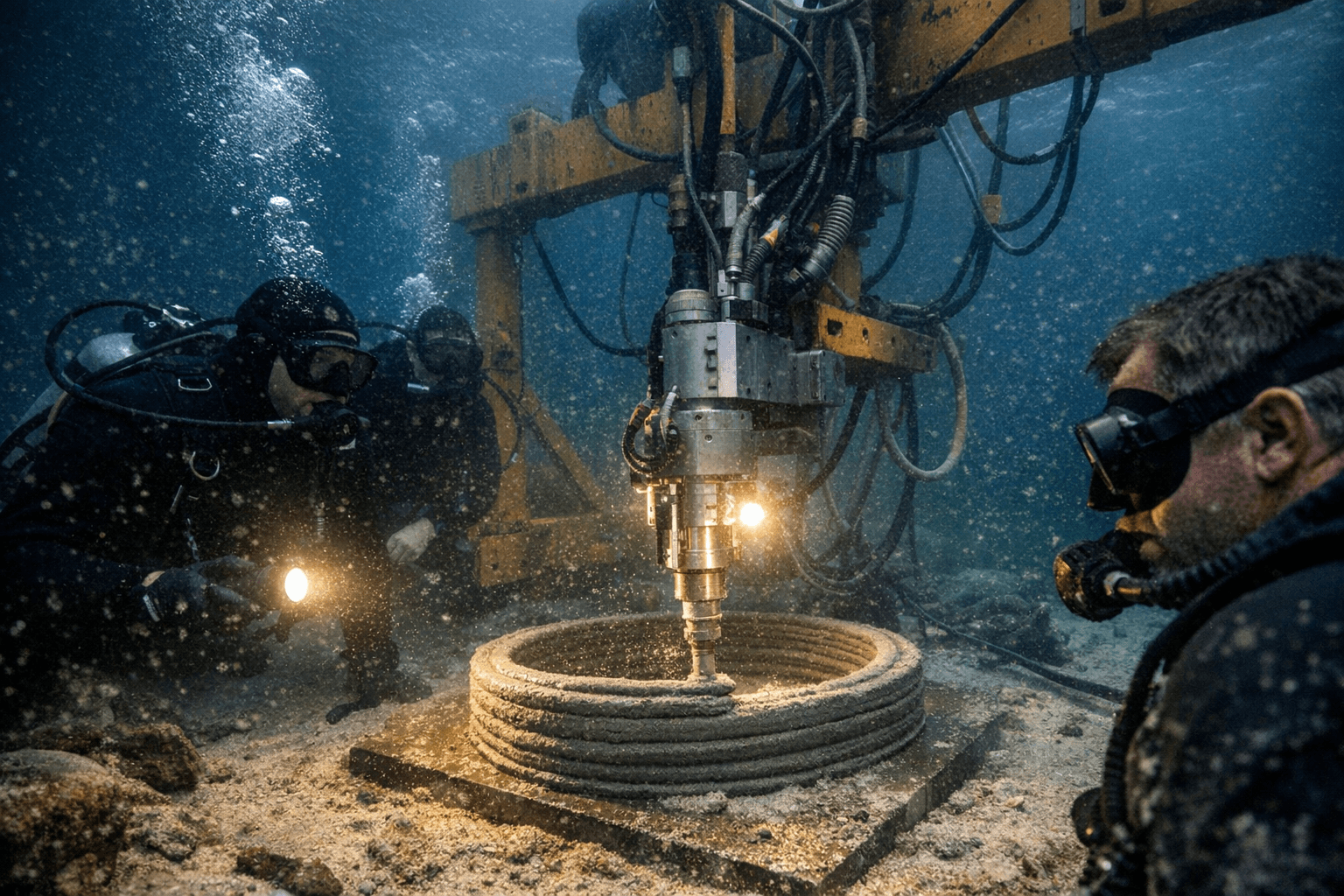
LUYTEN 3D and University of Wollongong researchers unveiled a submerged 3D concrete printing system that pairs a printer platform with a claimed world-first "single-mix" concrete formulation that sets and builds stably underwater without chemical accelerators. Ahmed Mahil, CEO and global president of LUYTEN 3D, framed the result as a new chapter for construction, saying, "Printing underwater fundamentally changes how we think about building, repairing and strengthening critical infrastructure in marine environments."
The project team says the single-mix approach relies on material design rather than multi-stage mixes or rapid-setting chemicals, allowing the concrete to set in saltwater and even with seabed sand used as aggregate. Aziz Ahmed, PhD and project lead at the University of Wollongong, described trial results: "Our trials confirm that our single-mix solution is not just theoretically sound but practically viable. It offers the structural integrity needed for real-world application while simplifying the logistics of underwater deployment." Project members also described a mixture that "doesn't disperse" and requires no moulds or formwork.
The team and industry backers are pitching immediate marine applications. The technology is being offered for pier pylons, wharves, bridge girders, anchors for floating wind farms, protection of seabed fibre-optic cables, and defence installations including hidden submarine stations. InterestingEngineering and the project lead singled out potential use for AUKUS-related submarine infrastructure and sustainable anchors for offshore wind. Aziz Ahmed and Mahil also pointed to environmental uses such as printing artificial coral reefs; Aziz Ahmed said, "It could be used to increase the marine biodiversity where it’s been lost," and added the mix avoids harmful chemistry.
Commercial readiness is part of the narrative. LUYTEN 3D describes the work as four years in the making and draws a through-line from the company’s earlier 3D-printed double-storey home in Melbourne to the submerged system. Wade Lestage of Concretta Homes called the breakthrough "a game changer for the future" and said it "gives us the comfort level we were looking for to make this kind of investment." Mahil painted a deployment picture of automated fleets, saying, "Now there will be a swarm of smart robots going under sea and laying concrete without disturbing the environment," and added, "This is Australian engineering coming to the global stage again."
Significant technical and regulatory details remain undisclosed. The exact composition and proportions of the so-called single-mix have not been published, and independent data on compressive and tensile strength, curing times under varied sea conditions, long-term durability, toxicity tests on benthic organisms, and comparative cost-per-unit versus traditional underwater concrete are not yet available. The project’s patent or IP filings, environmental approvals, and any signed government or commercial pilot contracts have not been detailed publicly.
If independent engineering and environmental data match the team’s trial claims, the combination of an accelerator-free mix and a submerged printer could simplify logistics and lower costs for marine construction. Senior Professor Gursel Alici, Executive Dean at the University of Wollongong, summed the laboratory achievement as solving "a complex material science problem, eliminating chemical accelerators without sacrificing stability," leaving the next step as large-scale demonstration and regulatory clearance before widespread deployment.
This article was produced by Prism’s automated news system from verified source data, official records, and press releases, then run through automated quality and moderation checks before publishing. The system is built and supervised by the people who set the standards it runs under. Read our full AI policy.
Did this article answer your question?