Microalgae-Based 3D Food Ink Mimics Fish Texture With Precise Processing Window
A 36% biomass concentration was the only formulation that worked when researchers 3D printed microalgae into fish-like food using a single-ingredient ink.
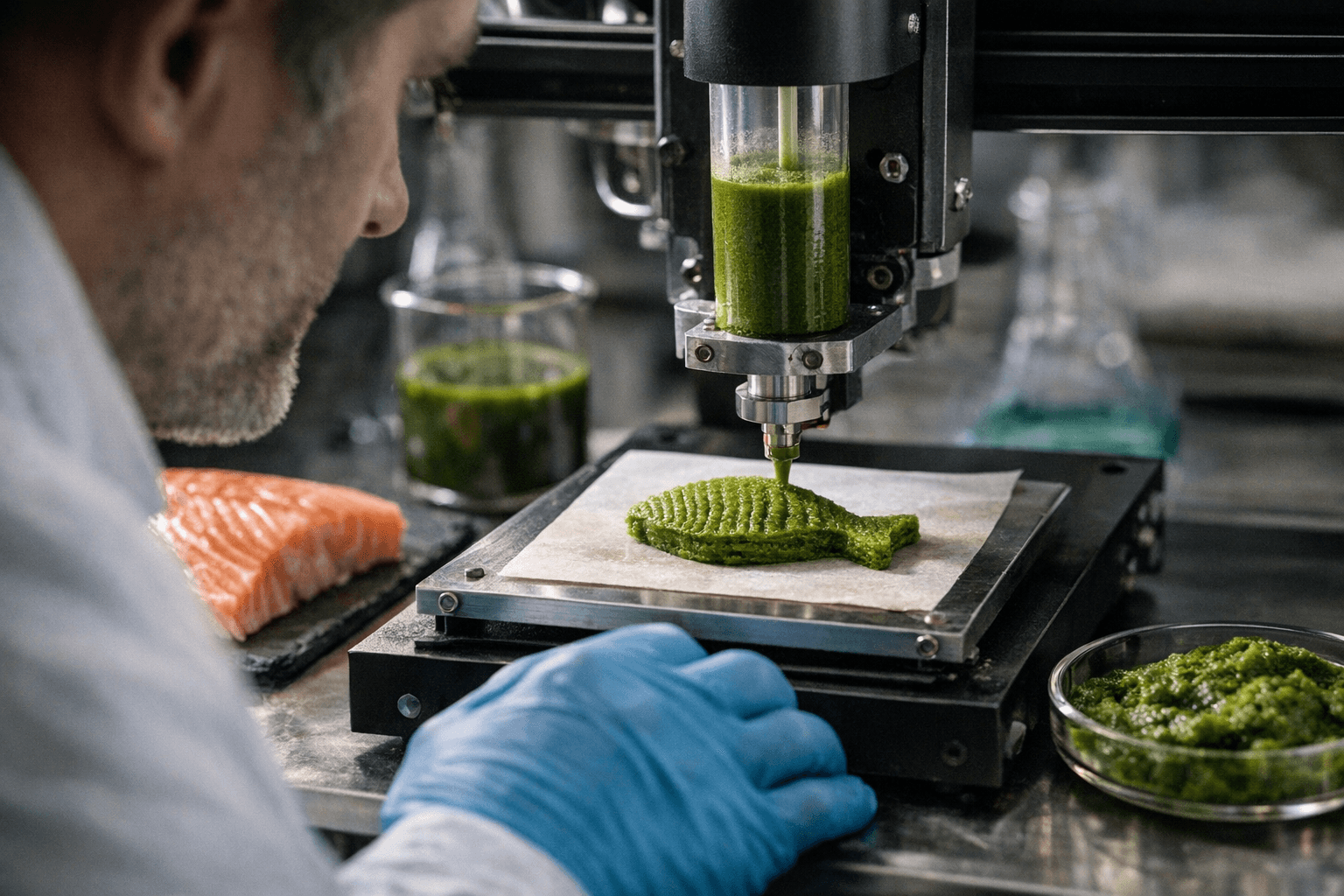
A single-ingredient food ink made from the microalga Auxenochlorella protothecoides can replicate white-fish textures through extrusion-based 3D printing, but only if you hit an exact 36% biomass concentration. Go above or below that mark and the print fails, producing filament spreading, under-extrusion, or a clogged nozzle.
That finding comes from a study published in LWT by Jin-Kyu Rhee, Yourim Oh, Eui-Jung Han, and Yurim Ha, researchers affiliated with Ewha Womans University's Department of Food Science and Biotechnology and South Korean company SuFAB Inc. The team ran rheological measurements, printability tests, and texture profile analysis across multiple formulations, and 36% biomass was the sole concentration achieving both stable extrusion and dimensional accuracy.
What makes A. protothecoides an interesting candidate for this application is what it is not: green. Most microalgae used in food research carry the visual baggage of chlorophyll, which creates an immediate color mismatch with white-fleshed seafood. A. protothecoides is naturally white-pigmented, so its pale appearance already aligns with the target product without any color correction. It also packs approximately 65% protein on a dry-matter basis, making it nutritionally dense as a standalone matrix rather than requiring supplemental plant proteins or hydrocolloids to bulk it up.
That multi-component approach is the standard in fish analog development right now. Most formulations blend plant proteins with hydrocolloids to reconstruct the fibrous structure and bite of fish flesh. The Ewha Womans University and SuFAB Inc. work tested whether a single ingredient could do the same job, and the answer was conditional: yes, but the processing window is extremely narrow.
The FAO data motivating this line of research is stark. Global seafood consumption has been increasing at nearly twice the rate of population growth, pressuring wild fisheries and driving biodiversity loss while also concentrating contaminants like mercury and microplastics in the supply chain. Fish analogs offer a potential off-ramp, and 3D printing gives developers precise control over structure and texture in ways that conventional extrusion or molding cannot easily replicate.
The study, formally titled "3D Printing Food Ink Development Using Auxenochlorella protothecoides: Rheology, Printability, and Fish Texture Simulations," establishes the relationship between biomass concentration, rheological behavior, and printing performance in microalgae-based systems. The key practical output is the failure mode map: too little biomass and the ink spreads; too much and the material resists flow entirely. At exactly 36%, the ink holds its shape through deposition and maintains dimensional fidelity in the finished print. That precision requirement will be the central engineering challenge for anyone trying to scale this ink toward a commercial food product.
This article was produced by Prism’s automated news system from verified source data, official records, and press releases, then run through automated quality and moderation checks before publishing. The system is built and supervised by the people who set the standards it runs under. Read our full AI policy.
Did this article answer your question?