new gel-suspended 3D printing technique creates intricate shapes without supports
Gel-suspended printing is chasing the pain points desktop makers know too well: support scars, failed overhangs, and awkward orientations.

The cleanest 3D print is the one that never had to lean on supports in the first place. That is the promise behind gel-suspended printing: instead of building a part in open air and then carving away scaffolding, the nozzle works inside a gel that holds the geometry in place while the shape forms. For anyone who has rotated a model three times to dodge overhangs, accepted ugly support scars, or watched a print fail because one thin section sank before it set, this is the kind of workaround that sounds less like a novelty and more like relief.
Where the idea started
The modern story here begins with Freeform Reversible Embedding of Suspended Hydrogels, or FRESH, which Carnegie Mellon researchers introduced in 2019. FRESH showed that hydrated materials with an elastic modulus below 500 kPa, including alginate, collagen, and fibrin, could be printed inside a secondary hydrogel support. That support is temporary, thermoreversible, and biocompatible, which made the method especially powerful for soft and living materials.
That original breakthrough mattered because it moved printing beyond the usual layer-by-layer tradeoffs. Instead of asking a delicate structure to survive in air, FRESH let complex biological shapes emerge inside a medium that did the holding for them. The result was unprecedented resolution and fidelity for biofabrication, and it gave the field a very practical idea to keep expanding: maybe the real trick is not stronger supports, but a smarter environment around the print.
Why hobbyists should care even if they are not printing organs
The immediate appeal is easy to understand if you already spend time tuning part orientation in a slicer. Gel-suspended printing attacks the pain points that make ambitious models annoying in everyday practice: support scars, orientation compromises, and failed overhangs. If the surrounding medium can hold the print from every direction, the part does not need to be “turned friendly” just to survive the build.
That does not mean a stock desktop machine can suddenly do this at home. Current hobby printers are still built around air, a bed, and a part cooling strategy that assumes the object is standing on its own. Gel-suspension workflows need the right material behavior, a compatible nozzle process, and a setup designed to work inside a medium rather than above one. For now, the practical lesson is not that your FDM printer will become a gel printer overnight. It is that the industry is actively exploring ways to remove the support tax that has shaped so many designs.
The field is widening beyond bioprinting
The most interesting part of this story is how fast it has spread beyond the first biomedical use cases. Carnegie Mellon’s FRESH work was rooted in soft biological materials, but newer systems are pushing the same logic into industrial parts, micro-components, and customized products. That broadening matters because it suggests gel suspension is becoming a general manufacturing tool, not just a lab trick for fragile tissue-like structures.
A 2025 MIT system pushed that idea in a different direction. MIT reported a resin that cures into two different kinds of solids depending on light wavelength: a sturdy part under ultraviolet light and a dissolvable support under visible light. MIT said the method was used to print functional gear trains, intricate lattices, and a dental implant. Even better for sustainability-minded makers, MIT said the dissolved support material could be blended back into fresh resin and recycled. That is not gel-suspended printing in the strict sense, but it points to the same destination: support removal becoming a designed feature rather than a cleanup chore.
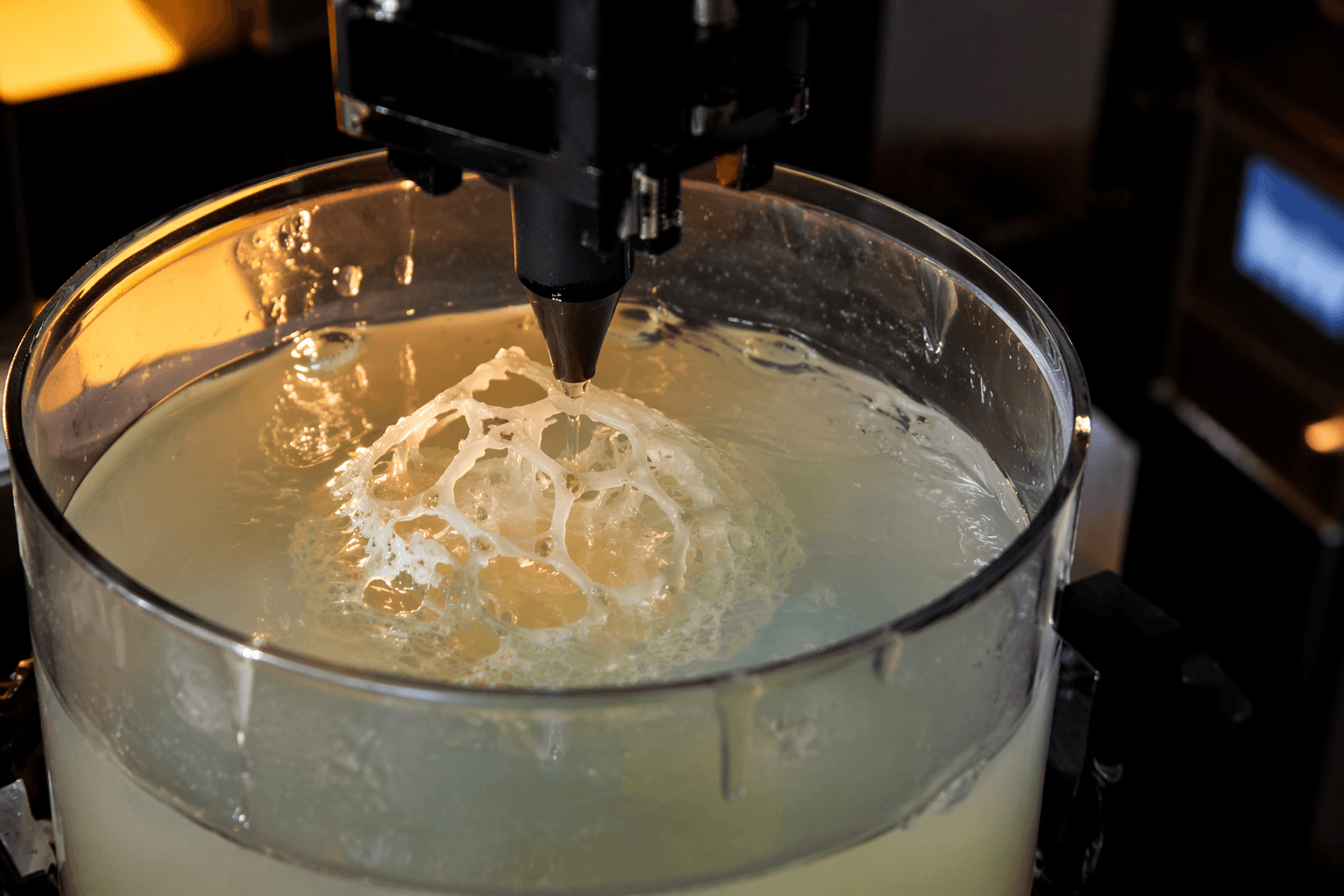
Then there is the work coming out of MIT’s Self-Assembly Lab and Rapid Liquid Print. The lab describes Rapid Liquid Printing as physically drawing in 3D space within a gel suspension, with an eye toward large-scale customized products made of real-world materials. Rapid Liquid Print says its Gravity Free Manufacturing process uses a reusable gel, eliminates supports, and targets industrial, medical, and consumer products. Its Levity printer is listed as shipping in 2026, which makes this one of the clearest signs that gel-suspension workflows are moving from research vocabulary toward actual hardware people can buy.
What the latest data says about speed and stability
The newest academic work is useful because it shows this is not just a pretty concept. A 2025 PLOS ONE paper on gellan gum granular gels reported print speeds up to 60 mm/s, along with yield stresses as low as 0.4 Pa for suspended bioinks. In plain printer terms, that means the support medium can be soft enough to let the nozzle move cleanly while still firm enough to hold shape during deposition.
A separate 2025 study on hollow silicone structures printed in hydrogel showed another key benefit: suspended-state deposition can prevent layers from sinking. That is a big deal for hollow channels, internal cavities, and other forms that often distort when printed conventionally. If the next wave of hardware and materials keeps improving on this, the payoff will not just be prettier prints. It will be more reliable first layers inside the medium, cleaner internal geometry, and fewer parts that need post-processing just to look finished.
What to watch for next
The most likely near-term wins are in medical implants, micro-scale components, and custom parts where complex geometry is worth the setup overhead. Those are the places where design freedom, reduced waste, and less post-processing have immediate value. A part that can be formed without traditional scaffolding is one less thing to sand, clip, or redesign around a support tower.
For desktop makers, the big caution is simple: this is still not a drop-in replacement for the printers already sitting on your bench. The current generation of consumer machines will not magically start printing inside reusable gel, and the materials in these systems are not the same as the PLA and PETG most people run every day. What is worth watching instead is how the ideas migrate downward, especially in ways that reduce support scars, shrink support waste, and make awkward geometries less dependent on a heroic slicer orientation.
That is why gel-suspended printing feels important even before it becomes common. It is not promising to make every desktop printer into a gravity-free machine tomorrow. It is promising something more useful: a future where the print that used to fail, sag, or wear ugly support scars can finally come off the build with its shape intact, because it never had to fight gravity in the first place.
This article was produced by Prism’s automated news system from verified source data, official records, and press releases, then run through automated quality and moderation checks before publishing. The system is built and supervised by the people who set the standards it runs under. Read our full AI policy.
Know something we missed? Have a correction or additional information?
Submit a Tip