North Dakota Engineer Replaces Printer Heated Bed With Bitcoin-Mining ASICs
A North Dakota maker swapped his printer's heated bed for four Bitcoin-mining ASIC chips that heat the build plate while hashing at up to 1 TH/s.
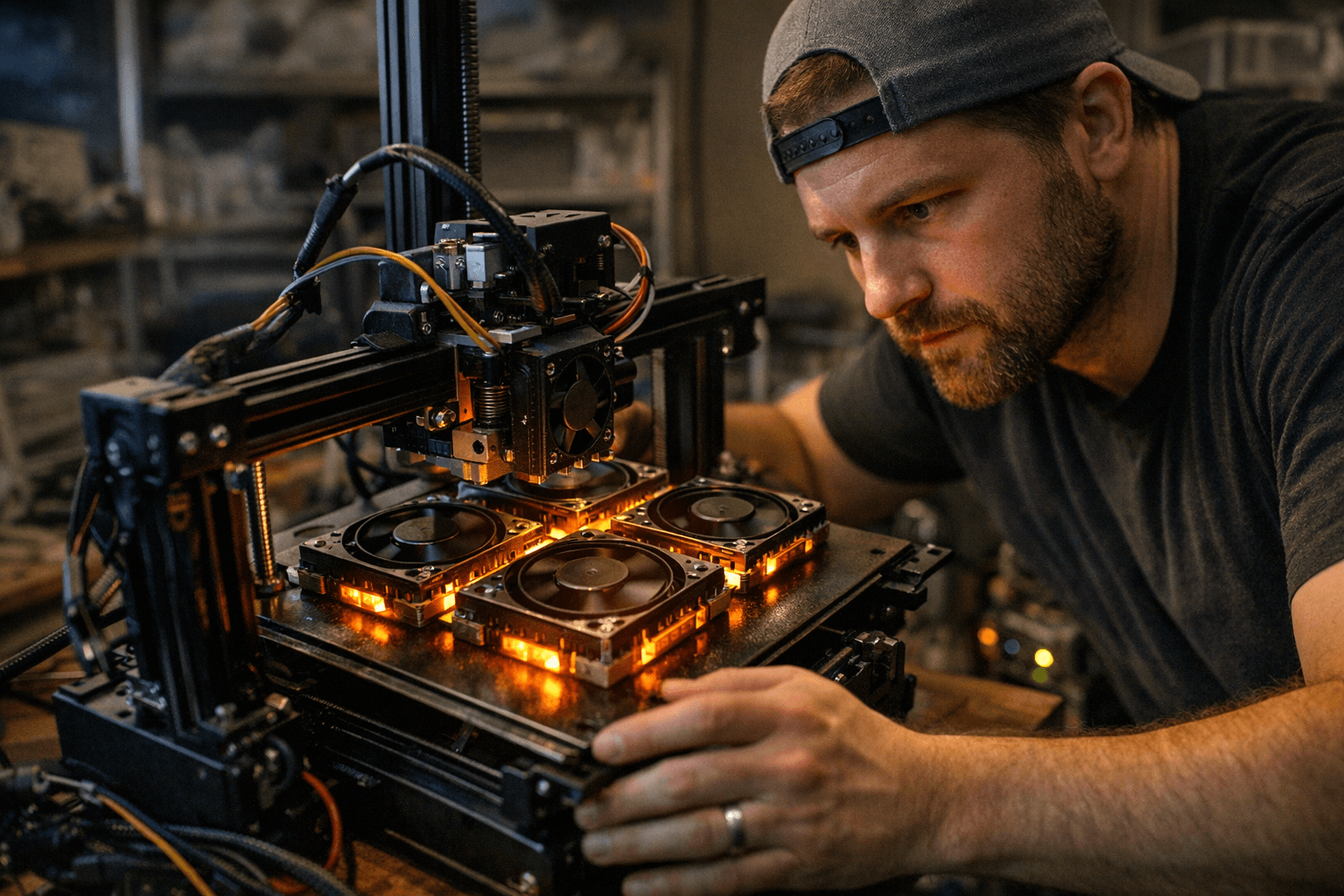
A mechanical engineer known online as PizzAndy pulled the resistive heated bed out of a 3D printer and replaced it with Bitcoin-mining hardware, producing a working prototype that heats the build surface through hashing activity while simultaneously mining Bitcoin. The project, published as an open-source proof-of-concept called Proof of Print, was showcased on the Home Mining Podcast.
The core insight driving the build came from a simple observation: ASIC chips run hot enough to meet the bed temperature requirements of certain filaments. PCTG, for example, typically prints with a bed temperature between 75°C and 80°C, which falls squarely in the operating range of mining hardware. Rather than waste that heat through a dedicated cooling solution, PizzAndy mounted the chips beneath the print surface and let the hashing do the heating.
The hardware started as a GeckoScience hashboard pulled from a coffee warmer. PizzAndy modified it with a custom heat sink to make it function as a heated bed, then mounted four BM1362 ASIC chips under a build plate measuring approximately 110 by 110 millimeters. The mining side runs on CGMiner, with a custom script bridging the printer controller and the mining controller so the two systems communicate directly.
The thermal control strategy is what makes the build genuinely interesting from an engineering standpoint. Rather than locking the chips at a fixed clock frequency for maximum hash rate, the system dynamically adjusts clock speed to maintain a target bed temperature. During active printing at around 75°C, the system averages roughly 500 gigahashes per second. During initial heat-up cycles, before the bed reaches setpoint, output can climb toward one terahash per second. Add a fresh layer of material to the bed and the added thermal mass pulls the temperature down slightly, which causes the system to clock up and hash faster to compensate.
The working prototype runs entirely through command-line controls. During the Home Mining Podcast interview, PizzAndy showed a graphical interface mockup modeled after XOS, though that UI has not been integrated into the functional build yet.
Several practical questions remain unanswered in the current documentation: power consumption figures, mining yield estimates, long-term thermal cycling reliability, and safety testing results are not yet published. The 110 by 110 millimeter bed size is also a significant constraint compared to the build plates on most modern printers. What PizzAndy has demonstrated is that the thermal overlap between mining hardware and filament requirements is real and exploitable. Whether Proof of Print scales beyond a proof-of-concept depends on how those open questions get resolved.
This article was produced by Prism’s automated news system from verified source data, official records, and press releases, then run through automated quality and moderation checks before publishing. The system is built and supervised by the people who set the standards it runs under. Read our full AI policy.
Did this article answer your question?