Spool-powered orrery turns Prusament waste into a mechanical solar system
A leftover Prusament spool becomes a crank-driven solar system that doubles as a test of gears, tolerances, and motion-heavy print reliability.
A playful build that actually teaches the mechanics
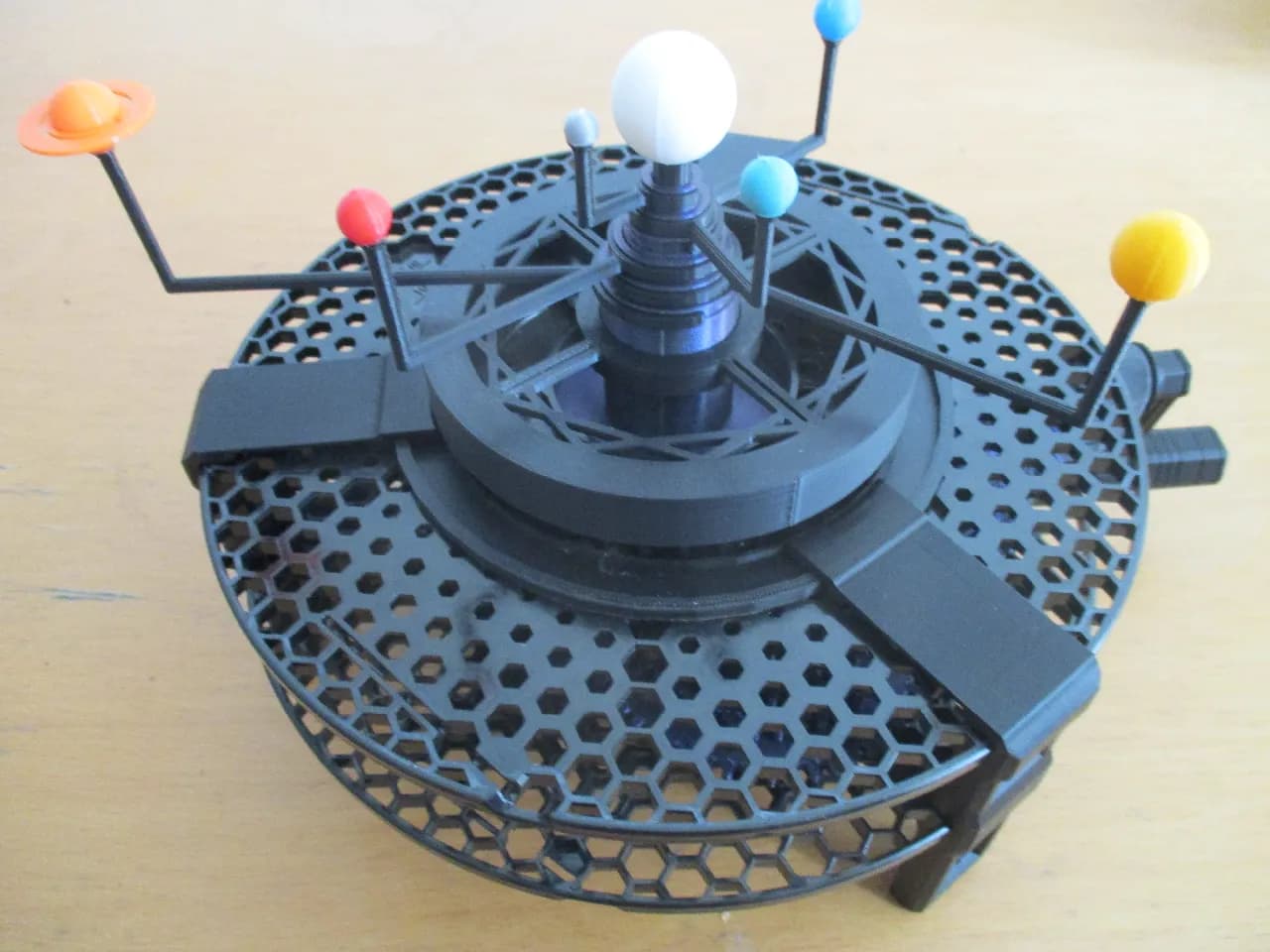
A leftover Prusament spool does more than sit in a drawer here. M4NU’s Spooletarium turns it into a crank-driven orrery that moves Mercury through Saturn with 18 gears, making the print as much a tuning exercise as a display piece.
That is the real appeal of this model: it looks whimsical, but it behaves like a compact lesson in motion design. The planets travel at different speeds and distances, the gear train has to mesh cleanly, and the whole build depends on prints that fit together without fighting each other. If your printer is already dialed in for functional parts, this is exactly the kind of project that tells you whether your settings are truly there.
Why the spool matters as much as the planets
The Spooletarium is built around a Prusament spool, which is a clever move because the spool stops being packaging and becomes structure. On the Printables listing, the model is described as adapted to both the new Prusament Spool NFC and the classic Prusament spool, and that compatibility is what makes the project feel especially current. It is not just recycling for the sake of recycling, it is a design that uses the spool’s shape as part of the build itself.
Prusa Research’s redesigned Prusament spool, announced on October 31, 2025, is slimmer, easier to take apart, easier to refill, and includes a reusable NFC tag based on OpenPrintTag. That matters here because the Spooletarium was built in the middle of a real shift in spool design, when reuse stopped being an afterthought and became part of the filament ecosystem. Prusa then launched an upcycling contest for new Prusament spools on April 2, 2026, which gives the model a wider context: this is not a one-off novelty, but a proof-of-concept for smart spool reuse.
If you do not have a Prusament spool on hand, the Printables page also says you can print one using the file named Spool_Prusament_NFC. That detail makes the project more accessible, because it keeps the model from being locked to one specific stash of packaging.
What the mechanism is really showing you
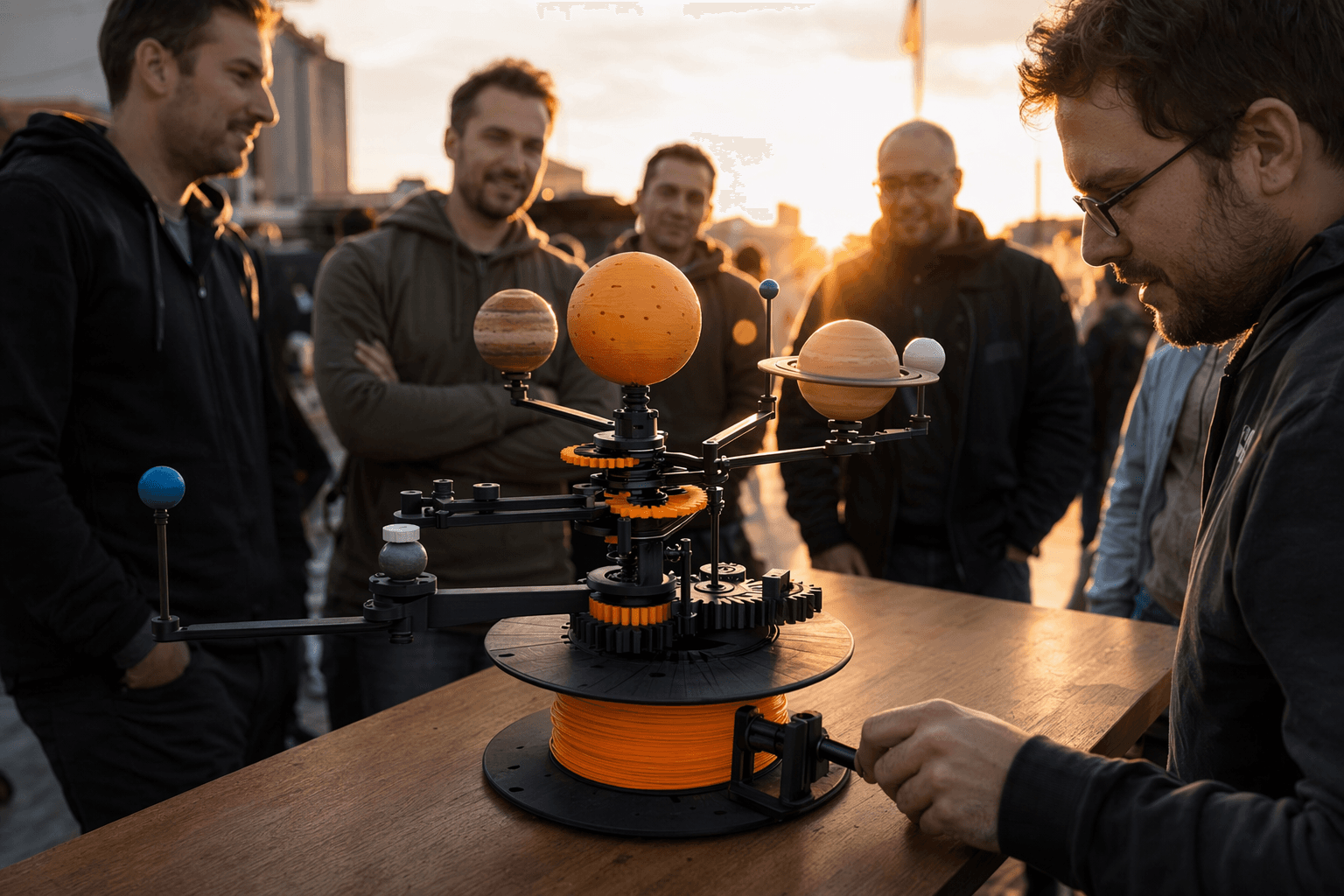
At its core, the Spooletarium is an orrery, a mechanical solar system that uses gears and hand power to move planets at different rates. The listing says it simulates the revolution of the six first planets, Mercury, Venus, Earth, Mars, Jupiter, and Saturn, and that movement is driven by 18 gears turned by a crank. That is a lot of mechanical intent packed into one print, and it is why the model feels more educational than decorative.
The gear ratios are not random ornament. The creator tuned the system to approximate orbital periods, with Earth listed at 365.256 days and the other planets compared against their real values. You can see the mechanical lesson immediately: speed reduction, ratio planning, and synchronized motion all matter, because the planets must stay visually believable while still being driven by a single hand input. This is the sort of project that makes gear design tangible in a way flat test prints never can.
- gear tooth accuracy and smooth meshing
- axle fit and rotational freedom
- support removal on small moving features
- long-term reliability in a print that is supposed to move, not just look good
For makers, that means the Spooletarium is a good calibration check for:
If any of those are off, the model will tell you fast. A decorative print can hide minor sins. A crank-driven orrery cannot.
Printing choices that make or break the build
The Printables listing keeps the setup practical, which is one reason the model has traction with the community. Recommended settings are PLA, a maximum layer height of 0.20 mm, and a 0.4 mm nozzle. That combination points directly at a hobbyist-friendly build: fine enough for gear teeth and planet parts, but still accessible on a typical desktop machine.
The assembly notes also lean toward reliability over bravado. The listing suggests gluing the rings to the spools for extra stability and gluing the planets to their supports. That is the sort of advice functional-motion prints live or die by, because vibration and repeated cranking will expose weak joints long before a display model would. If you are testing whether your printer can do real motion work, those glue points matter as much as the slicer profile.
The model’s community response suggests people are responding to that mix of fun and function. The Printables page shows 1 review, 19 likes, 787 downloads, and 8,775 views, which is a decent signal for a niche mechanical project that has to compete with flashier showpieces. It also sits in Printables’ Learning / Physics & Astronomy category, which fits its role neatly: it is a build that teaches while it entertains.
A worthwhile calibration project, not just a shelf piece
What makes Spooletarium stand out is that it asks useful questions of the printer before it asks for praise from the room. Can your gears turn without binding? Do your tolerances hold across multiple moving assemblies? Are your supports clean enough that the moving parts do not drag? Those are the same questions behind any functional print, only here they are wrapped in a solar-system display that people actually want to keep spinning.
That is why the project feels bigger than its playful theme. It uses a discarded spool as structure, pairs that reuse with a precise gear train, and makes the motion visible enough that you can diagnose problems just by turning the crank. The fact that it works with both the classic Prusament spool and the newer NFC version only sharpens the point: this is a model designed in the real world, for the real world, where packaging changes, materials change, and a good print has to adapt.
The Spooletarium lands because it turns a leftover spool into something that teaches you what your printer can really do. By the time Mercury and Saturn are orbiting under hand power, the novelty has done its job and the useful part has already sunk in: this is what tuned motion, careful tolerances, and smart support strategy look like when they are built into a print that still makes you grin.
This article was produced by Prism’s automated news system from verified source data, official records, and press releases, then run through automated quality and moderation checks before publishing. The system is built and supervised by the people who set the standards it runs under. Read our full AI policy.
Did this article answer your question?