State Laws Targeting 3D Printing Threaten the Future of Hobbyist Manufacturing
California's AB-2047 would ban uncertified 3D printers from sale by 2029, joining New York and Washington in a wave of state laws that critics say threatens every maker's garage, not just gun manufacturers.
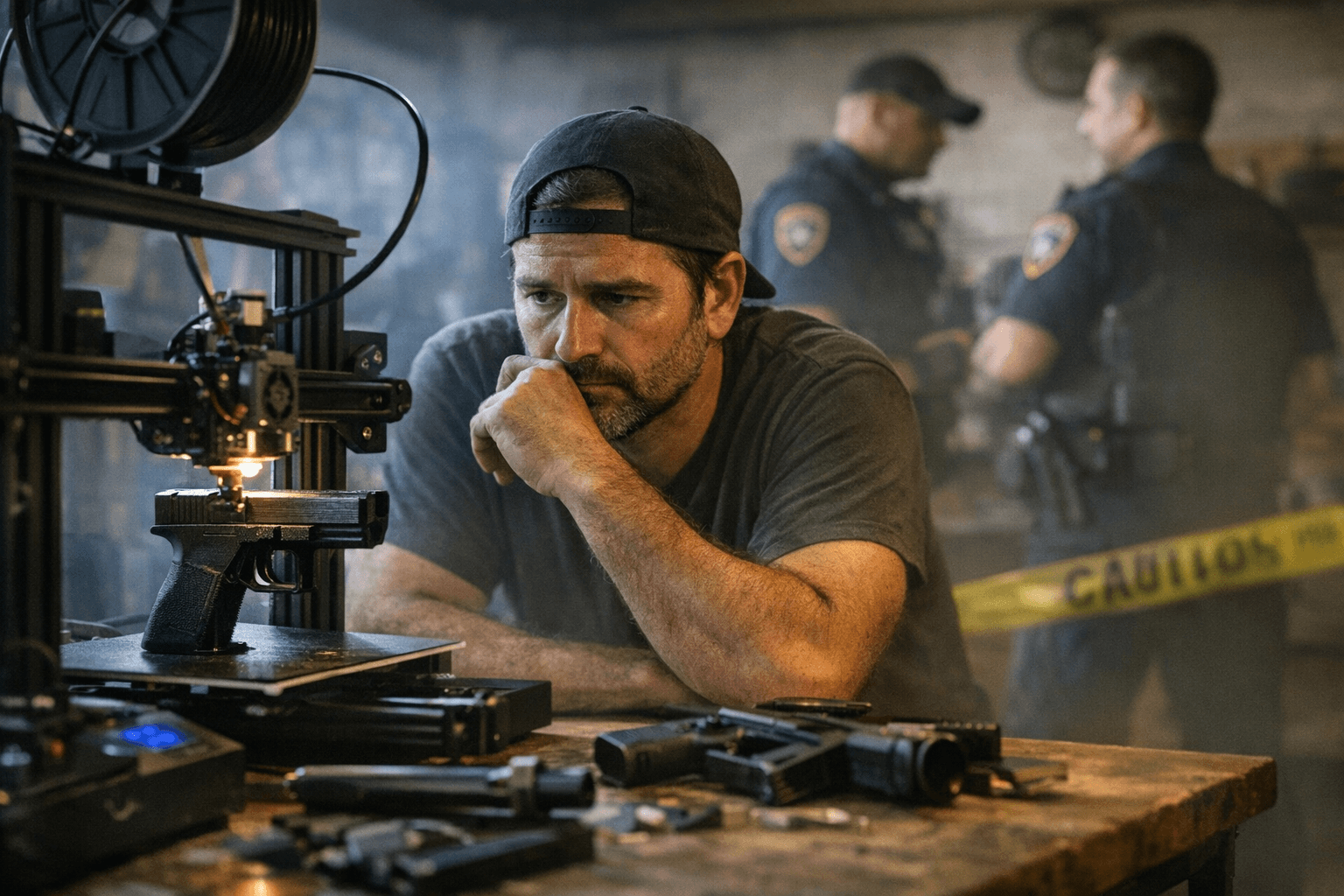
California's AB-2047 would make it illegal to sell any 3D printer in the state that isn't certified by the Department of Justice and equipped with state-approved "firearm blocking technology," with a hard deadline of March 1, 2029. That single bill, introduced February 17 by Assembly Member Rebecca Bauer-Kahan, would have consequences well beyond California's borders, and it didn't arrive in a vacuum.
Washington proposed its version first, then New York, and now California. Once those three states pass a law, they collectively represent roughly 20 to 25 percent of the country by GDP and population, which means every printer manufacturer is effectively forced to comply to stay in business.
Washington's House Bills 2320 and 2321, introduced for the 2025-2026 legislative biennium, represent a fundamental shift in how the state approaches regulation. These bills move "upstream," away from the completed firearm and toward the process of manufacturing itself. Under this framework, the act of making becomes regulated before a physical object ever exists. The implications are significant, because once manufacturing is the target, the tools, software, and digital designs involved inevitably fall under scrutiny.
New York's 2026-2027 executive budget bill includes language requiring that all 3D printers operating in the state include software or firmware that scans every print file through a "firearms blueprint detection algorithm" and then locks the hardware so it refuses to print anything it flags as a potential firearm or firearm component. New York's version extends the mandate beyond printers to CNC mills and anything else used for "subtractive manufacturing."
Colorado moved furthest of all. HB-1144 makes "manufacturing or producing a firearm, unfinished frame or receiver, large-capacity magazine, or rapid-fire device by 3-dimensional printing" a criminal act, punishable as a class 1 misdemeanor and a class 5 felony on a second offense. The bill also prohibits selling or distributing digital instructions containing the codes to 3D print a firearm.
The community is not unified in opposition. Lawmakers cite real incidents to justify the push. Washington State Rep. Salahuddin pointed to a September 2025 incident in which Pierce County law enforcement recovered over 23 firearms, many of which had 3D-printed parts, from a 13-year-old boy with alleged school shooting ideations. Governor Kathy Hochul framed New York's push in similar terms, noting that the NYPD removed thousands of ghost guns from streets, including 438 in 2024.
But critics argue the technical demands written into these bills are simply unworkable. As Michael Weinberg noted after the New York and Washington proposals dropped, accurately identifying gun parts from geometry alone is incredibly hard, desktop printers lack the processing power to run this kind of analysis, and the open-source firmware that runs most machines makes any blocking requirement trivially easy to bypass. Jon Lareau called California's AB-2047 "stupidity on steroids," pointing out that a simple spring-shaped part has no way of revealing its intended use.
The broader concern for makers is what comes after the blocking mandate. Critics warn that companies often use the cover of "safety" and "regulation" to turn printing into a service with a kill switch rather than a tool users control. Once file authentication exists, extending that control to materials like chipped filament spools and locked resin tanks tied to specific providers is a predictable next step.
Critics, including technology enthusiasts, contend that such requirements represent an unprecedented intrusion into personal manufacturing and innovation. They note that 3D printing serves countless legitimate purposes, from custom prosthetics and prototypes to hobbyist projects, and question the feasibility of reliable, evasion-proof detection algorithms. In a Washington State hearing, Salahuddin said he had heard from people, including a dentures maker, who were not interested in firearms manufacturing but were concerned they could be caught up in legal trouble for possessing a machine without proper blocking features.
For the first time, Washington law treats a general-purpose manufacturing tool not as neutral equipment, but as a potential vector of harm. For makers, engineers, and hobbyists, that distinction matters. It is the difference between regulating behavior and regulating capability, and once that line is crossed, it becomes much harder to draw clear boundaries around what remains permissible.
This article was produced by Prism’s automated news system from verified source data, official records, and press releases, then run through automated quality and moderation checks before publishing. The system is built and supervised by the people who set the standards it runs under. Read our full AI policy.
Did this article answer your question?