Tsinghua AI Tool Uses Rheology Data to Predict Bioink Print Quality
Tsinghua's AI framework pulls 21 rheological descriptors from bioink data and predicts print defects with under 15% error, signaling where consumer AI print forecasting is headed.
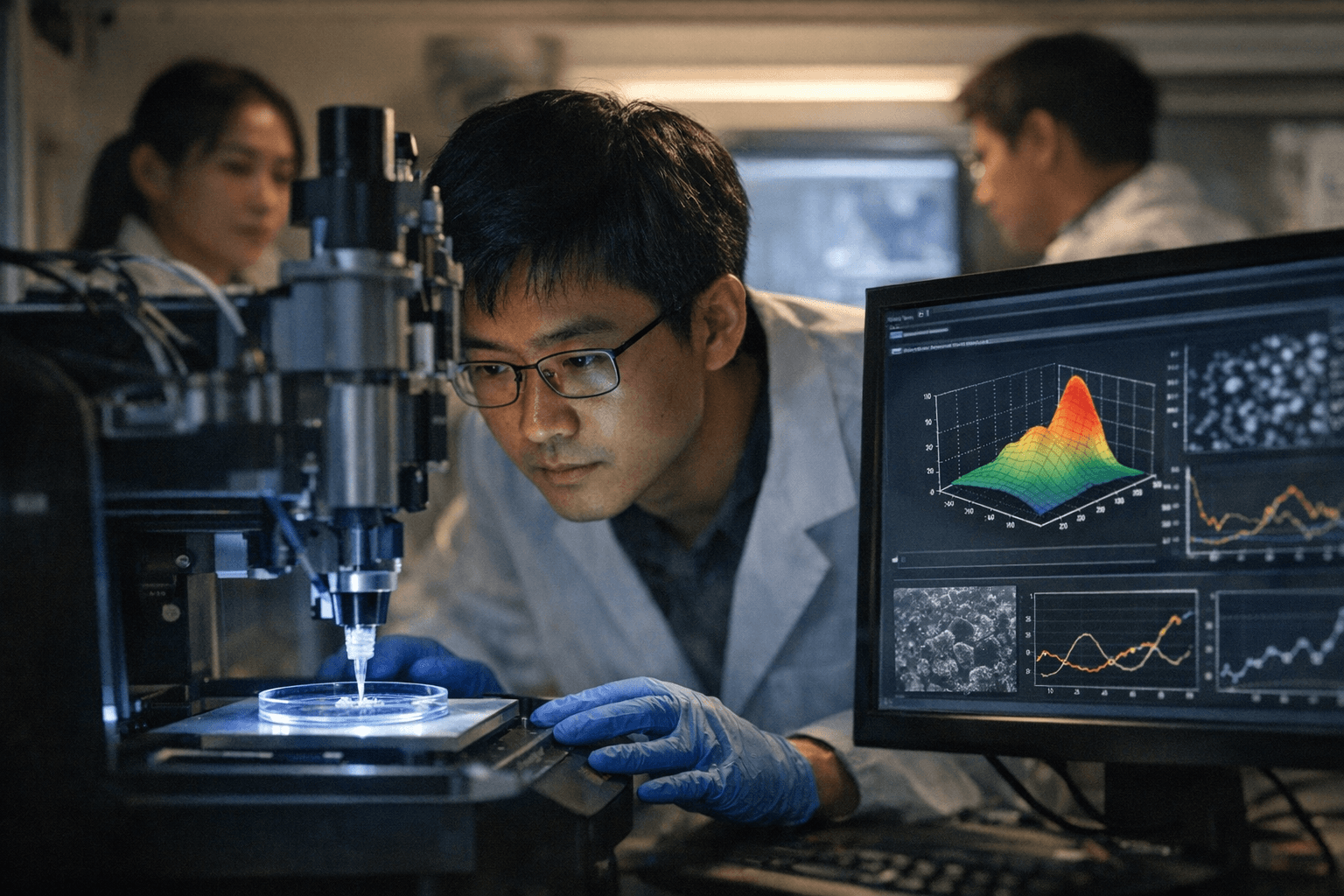
A research team at Tsinghua University has built an AI-driven framework capable of predicting print quality in embedded 3D bioprinting before a single layer is deposited, and the underlying logic maps directly onto where consumer FDM printing is headed. The system, published in Bio-Design and Manufacturing, ingests rheological data from both the ink and its yield-stress support bath, extracts 21 rheological descriptors through a standardized workflow, and maps those descriptors against 12 indicators covering structural continuity and geometric fidelity. A cascaded neural network then forecasts print outcomes with mean relative prediction errors below 15% across all indicators.
The rheology-to-defect connection the team uncovered is worth understanding specifically. Interpretable machine learning models identified that direction-dependent defects, the kind that cause a print to fail differently along the X axis than the Y, are governed by the interplay of four variables: ink yield stress, support bath zero-shear viscosity, flow behavior index, and time constant. That is not a vague "material compatibility" finding. It is a ranked, quantified defect map derived from measurable material properties before the job runs.
That principle, use characterization data to forecast failure rather than print-and-inspect, is exactly what is creeping into hobbyist workflows right now. If you run Klipper, your pressure advance tuning and PA tower prints are already generating a primitive version of this dataset. Pressure advance captures how your specific filament resists flow at your specific temperature; flow rate calibration towers quantify extrusion consistency under varying conditions. A temperature tower run from 190°C to 240°C in 5-degree steps is, functionally, a viscosity-behavior profile across a shear-rate range. You just have not been feeding that data into anything smarter than a slicer profile.
The Tsinghua framework accelerates material development by cutting the trial-and-error loops that define early-stage bioink formulation. In the hobbyist context, that same loop is what makes dialing in a new spool of PA-CF or a fresh brand of PETG take three or four failed prints. Your Mainsail or Fluidd dashboard logs every temperature deviation, every pressure advance correction event, every extruder current spike. That is rheology-adjacent data sitting in a CSV that currently goes nowhere.
The near-term translation to watch: OrcaSlicer's flow calibration and multi-step filament profiling are already inching toward structured characterization. Bambu's AMS flow rate compensation represents a live feedback loop during printing. What the Tsinghua work previews is the next layer up, where that characterization data feeds into a model that flags a probable stringing zone or layer-separation risk at layer 47, before the print reaches layer 47.
The specific features worth tracking as slicers and printer firmware evolve: automated anomaly alerts triggered by deviation from a learned extrusion signature, not a hardcoded threshold; and material profiles that adapt mid-print based on live sensor data compared against a pre-run rheological fingerprint. Klipper's ADXL345 resonance profiling already demonstrates the hardware architecture for this. The Tsinghua team's cascaded neural network shows the software architecture. Those two things meeting in a $300 printer is not a distant prospect.
This article was produced by Prism’s automated news system from verified source data, official records, and press releases, then run through automated quality and moderation checks before publishing. The system is built and supervised by the people who set the standards it runs under. Read our full AI policy.
Did this article answer your question?