Ursa Major Completes First Hot Fire Tests of 3D Printed H13 Rocket Engine
Ursa Major's H13 rocket engine passed its first hot fires, with 80% of parts 3D printed and CEO claiming double the reuse life of previous Hadley variants.

Ursa Major's Hadley H13 liquid rocket engine has cleared its first hot-fire tests, the Berthoud, Colorado company announced on March 4, 2026. The H13 is a mission-upgraded derivative of the flight-proven Hadley H11 and arrives after a round of design improvements and updated manufacturing processes that push the engine's reliance on additive manufacturing even further than previous variants.
The Hadley family already carries some serious AM credibility: roughly 80% of the engine's components are 3D printed, a figure the company attributes to enabling rapid iteration, reduced part count, and accelerated production timelines. For the H13 specifically, Ursa Major went further by developing new alloys through additive manufacturing. Joe Laurienti, speaking on the Additive Insight podcast with TCT Group Content Manager Sam Davies, was direct about where the real engineering effort went: "Developing new alloys with additive manufacturing has been the biggest piece of Ursa Major's process."
That alloy work feeds directly into the H13's headline claim on reusability. CEO Chris Spagnoletti framed it this way: "Hadley is Ursa Major's foundational engine that has already flown hypersonic several times. With new materials and manufacturing, H13 can be reused more than twice as many times as previous variants, driving down the cost per flight while supporting new test objectives and mission profiles." Ursa Major positions the H13 as the lowest cost-per-flight and highest-performing engine it has built to date, though both figures are company claims rather than independently verified benchmarks.
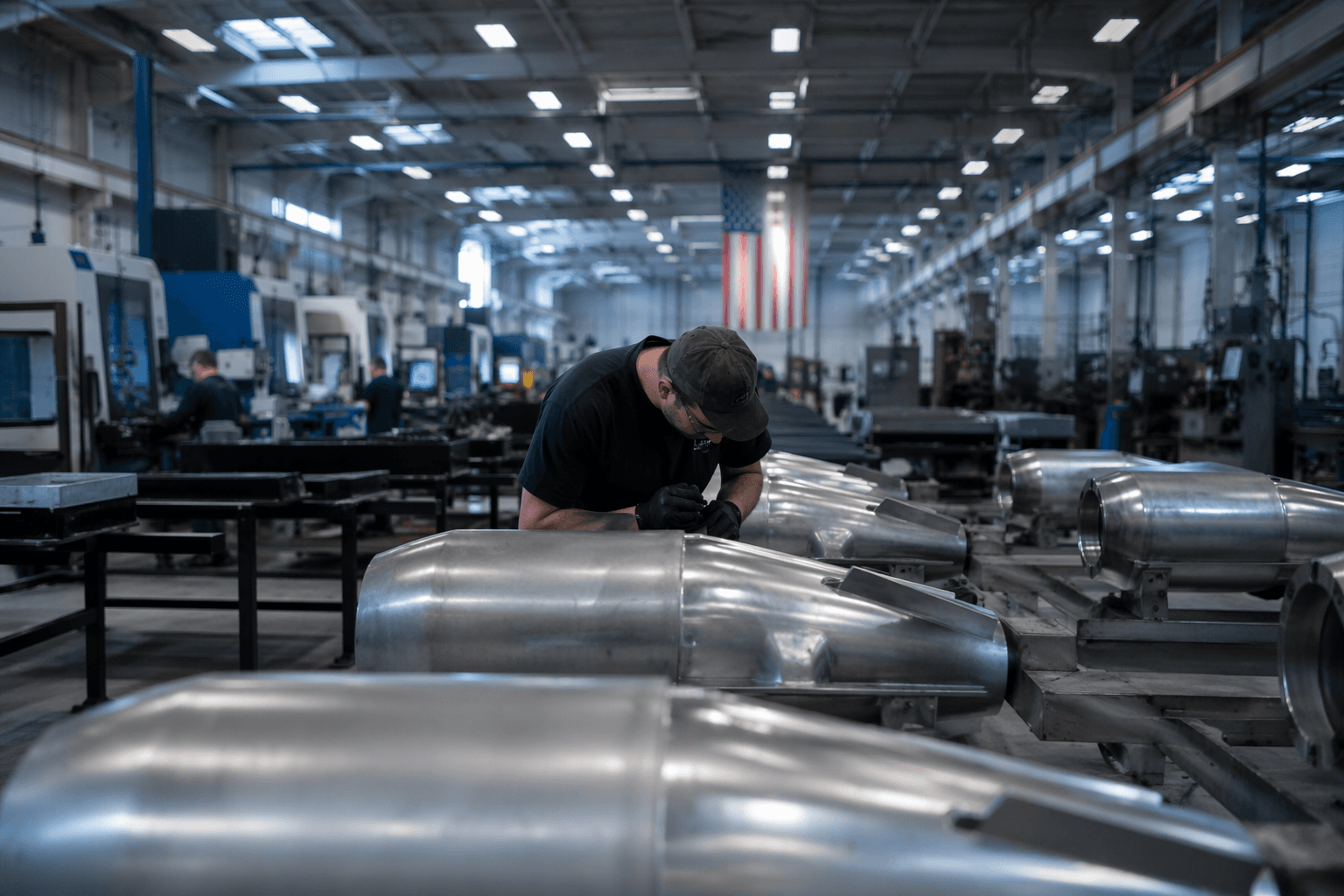
On the production side, TCT Magazine reported that Ursa Major has insourced major components as part of what the company describes as a strategic vertical integration of additive manufacturing, resulting in a more streamlined and cost-efficient workflow. That shift is meaningful context for anyone watching how AM is changing aerospace supply chains: rather than farming out complex assemblies, Ursa Major is using in-house 3D printing to consolidate what would traditionally be multi-vendor parts programs.

The core specs for the Hadley line remain: 5,000 lbf of sea-level thrust, up to 6,500 lbf in a vacuum variant, running on liquid oxygen and kerosene through an oxygen-rich staged combustion cycle. The H11 before it already had a notable flight record, including being the first American-made propulsion engine of its kind to reach sustained Mach 5+ speeds and return, flying on Stratolaunch's Talon-A vehicle.
Where the H13 breaks from its predecessor is in its positioning as an off-the-shelf product. Earlier Hadley variants required bespoke development cycles that stretched lead times; the H13 is explicitly designed to fly across a range of hypersonic and light-launch applications without platform-specific customization, giving potential customers a faster path to propulsion. Whether that productization translates to flight contracts will be the next milestone worth watching.
This article was produced by Prism’s automated news system from verified source data, official records, and press releases, then run through automated quality and moderation checks before publishing. The system is built and supervised by the people who set the standards it runs under. Read our full AI policy.
Did this article answer your question?