Viral 3D-Printed Snap-Fit Ball Joints Bring Cheap Modular Robot Motion
Bionicle-style ball joints now print in PLA for cheap robot motion, but the real trick is a little sanding and knowing where these joints fail.
Why this shape keeps coming back
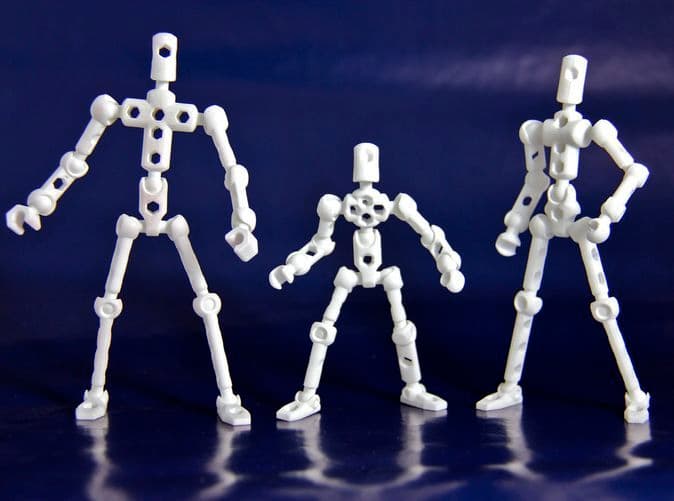
The BIONICLE silhouette is back for the same reason it worked in the first place: a ball-in-socket joint gives you a lot of motion with very little hardware. The LEGO Group introduced BIONICLE in 2001 as a constructable action-figure line built from LEGO Technic elements, and it helped pave the way for the story-led LEGO lines that followed. That legacy still matters because the basic joint geometry is familiar, remixable, and easy to understand at a glance, which is exactly what makes it attractive for quick robot prototypes today.
The new twist is that you do not need a big budget or a machine shop to get there. A viral snap-fit approach lets you print Bionicle-style ball joints in PLA, then use a little sanding to get functional multi-degree-of-freedom motion. For cheap robot limbs, creature maquettes, and articulated props, that is a very useful trade: you lose the complexity of active control, but you gain instant poseability and a part you can iterate on tonight.
What the printable snap-fit version actually unlocks
The appeal here is not just nostalgia. A snap-fit ball joint gives you modular motion without motors, sensors, or a pile of fasteners, which makes it ideal for rough concepting. You can mock up a shoulder, a hip, a neck, or a prop hinge that needs to hold a pose and still move freely enough for camera blocking or tabletop demos.
The practical win is speed. Instead of designing around bearings and shafts from the start, you can print the geometry, tune the fit, and move on. That is why the maker community keeps circling back to these parts: they are fast to print, easy to remix, and good enough for prototypes where the real question is range of motion, not production durability.
How to get the fit right in PLA
Quick sanding is the difference between a joint that feels clever on screen and one that actually articulates. The ball and socket need to mate cleanly, but not so tightly that the surfaces bind or chew themselves up. If the joint starts too stiff, you are better off easing the contact surfaces and re-testing than forcing it and cracking the fitting.
That matters because PLA is not forgiving in every geometry. Some Bionicle remix listings explicitly note that PLA can be brittle for certain fittings and may need scaling adjustments or print-setting changes. In practice, that means printing a test joint before committing to a full robot arm, then checking for three things: whether the ball seats fully, whether it can move without gouging, and whether the socket cracks when you flex it by hand.
- Print a small test pair before a full assembly.
- Sand the contact surfaces lightly and evenly.
- If the fit is too loose or too tight, change scale before chasing it with brute force.
- Expect the first PLA revision to teach you more than the CAD file did.
A few practical habits make these prints much less annoying:
The high-end version shows the opposite extreme
If the snap-fit PLA route is the light, playful end of the spectrum, ABENICS is the serious engineering version of the same idea. ABENICS stands for Active Ball Joint Mechanism With Three-DoF Based on Spherical Gear Meshings, and the IEEE paper describes a gear-based joint that drives three rotational degrees of freedom without slippage. The paper also says it can transmit high torque and provide reliable positioning without an orientation sensor.
That is a very different animal from a print-it-and-snap-it-together joint. Ty Porter’s 3D-printable ABENICS model on Printables, updated on June 28, 2023, shows how hardware-heavy the actuated approach gets: the bill of materials includes 8 5/16"-18 by 5" hex bolts, 28 5/16"-18 hex nuts, 24 washers, and multiple bearings. It is a useful contrast because it makes the snap-fit Bionicle-style trick feel even smarter for quick work. If you do not need torque control, the cheap PLA joint wins on simplicity every time.
Why the hard lessons from other builders still matter
Hackaday’s coverage of ABENICS pointed out that the original paper did not provide 3D-printed models, though it did mention SLA-printed parts. That is a clue worth remembering: elegant joint theory often arrives before a truly maker-friendly implementation does. The printable ecosystem fills that gap, but it still benefits from the same stubborn iteration that more ambitious robots require.
You can see that in Hackaday’s 2022 ball-and-socket robot writeup featuring Matthew Finlay. He had gone through six versions of the design, and the earlier ones ran into the same kinds of headaches that eat time on any articulated build: oscillation, centering, assembly, and joint stability. That history is why a simple snap-fit joint gets attention so quickly. It offers a lower-drama path to the same end result, especially when you just want one clean, printable degree of freedom instead of a full mechanical research project.
Where the ecosystem already is
This is not a one-off stunt. Printables and Thingiverse already host multiple Bionicle-compatible ball socket files and replacement parts, which tells you there is a real demand for remixable articulation in the LEGO and BIONICLE community. Some of those listings are blunt about the wear problem, calling out cracked or brittle original joints and recommending scale tweaks or print settings to improve the fit.
That ecosystem is what makes the viral snap-fit approach so practical right now. You are not starting from zero, and you are not locked into one exact part. You can borrow a socket profile, change the scale a little, print in PLA, sand the contact patch, and have a usable joint for a robot limb, a creature spine, or a prop armature before the day is over.
What this means for your next build
If you want cheap modular motion, the lesson is simple: start with the smallest workable joint, not the most ambitious mechanism. The snap-fit Bionicle-style approach is good when you want a part that can move, hold a pose, and be remixed fast. ABENICS is the reminder that if you need true actuation, the bill of materials grows immediately and the engineering gets serious.
For most hobby robotics work, though, the PLA version is the sweeter deal. It is fast, familiar, and forgiving enough to encourage experimentation, which is exactly why it is spreading. The old toy joint never stopped being useful, it just found a new job in the maker world.
This article was produced by Prism’s automated news system from verified source data, official records, and press releases, then run through automated quality and moderation checks before publishing. The system is built and supervised by the people who set the standards it runs under. Read our full AI policy.
Did this article answer your question?