Dwarf hairgrass offers a hardy, meadow-like foreground for aquascapes
Dwarf hairgrass can build a true foreground meadow, but only if you plant it in small, tight bunches and give it time to knit together.
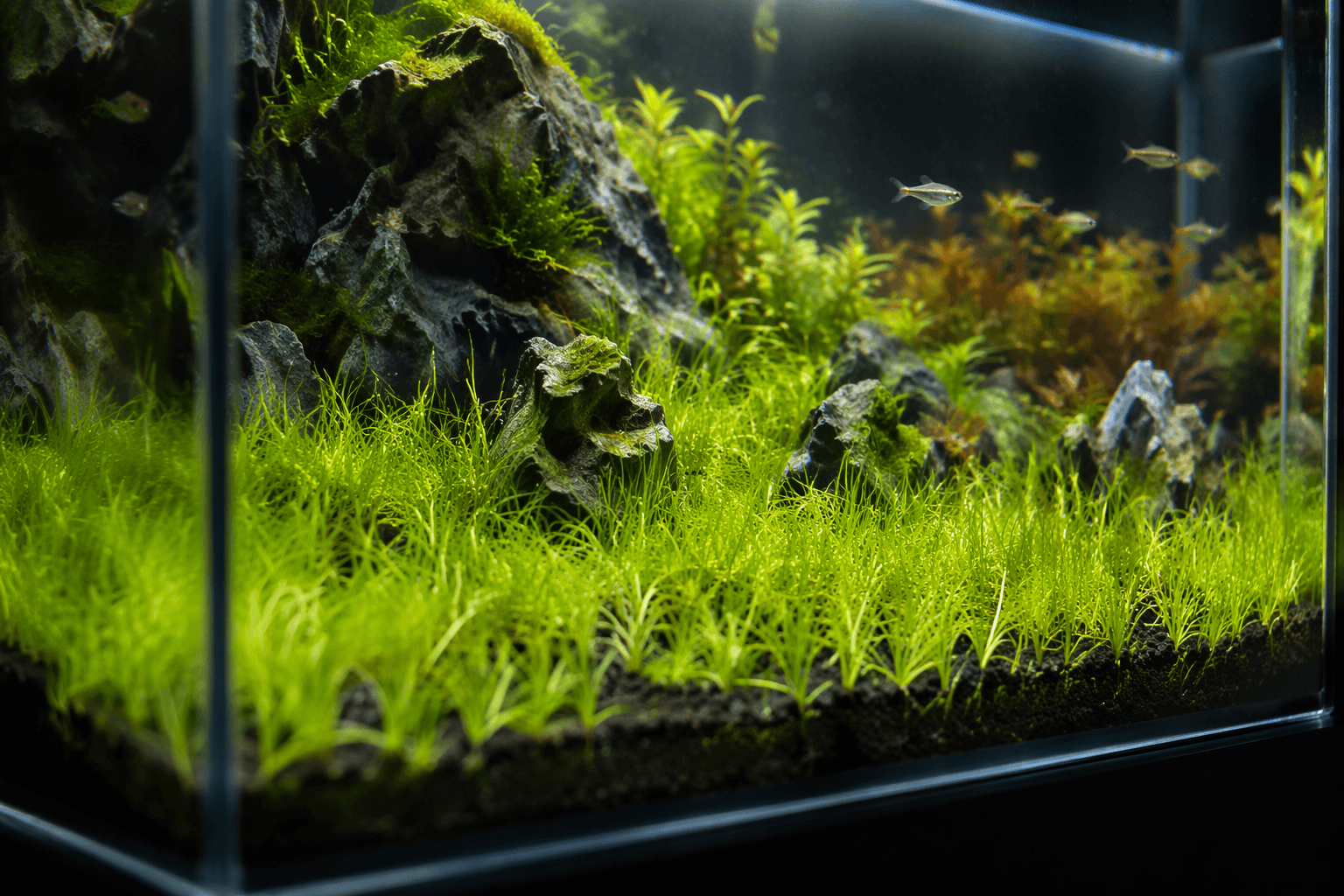
Dwarf hairgrass can turn an aquarium foreground into a carpeted meadow without acting like a diva. It is hardy, forgiving, and capable of delivering the meadow look many layouts chase, while still adding practical value by helping filter waste, contributing oxygen, and giving smaller fish a sheltered zone close to the substrate.
Why it works in the foreground
The plant is most convincing when it is used as a foreground tool, not as a one-off accent. In clear freshwater with low to moderate current, it stays rooted in stable conditions rather than constant disturbance, which makes sense in a scape built around open negative space, texture, and scale. It can read as a living lawn in both large and small aquariums, instead of just another strip of greenery.
Eleocharis parvula is a low-growing Eleocharis that sends runners close to the parent plant. That runner habit is the whole story here: the carpet fills by knitting itself outward, not by exploding upward.
Know which dwarf hairgrass you are buying
The two names most aquarists run into are Eleocharis parvula and Eleocharis acicularis, and the basic care approach is similar for both. Eleocharis acicularis ‘Mini’ is an even smaller dwarf hair grass, and the first specimen was supplied to Tropica by Tom Barr from the USA. That same form has become one of Tropica’s most popular carpeting plants.
Kew’s Plants of the World Online lists Eleocharis as a genus of about 250 species, mostly American, adapted to permanently to periodically wet habitats. Eleocharis acicularis is accepted, with a native range from the temperate Northern Hemisphere to western South America. Eleocharis parvula is also accepted, with a native range stretching from the temperate Northern Hemisphere to western Malesia and northwestern Venezuela.
Plant it like a carpet, not like a clump
The most important decision happens before the plant ever settles into the substrate: portion size. Eleocharis parvula is prettiest when planted in small bunches quite close to each other, so the individual tufts can gradually form a solid mass. That means the first pass should look intentionally sparse, but not random.
A strong planting pattern usually comes down to three choices:
- Break the plant into small bunches instead of leaving it in one dense plug.
- Set those bunches close together so the runners can bridge the gaps.
- Keep the foreground plan clean so the plant has room to spread without being smothered.
Too wide, and you wait forever for the carpet to close. Too tight without enough light and nutrition, and the lower growth struggles to keep pace.
Lighting, substrate, and CO2 decide how fast it fills in
This is not a plant that is impossible without CO2, but CO2 changes the game. Carpeting plants can grow in low-tech setups without CO2 if lighting, substrate, and acclimation are handled carefully. Dwarf hairgrass grows faster and shows more intense coloration under strong lighting and CO2 fertilization.
Dwarf hairgrass benefits from a nutritious substrate, a lot of light, and CO2 that helps it carpet more effectively. The plant can survive in a simpler setup, but the carpet effect becomes far more reliable when the roots have food and the leaves have enough light to drive dense growth.
That makes substrate choice especially important in a foreground plant. A nutrient-rich base gives the runners something to work with, while brighter light helps the plant stay compact instead of stretching. In taller tanks, where light pressure at the bottom is weaker, CO2 becomes even more useful because it helps the plant keep up from the substrate upward.
Flow and stability matter more than gimmicks
Dwarf hairgrass does best in conditions that feel steady rather than chaotic. Its natural preference for clear freshwater with low to moderate current is a good reminder that the foreground should not be blasted by aggressive flow. You want enough movement to keep the tank healthy, but not so much that the substrate shifts or the new plantings are constantly disturbed.
That stability matters during the early stage, when the carpet is still thin and the runners are trying to establish. A freshly planted foreground will always look less finished than the photos that sold you on the idea. It spreads by close runners, so the surface fills in step by step, not all at once.
Use it where a meadow makes sense
Dwarf hairgrass fits layouts that need a soft, natural foreground without a high-maintenance reputation. It works in both large and small aquariums, it complements open hardscape, and it gives shy fish a low, sheltered zone at the bottom of the tank.
This article was produced by Prism’s automated news system from verified source data, official records, and press releases, then run through automated quality and moderation checks before publishing. The system is built and supervised by the people who set the standards it runs under. Read our full AI policy.
Did this article answer your question?