How to build a lush paludarium, from waterline to land
The best paludariums turn the waterline into the main event. Match each plant to the right zone, and the whole enclosure starts to read like a living wetland.

A paludarium works when submerged growth sits below the waterline, humid terrestrial planting rises above it, and a transition zone stitches the two together with rocks, moss, and trailing forms. The whole scene depends on putting each species where it can actually thrive.
Build the paludarium around three planting zones
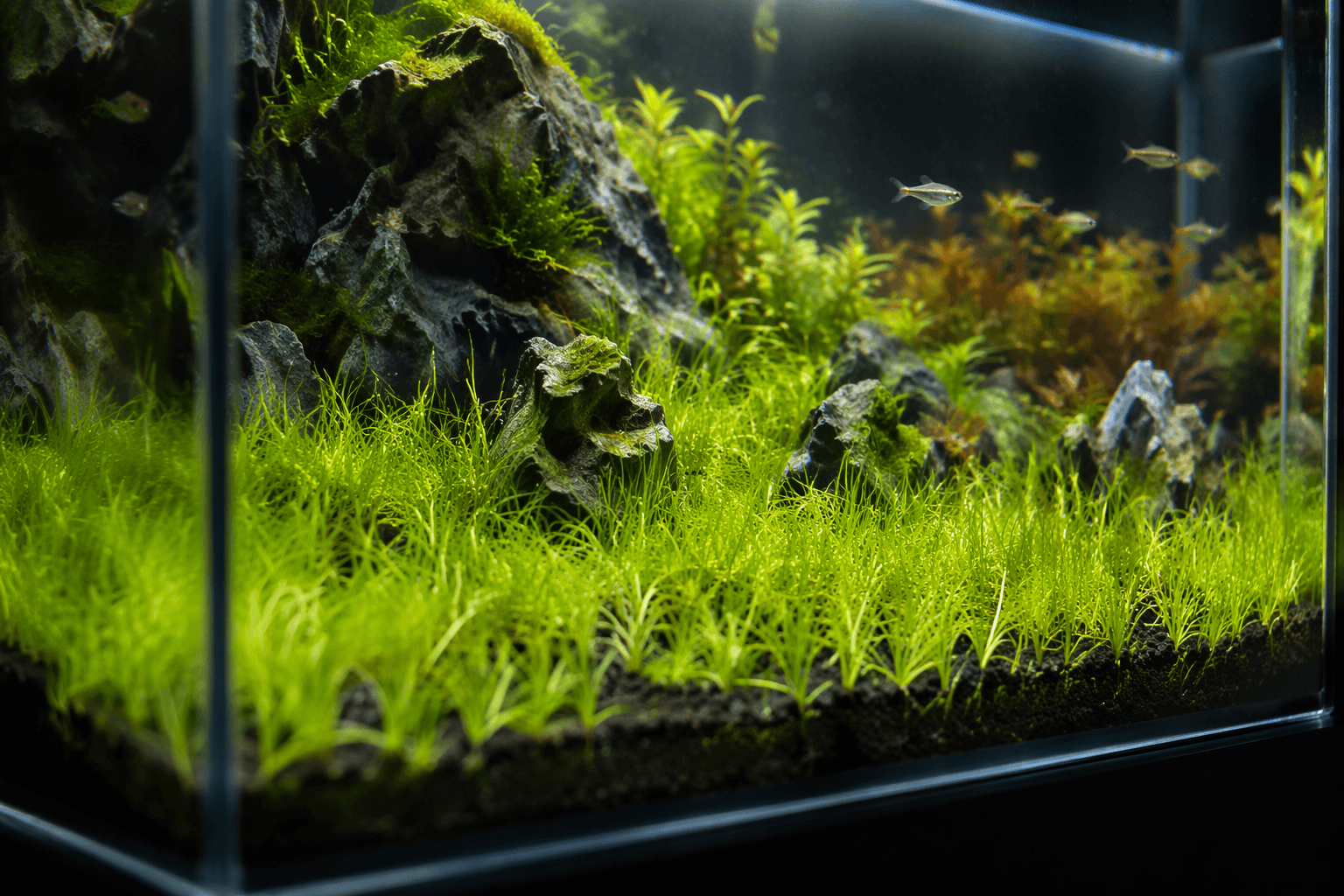
A paludarium is a type of vivarium that combines terrestrial and aquatic elements, and the name itself points to its wetland identity, from the Latin palus, meaning swamp or marsh, plus -arium, an enclosed container. It is a semi-aquatic system that can replicate rainforest, swamp, or stream environments, the framework Exo Terra uses and a better mental model than thinking of it as a decorative tank with a little land bolted on. In Science Mill's formulation, the paludarium is a living ecosystem where living and non-living elements interact through nutrient cycles and energy flows.
The aquatic zone follows planted-tank rules underwater, the transition zone has roots in water and foliage in air, and the terrestrial zone sits above the surface in high humidity.
Think vertically before you think front to back
In a standard aquascape, layout usually starts with depth, height, and sightlines across the glass. In a paludarium, vertical planning comes first, because the most important visual move is not how far a plant sits from the front pane, but whether it belongs below the waterline, at the interface, or fully in air. Aqueon’s planted-aquarium rules still apply here: tall or rapid growers belong in back, low-profile plants in front, and form should be planned alongside plant size.
That same discipline helps keep the composition clean when land and water overlap. If the tallest emergent growth is placed where it blocks the transition zone, the whole scene loses the layered effect.
Use plants that can cross the boundary
The easiest way to get a paludarium to feel seamless is to rely on species that are comfortable bridging more than one moisture zone. Java Fern is one of the most useful choices because it grows on wood or rocks and its rhizome must stay above substrate to thrive, which makes it ideal for hardscape that rises from the water and into the air. Buce Plant includes Java Fern, Anubias, and moss among the plants that can be attached to wood, rock, or other decorations with super glue, tying thread, or plant weights, which gives you real control over where the plant sits in the composition.
Anubias earns its place for the same reason. It can attach to hardscape and tolerate growth both above and below water, so it works as a bridge plant in the transition zone instead of being trapped in one side of the enclosure. Java Moss is another useful connector, since it can carpet submerged hardscape and also grow in the splash zone, making it perfect for rocks, driftwood, and humid ledges where the waterline is always nearby.

Keep rooted plants rooted
Not every popular aquarium plant is a hardscape epiphyte, and that distinction matters even more in a paludarium. Cryptocoryne is best treated as a substrate plant in the underwater section, not as something to glue onto a branch or stone. That makes it a strong fit for the submerged midground, where it can fill space without competing with the emergent plants above.
A lot of paludariums go wrong when they look for beautiful plants first and ask later whether those plants want to be attached, rooted, submerged, or simply kept humid. If a species is meant to root into substrate, give it substrate. If it is a rhizome plant like Java Fern, keep that rhizome above the substrate and let the hardscape do the work.
Treat light and maintenance as part of the design
A lush paludarium still depends on basic planted-tank discipline. Aqueon recommends full-spectrum lighting in the 6,500K to 8,000K range for aquatic plants, and that kind of light helps the underwater section stay vibrant while the emergent growth gets the energy it needs to fill out the upper half of the scene. Once the tank is planted, regular maintenance is not optional. Nutrient dosing, trimming, water exchanges, manual CO2 operation, and filter maintenance all need to happen on a routine basis.
The aquatic section, the transition zone, and the land area all change at different speeds. In practice, that means trimming a trailing stem before it shades the lower plants, cleaning hardscape before moss takes over, and keeping the water moving cleanly so the edge between wet and dry stays healthy.
Why the format keeps drawing aquascapers in
Paludariums are an unconventional habitat and a strong next project for hobbyists who want an alternative tank build; Fluval makes that case for the format. Tom Sarac treats it less like a stunt and more like a practical extension of planted-tank thinking, combining aquatic plants, emergent growth, and habitat design in one enclosure with the waterline acting as the scene’s visual hinge.
This article was produced by Prism’s automated news system from verified source data, official records, and press releases, then run through automated quality and moderation checks before publishing. The system is built and supervised by the people who set the standards it runs under. Read our full AI policy.
Did this article answer your question?